
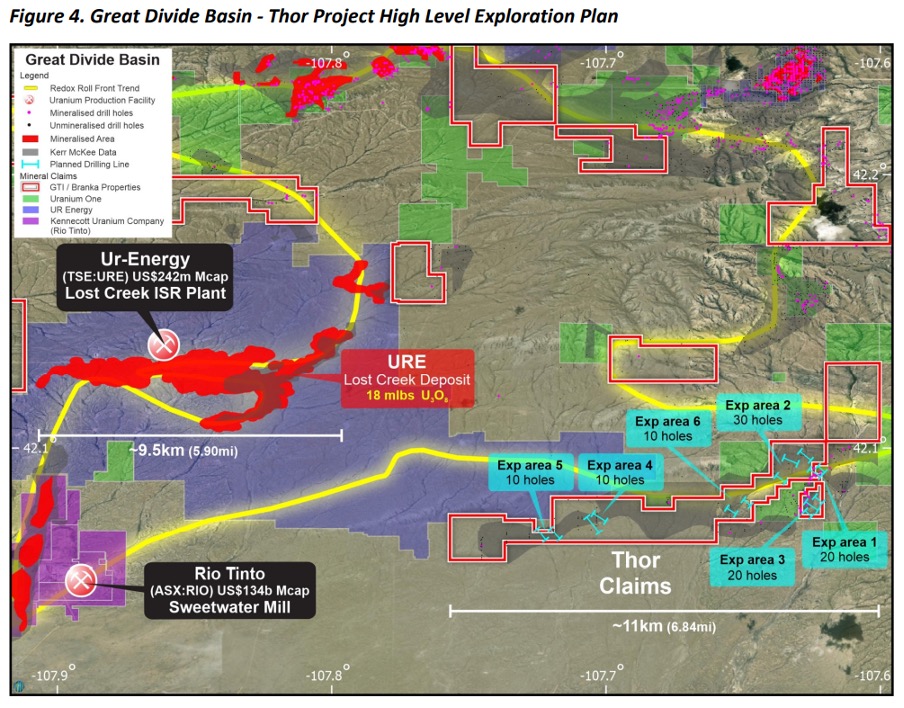
GTI Resources Ltd (ASX:GTR) has secured two mud rotary drill rigs for its planned drilling campaign at the Thor ISR uranium project in Wyoming’s Great Divide Basin.
GTI is on track to begin its maiden drilling program in December as it looks to confirm the grade and tenor of uranium mineralisation that was previously identified by Kerr McGee in the 1970 and 1980s and to support the definition of an economic uranium resource.
Current work at Henry Mountains complete
GTI has also completed a field reconnaissance exploration program at its Henry Mountains project.
The company has ~1,500 hectares of land holdings in the Henry Mountains region of Utah, within Garfield and Wayne counties.
GTI’s current focus is on approximately five kilometres of mineralised trend that extends between the Rat Nest & Jeffrey claim groups and includes the Section 36 state lease block.
Uranium and vanadium mineralisation here is generally shallow at 20‐30 metres average depth.
GTI’s program is aimed to enhance its understanding of uranium and vanadium mineralisation within Section 2 at the southwestern end of the 5.5-kilometre mineralised strike including Section 36 between the Jeffery & Rats Nest areas.
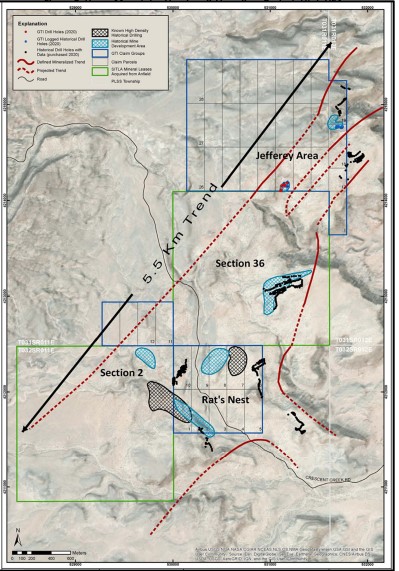
The data collected will help guide any further exploration drilling at the project area.
The recently completed program discovered 308 additional backfill‐abandoned drill holes and four open and loggable drill holes within the extents of the Rats Nest and Section 2 properties.
In addition, 3,700 ft of mineralised contact was mapped via outcrop and confirmed by scintillometer reading.
Thirty-four open underground mine workings were located and mapped with four of the underground workings shown to extend beyond 100 feet in drift length.
All information collated has provided valuable data to help GTI plan the next phase of drilling for the Utah spring in early 2022.