
Apollo Minerals Ltd (ASX:AON) has received further thick, shallow zinc-lead results at its province-scale Kroussou Zinc-Lead Project in Gabon.
The company’s maiden drill program at Niamabimbou Prospect continue to support the potential for a large-scale, shallow, flat-lying, broad mineralised system with possible continuity across multiple zones.
Results from the previously untested Niamabimbou have confirmed thick, shallow zinc-lead mineralisation similar to that reported at the Dikaki Prospect with intersections including:
- 19.9 metres at 1.6% zinc+lead from 8.0 metres, including 5.7 metres at 3.0% zinc+lead from 22.2 metes; and
- 19.9 metres at 1.6% zinc+lead from 13.5 metres, including 4.5 metres at 2.8% zinc+lead from 27.4 metres.
Additional results received from the Dikaki Prospect continue to demonstrate a broad mineralised system with an average accumulated mineralised thickness of 20 metres.
Dikaki results include 23.2 metres at 2.4% zinc+lead from 36.1 metres including 10.9 metres at 3.1% zinc+lead from 39.9 metres.
Drilling is now completed for the 2021 field season, with assay results from an additional 46 holes pending.
“Highly encouraging”
AON executive director Neil Inwood said: “The assay results returned from the first six holes at the previously untested Niamabimbou Prospect are highly encouraging, and display similar mineralised geometries to the Dikaki Prospect, which is located 16 kilometres to the north.
“The company has now demonstrated thick shallow zinc-lead mineralisation in two prospects in 2021; and will continue expanding on these two discoveries with a comprehensive exploration program planned for 2022.
“The recent successful capital raise of A$7.2 million spearheaded by Sprott Capital Partners will allow Apollo Minerals to aggressively advance our developing large-scale discovery at Kroussou.
“In addition to expanded exploration programs at Dikaki, Niamabimbou and the many other highly prospective areas along the 80-kilometre province, we are looking forward to commencing technical studies aimed at demonstrating the commercial viability of a future mining operation at Kroussou.”
Niamabimbou prospect
Niamabimbou is one of 18 identified prospects at the province-scale Kroussou project 16 kilometres south of the Dikaki Prospect where drilling has confirmed shallow high-grade zinc-lead mineralisation.
The completed drilling program represents the first-ever drilling at Niamabimbou with results confirming the presence of mineralisation with similar geometry to that seen at Dikaki.
Mineralisation is open along with a 9-kilometre trend throughout Niamabimbou, comprising three distinct sections of a prospective trend.
Assay results from an additional 34 holes completed at Niamabimbou are pending and will be reported when received.
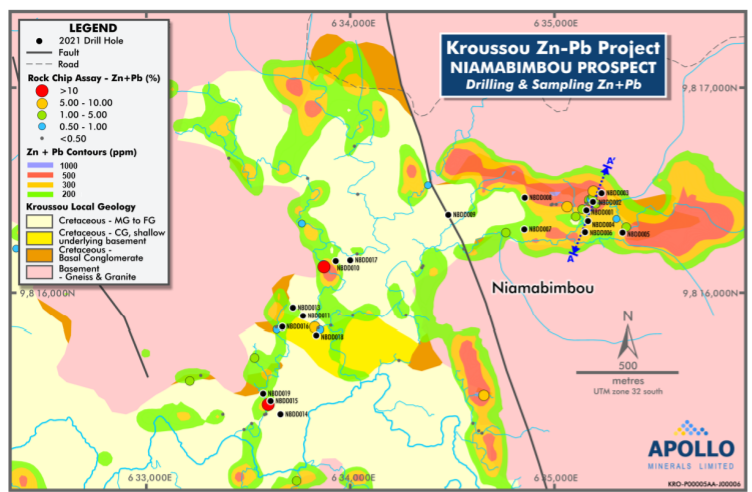
Niamabimbou Prospect geology within the 80km of Kroussou Project.
Further results from Dikaki
Assay results from Dikaki continue to display the potential for a large-scale, shallow, flat-lying, broad mineralised system.
The main Dikaki system is more than 6.8 kilometres long, averages 400 metres wide and is now interpreted to have the potential to be mineralised across the whole channel width, with an average accumulated mineralised thickness of 20 metres from recent drilling.
Results from a further 12 holes at Dikaki are still outstanding and will be reported when received.
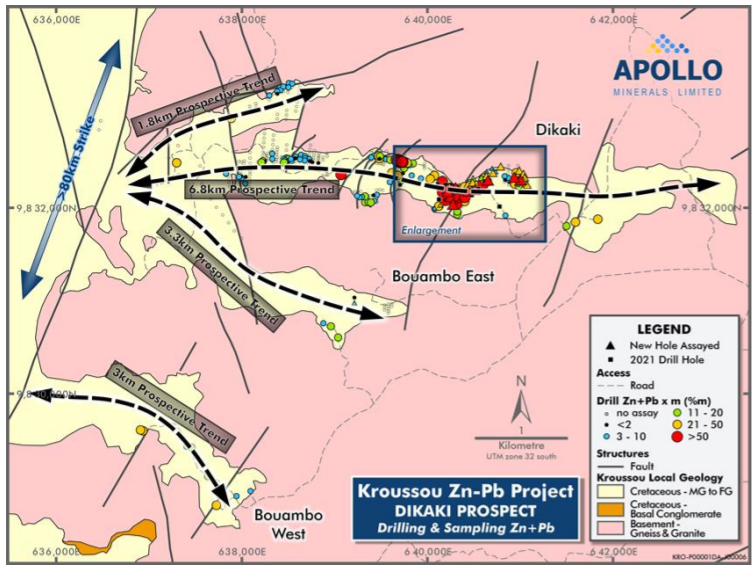
Dikaki Prospect drill hole location.
Forward plan
Drilling activities for 2021 have now been completed at Kroussou; with 58 holes for 3,000 metres drilled at Dikaki and 40 holes for 2,200 metres drilled at Niamabimbou.
On ground exploration activities and core processing will continue on-site until the end of November.
Assay results from 46 holes at Dikaki and Niamabimbou remain outstanding and are expected to be received during the December quarter.
Results from field mapping and soils sampling programs are also expected to flow through over the coming weeks.
Planning is underway for a comprehensive exploration program at Kroussou in 2022 which is expected to include geophysical surveys to prioritise targets, further drilling programs, metallurgical test work, and commencement of technical studies to demonstrate project viability.