
Rumble Resources Ltd (ASX:RTR) is doubling down on a series of multi-element exploration targets within its wholly-owned Wardawarra Project in Western Australia’s Murchison district.
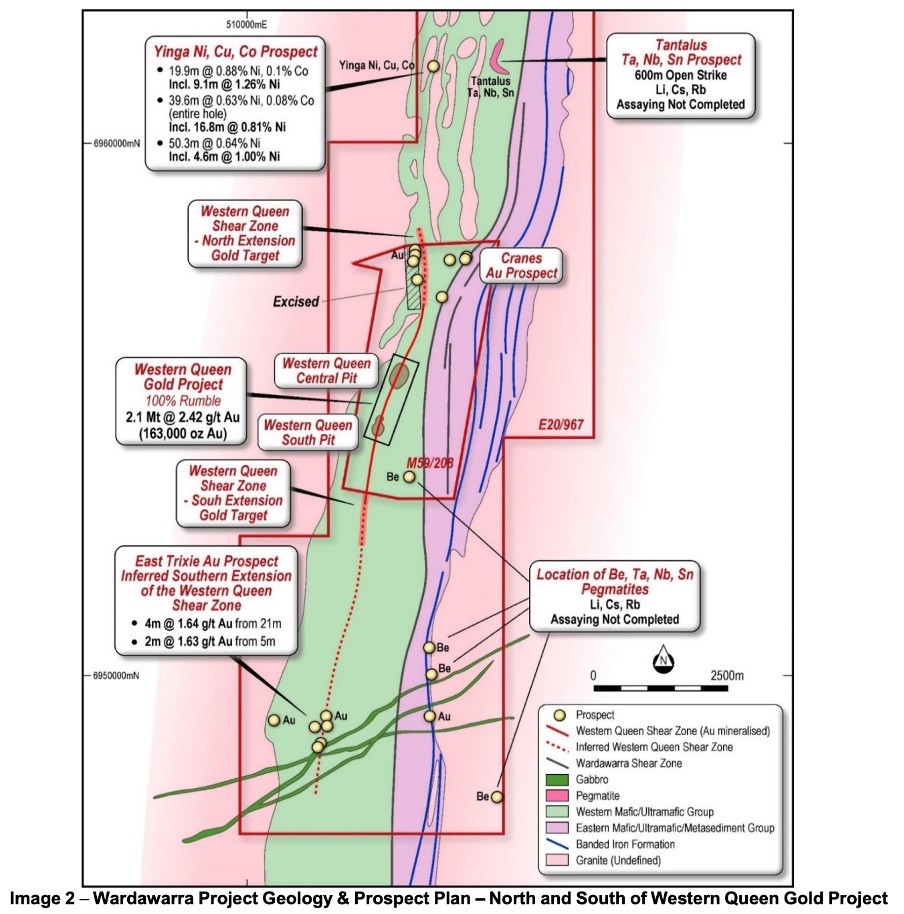
Following a historical data review, the explorer and project developer has identified three properties — the Yinga, Tantalus and East Tixie prospects — along strike from its nearby Western Queen Gold Project.
Between them, the newfound targets are prospective for major nickel, copper, cobalt, gold, tantalum, niobium, tin and lithium occurrences.
Rumble plans to embark on an exploration campaign across the prospects with a range of drilling and surveying techniques.
About Wardawarra
Spanning 213.3 square kilometres, Rumble’s newly renamed Wardawarra asset lies 100 kilometres northwest of Mt Magnet in Western Australia.
It’s made up of a recently granted exploration licence and one application, but it’s also contiguous to the ASX-lister’s 100% Western Queen Gold Project.
Western Queen lies at the epicentre of the Wardawarra exploration licence, where Rumble recently identified the three new exploration targets following a technical review.
The Western Queen Gold Project hosts a JORC-compliant mineral resource, comprising 2.1 million tonnes of ore at 2.4 g/t for 163,000 gold ounces.
Yinga nickel-copper-cobalt prospect
Wardawarra’s newfound Yinga target has proven base metal potential.
In the past, drilling has defined oxide nickel, copper and cobalt occurrences 5 kilometres north of the Western Queen asset.
Some of the best historical intersections include:
- 19.8 metres at 0.88% nickel and 0.10% copper from 10.7 metres, including 9.1 metres at 1.26% nickel from 19.8 metres.
- 50.3 metres at 0.64% nickel from 10.7 metres, including 4.6 metres 1.00% nickel from 15.2 metres;
- 39.6 metres at 0.63% nickel, 0.08% cobalt from the surface, including 16.8 metres at 0.81% nickel from 6.1 metres;
- 25.9 metres at 0.69% nickel from 13.7 metres;
- 22.5 metres at 0.69% nickel from 12.5 metres; and
- 7.62 metres at 0.19% nickel and 0.32% copper from 44.2 metres.
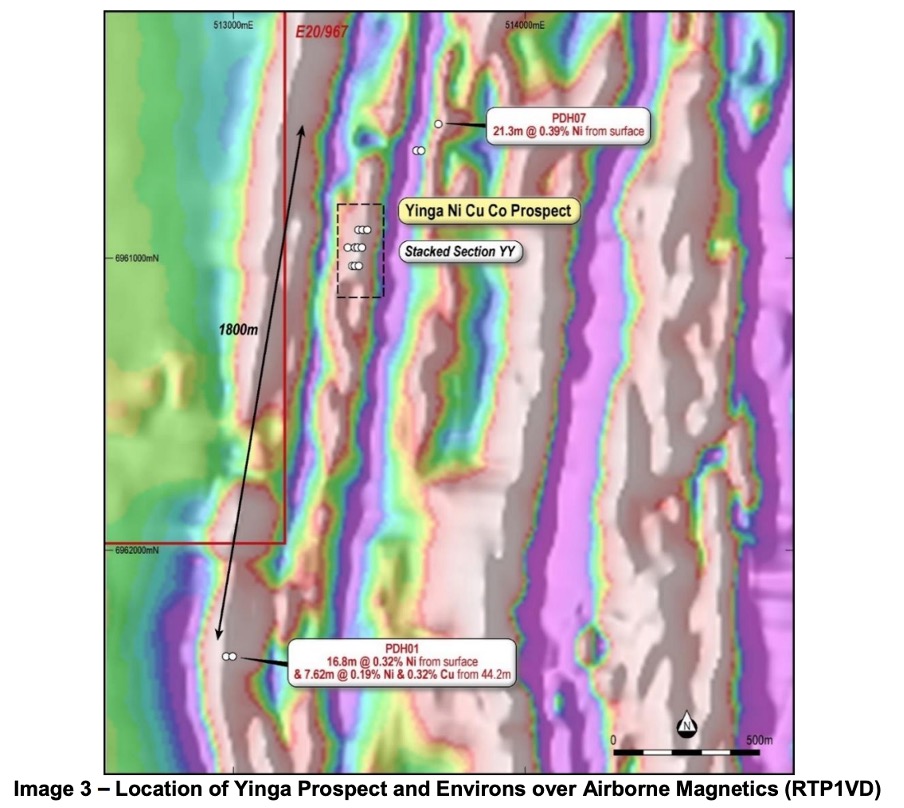
Nickel mineralisation at Yinga is defined over 1.8 kilometres of strike within three prospective ultramafic horizons.
There’s also scope for further parallel zones east of the Yinga prospect because mineralisation is open along strike and down-dip.
Historical drilling only tested the target’s shallow oxide-transition zone, which highlights the significant potential for massive nickel-copper-cobalt sulphides down dip and plunge and along strike.
No gold, platinum or palladium assays have been completed to date.
To follow up on this opportunity, Rumble has pencilled in a six-month exploration program.
The explorer intends to conduct aircore drilling over the 1.8 kilometres of strike, which has been delineated by historical work.
A moving-loop electromagnetic survey will also take place over Yinga’s main zone.
Finally, reverse circulation and diamond drilling will double down on the high priority targets and conductors at the base metal target.
Tantalus tantalum-niobium-tin-pegmatite field
Just to the west of Yinga, the Tantalus target boasts promising lithium potential.
The prospect, a historical pegmatite field to the north of the Wardawarra exploration licence, hosts a series of fertile tantalum-niobium-tin pegmatites.
The pegmatite field runs for more than 600 metres of strike and up to 60 metres in width.
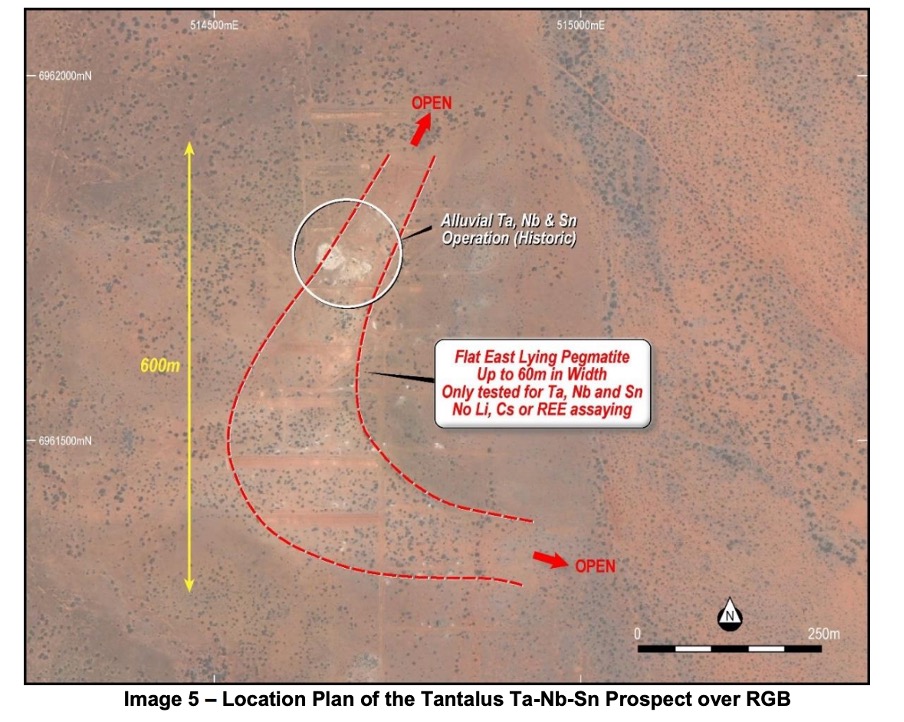
In the past, it’s been mined for alluvial tantalum, niobium and tin and remains open along strike and down-dip.
So far, no assays for lithium, rubidium, caesium or rare earth elements has been completed.
As part of its future exploration, Rumble will complete reverse circulation drilling over the main pegmatite.
The program is designed to get a better sense of its litho-geochemistry and zonation, as well as test for deeper sub-parallel pegmatites below the current flat, east-dipping zone.
East Trixie gold prospect
At East Trixie, Rumble is focused on 35 kilometres of strike within the largely untested Western Queen Shear Zone.
Historical gold-in-soil geochemistry and shallow drilling has highlighted a poorly tested, north-trending zone of gold anomalism some 5.5 kilometres south of the Western Queen Gold Project.
Shallow historical intersections include:
- 4 metres at 1.63 g/t gold from 21 metres; and
- 2 metres at 1.64 g/t from 5 metres.
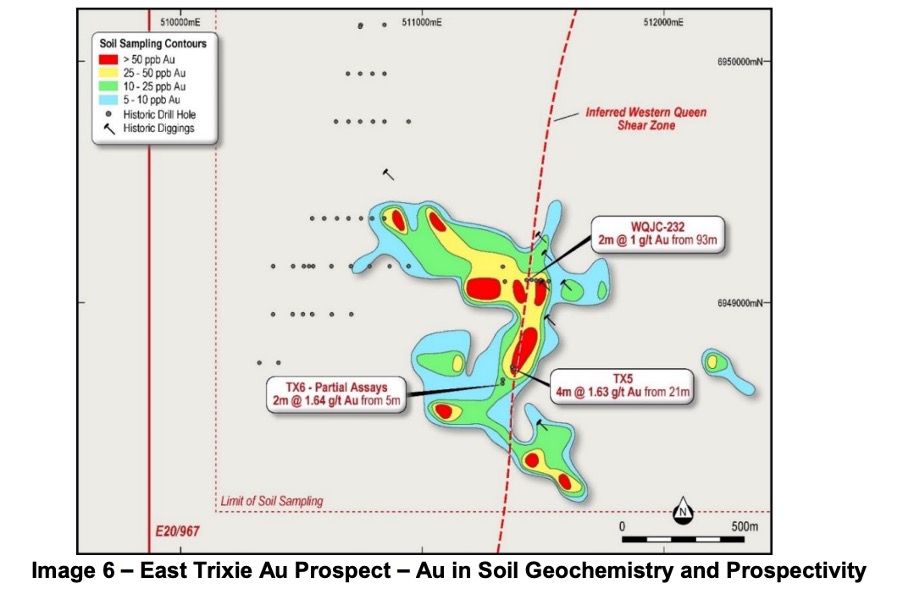
Aircore drilling is proposed to test the strike potential of the newly interpreted Western Queen Shear Zone.