
Chalice Mining Ltd (ASX:CHN, OTCQB:CGMLF) has skyrocketed on the local share market thanks to a record-breaking maiden mineral resource at the Gonneville deposit in Western Australia.
The base metals explorer closed 28.51% higher at $8.70 and went for as much as A$8.95 per share after unveiling the largest platinum group element discovery in Australian history and the biggest nickel sulphide find in more than two decades.
While Gonneville’s maiden resource has broken records, the deposit covers just 7% of the 26-kilometre Julimar complex and remains open to the north and at depth, meaning there’s scope for even more upside in the years to come.
Today’s share price hike values Chalice at slightly more than A$3 billion as the explorer establishes a firm foundation for a world-class green metals asset on Australian shores.
18 months to “major milestone”
Commenting on the maiden resource, Chalice managing director and CEO Alex Dorsch said: “This is a major milestone for Chalice, coming just 18 months after our stunning first hole discovery at Julimar.
“Since then, we have completed more than 175,000 metres of diamond and reverse circulation (RC) drilling and now defined a genuine tier-one scale deposit of critical minerals, with exceptional growth potential.
“The resource confirms that Gonneville is the largest nickel sulphide discovery globally in over two decades, and the largest PGE discovery in Australia’s history – a remarkable achievement considering that this is the first discovery in what we consider to be an entirely new district, Julimar, within a new nickel-copper-PGE province, the West Yilgarn.
“Given its sheer scale, the attractive suite of six payable metals it contains and its premier location close to world-class infrastructure and services in Perth, Chalice clearly has the potential to become a leading global player in the green metals space.”
A greenfield discovery with golden potential
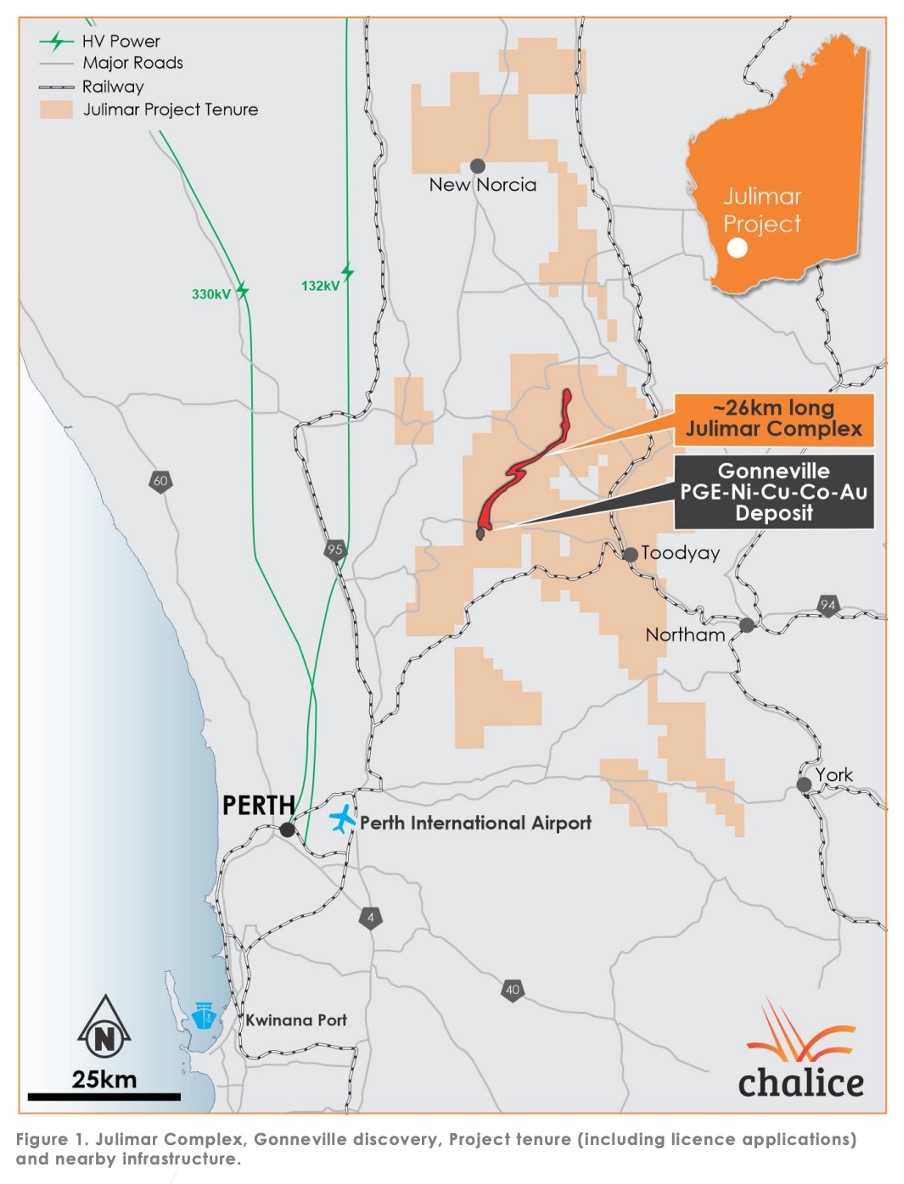
The Gonneville deposit forms a key part of Chalice’s wholly-owned Julimar asset, which sits just 70 kilometres from Perth in WA.
The greenfield project was staked in early 2018 as part of the company’s global search for high-potential nickel sulphide exploration opportunities.
It wasn’t long before that dream became a reality: Chalice encountered a previously unrecognised, 26-kilometre-long mafic-ultramafic layered intrusive complex.
During an initial RC campaign in early 2020, the ASX-lister discovered high-grade PGE-nickel-copper-cobalt-gold sulphide mineralisation near the surface — an occurrence known as the Gonneville discovery.
Flash forward to today, and Chalice has established its maiden, indicated and inferred, pit constrained, mineral resource estimate (MRE) for the record-breaking deposit.
World-class mineral resource
Gonneville’s MRE stands at 330 million tonnes of ore, grading 0.94 g/t palladium, platinum and gold (3E), 0.16% nickel, 0.10% copper and 0.016% cobalt (roughly 0.58% nickel equivalent or around 1.6 g/t palladium equivalent).
That’s equal to 10 million ounces of 3E, 530,000 tonnes of nickel, 330,000 tonnes of copper and 53,000 tonnes of cobalt (roughly 1.9 million tonnes nickel equivalent or around 17 million ounces of palladium equivalent).
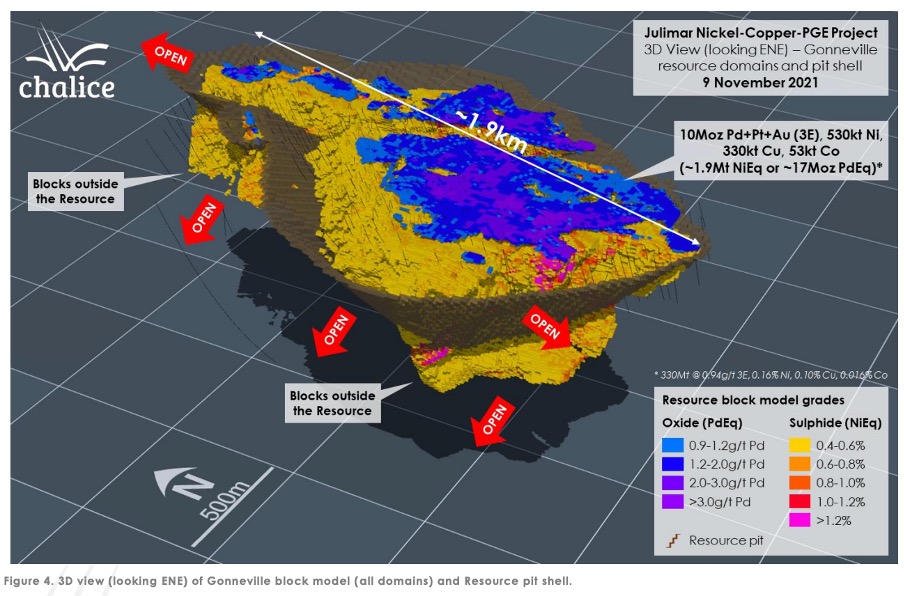
Promisingly, roughly 150 million tonnes — or around 45% — of the mineral resource already lies in the indicated category.
In particular, the pit-constrained resource includes a major, higher-grade sulphide component above a 0.6% nickel equivalent cut-off grade, starting from a depth of roughly 30 metres.
This comprises 74 million tonnes of ore at 1.8 g/t 3E, 0.22% nickel, 0.21% copper and 0.021% cobalt (roughly 1% nickel equivalent or around 2.8 g/t palladium equivalent).
That’s 4.2 million ounces of 3E, 160,000 tonnes of nickel, 150,000 tonnes of copper and 15,000 tonnes of cobalt (roughly 760,000 tonnes nickel equivalent or around 6.6 million ounces of palladium equivalent).
All in all, this higher-grade component affords the project noteworthy optionality in development and could materially enhance Julimar’s economics in the initial years of operation.
Is the best yet to come?
Dorsch explained: “The high-grade sulphide component of the maiden resource is very important to the project, as it provides a degree of optionality for mine development that is not often seen in mining projects of this nature.
“The vast majority of competitor projects worldwide are narrow, high-grade underground deposits, whereas high-grade mineralisation at Gonneville starts near surface, which could be a material factor when considering project economics in the initial years of operation.
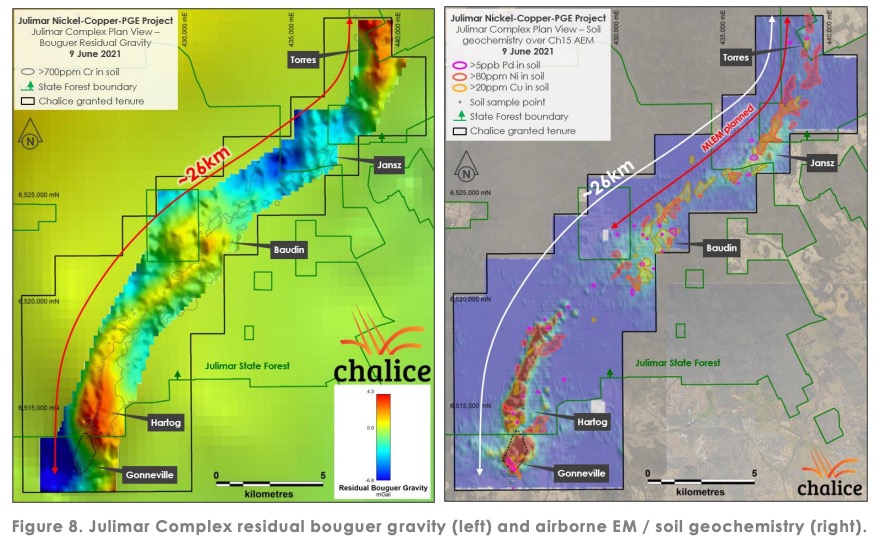
“It is also important to emphasise that the current resource covers just 7% of the Julimar Intrusive Complex, which has been interpreted to cover a strike length of more than 26 kilometres.
“We know that the deposit remains open along strike to the north, and we are very much looking forward to receiving the final clearances to commence our initial low impact drilling program in the Julimar State Forest.”
What’s next?
With the maiden Gonneville resource in tow, Chalice is eager to advance studies that consider an initial mining operation at the world-class deposit.
Primarily, the explorer plans to conduct further infill RC and diamond drilling to improve confidence in the inferred resource areas that span less than 200 metres deep.
Once resource drilling concludes, geotechnical, metallurgical, hydrogeological and infrastructure exploration will continue into the first quarter of next year.
In the meantime, work to support studies and ongoing metallurgical test-work will also continue ahead of a scoping study for quarter two, 2022.
Speaking to Chalice’s current activities, general manager of development Bruce Kendall said: “Deep drilling targeting higher grade extensions and infilling drilling in the northern part of the deposit, where most of the inferred resources are located, will be a focus in the coming months.
“Mineralisation is still open to the north within the Julimar State Forest, and we eagerly await the necessary approvals so that we can start drilling the Hartog target where soil sampling and moving loop electromagnetics has identified a number of compelling anomalies for drill testing.
“Despite the scale and significance of the maiden Gonneville resource, we believe that the broader Julimar Project is still at a very early stage in its discovery history – and we are very excited about the discovery and growth opportunities within the extensive Julimar Complex.”