
Volt Resources Ltd (ASX:VRC) has established proof-of-concept for the use of Bunyu Project large flake graphite in battery anodes, confirming successful lithium-ion battery cell cycle testing results using coated spheronised purified graphite (CSPG).
The test-work program on natural graphite originating at Volt’s Bunyu Graphite Project in Tanzania was undertaken by an established commercial graphite producer and processor, American Energy Technologies Co. (AETC), which is headquartered in Illinois, USA.
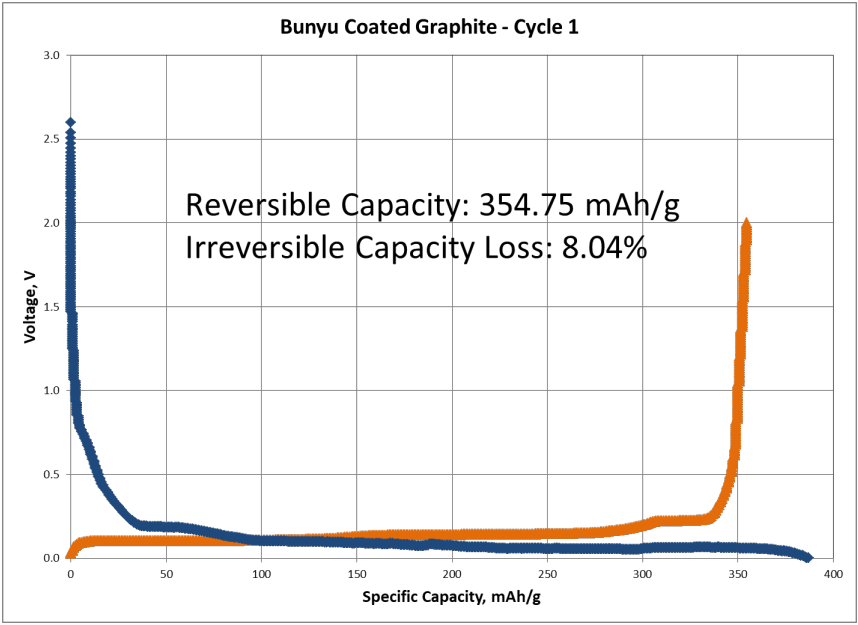
Results showed low irreversible capacity loss for the battery cells, maintaining this quality through 100-170 cycles to date. Low capacity loss is a key performance factor in extended battery life, important for anode material intended to be used in battery technologies.
Feasibility study on the horizon
“We continue to be delighted with the battery cycle test-work results reported by AETC. This has confirmed Bunyu’s flake graphite is suitable for use in the production of battery-ready anode material for energy storage solutions," Volt Resources managing director Trevor Matthews said.
“Now that we have completed 170 cycles of the battery cell test-work program with Bunyu flake, we will shortly commence feasibility studies for the development of battery anode production facilities in Europe and the USA.
“Additionally, we will undertake an evaluation and sampling program with a number of technology and battery end-user groups which we have engaged with in the past months, to further our commercialisation objectives in the electric vehicle, consumer and energy storage battery platforms in Europe, the United States and Asia.
“Volt will be adopting the inverted flow sheet for its downstream operations following the successful spheronisation and purification results achieved during the test-work program.
“The use of this flowsheet will allow us to not only convert a significant portion of our graphite into battery-ready anode material for lithium-ion batteries but will also generate a range of ultra-high purity by-products for use as electrically conductive diluents in battery cathodes and in a variety of valuable non-battery applications.”
Battery cell cycling
Volt’s test-work program was designed to develop a technical support data package for market introduction of the Bunya natural graphite product and the provision of battery-ready CSPG material to be provided to potential lithium-ion battery manufacturing customers.
The program involved first producing spheronised purified graphite (SPG) before performing initial surface coating and commencing extended cycling testing of the batteries.
Cycling tests assess the initial electrochemical performance of carbon-coated spherodised graphite in the industry-standard CR2016 coin cells (ie reversible, irreversible capacity and irreversible capacity loss).
The program is intended to perform long-term cycling (100 cycles initially), which is used to assess the viability of the Bunyu CSPG for energy storage applications.
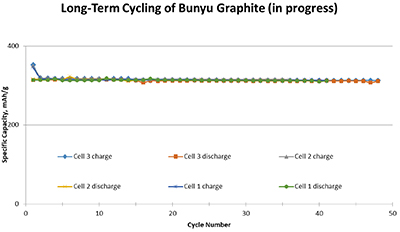
The cells were intentionally built with slightly lower capacity ratings, as most cells designed for long-cycle testing are, with capacity ratings between 315 and 320 milliampere hours per gram.
According to Volt, its test cells demonstrated highly consistent performance with negligible degradation from cycle to cycle.
The flat curve on the graph above indicates Bunyu graphite could compete not only with other natural graphite battery anode material but also a great number of more cost-intensive synthetic graphite battery anode material offerings in its long-term cycling performance.
The Cell Comparison Maximums reported in Chart 2 below show strong cell-to-cell stability and low 1.79% reversible capacity decay (or 98.21% capacity retention) after 100 cycles.
Further results were a low 2.69% reversible capacity decay (or 97.31% capacity retention) after 150 cycles and 2.83% reversible capacity decay (or 97.17% capacity retention) after 170 cycles.
High-quality production process
The production of spheronised purified graphite is complicated by a number of well-known, built-in disadvantages predominantly generated by processing the mineral impurities (mainly silica and alumina, abrasive materials) within natural graphite, which grind and wear processing machinery, leading to greatly increased repair and maintenance cost and high downtime during spheronisation.
Leftover material from the process is often too costly to refine or purify as fines, leading the material to be sold into low technology markets at a much lower price point.
In contrast, Volt is seeing greatly increased spheronisation yields (approximately 70 wt.% of Bunyu flake input into the spheroniser mills), reduced repairs and maintenance and equipment downtime, while collecting approximately 30 wt.% of spheroidisation process rejects that retain the premium level of purity on the order of 99.95+ wt.%C.
This purity level renders the left-over material suitable for a host of applications in electrical conductivity enhancement markets, such as in battery cathodes of lithium-ion batteries and in a variety of other advanced battery and non-battery applications.
Volt is currently evaluating the electrochemical performance of its ultra-high purity spheroidisation rejects for use in the expander of lead-acid batteries.
Test data from the initiative will be published in the coming weeks. This work is being performed under the close oversight of Volt’s potential off-take partner, a lead-acid battery company.
Industry comparison
The electrical performance of Bunyu’s thermally refined spheroidisation rejects has been compared to the performance of the industry’s premium grade of synthetic graphite, MX15 (a product by Imerys Graphite & Carbon, Bodio, Switzerland).
This product’s selling price is believed to be greater than US$10,000 per tonne in its main application in cathodes of alkaline primary Zinc (Zn) / Manganese Dioxide (EMD) batteries. The market for graphite in alkaline batteries exceeds 12,000 tonnes a year with a compound annual growth rate (CAGR) of 4%.
The chart below represents results from an alkaline battery industry-standard four-probe (4-T) resistivity test of compression moulded EMD pellets which contain various concentrations of Bunyu’s thermally purified spheroidisation rejects graphite.
The laser diffraction pattern of this graphite is presented below. The 4-T data for Bunyu flake is plotted on the same graph with 4-T performance of MX-15 synthetic graphite, which was used in this study as control. MX-15 is a similarly sized graphite, which has a nominal D90 (particle size) of approximately 15 microns.
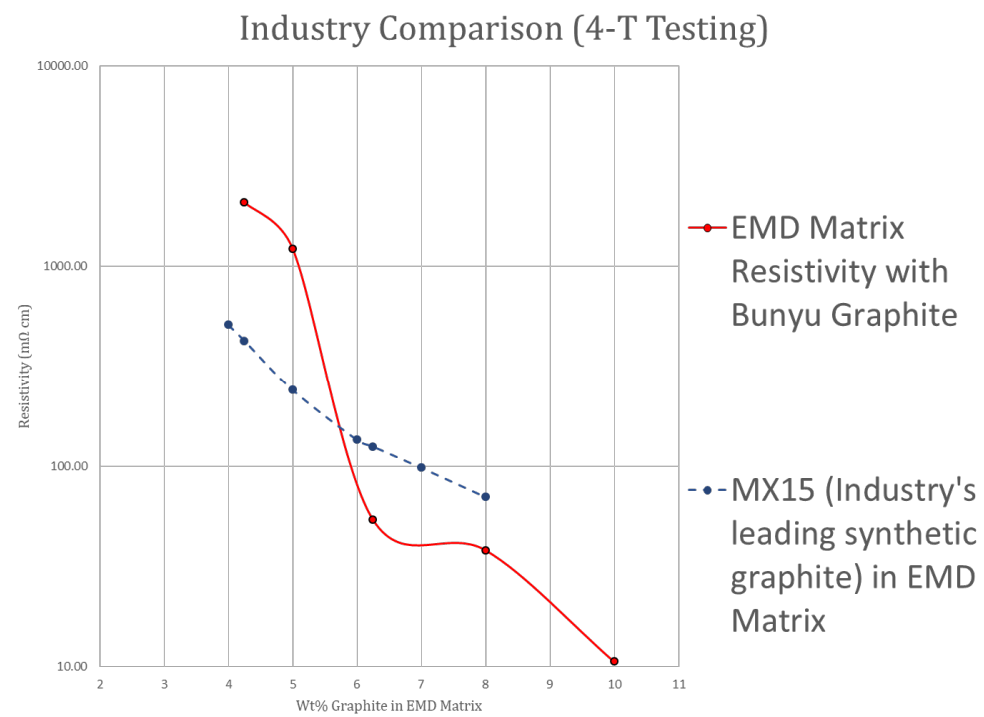
Volt asserts that starting from approximately 5.75 wt.% loading of graphite in the EMD, both graphites display similar electrical performance. Most alkaline zinc/EMD primary batteries employ 6.25 to 8 wt.% of graphite in their cathodes.
This is the range where Bunyu natural flake graphite significantly exceeds in performance compared with the premium grade synthetic graphite, MX15.
Volt says that primary alkaline batteries with EMD matrixes containing Bunyu’s spheroidisation process rejects of 99.95+ wt.%C purity level are positioned to last longer, work at higher operating current densities, demonstrate reduced tool wear in cathode manufacturing processes (natural graphite is far less abrasive than its synthetic counterpart) and enable cost reductions to the alkaline battery industry.
Cost reductions to the alkaline cell producers will also be enabled by the fact that spheroidisation rejects is a by-product stream of Volt’s main process (the production of spherical graphite for LIBs).
About the company
Volt Resources is focused on the exploration and development of its wholly-owned graphite and gold projects in Tanzania and Guinea, as well as its 70% interest in the ZG Group in Ukraine.
The company has plans to produce battery anode material using existing graphite production to become a fully integrated supplier to lithium-ion battery cell makers based in Europe.
Volt will also be able to leverage off the existing customer base and graphite product supply chains of the ZG Group in developing the Bunyu Graphite Project in Tanzania.
The Bunyu Graphite Project is the largest graphite resource in Tanzania, East Africa, and is being developed in two stages, with the feasibility study for Stage 1 completed in 2018 and the Stage 2 expansion based on a PFS that was released in 2016.