
Archer Materials Ltd (ASX:AXE, OTC:ARRXF) is positioning itself to be an Australian leader in the burgeoning deep technology market, as it doubles down on its quantum computing and biochip focus.
On finalising the sale of its mineral exploration assets to iTech Minerals Ltd (ASX:ITM), Archer has completed its transition to become a pure-play deep technology company - a market that could potentially come to dominate multi-billion-dollar global semiconductor supply chains.
As a technology company, Archer is developing next-generation semiconductor devices, including chips that are relevant to quantum computing and medical diagnostics; a quantum computing technology on which it is working closely with US$170 billion IT giant IBM.
Pure-play deep-tech
What does pure-play deep-tech mean?
A ‘pure-play’ is a company that is focused solely on one area; Archer can now be considered a pure-play, thanks to the sale of its mineral assets.
Deep-tech is a little more complicated.
It is a term most often used to describe companies exploring the development of technology solutions based on substantial scientific or engineering challenges; ones that require significant research, investment and generally carry a higher risk load.
The payoff is the development of technology that could genuinely change the world; tech that solves solutions that simply aren’t solvable with current technology.
A recent report from global data analyst Deal Room covered how transformational deep-tech could be, helping to solve significant worldwide challenges such as climate change and the semiconductor shortage, which is wreaking havoc on the electronics and electric vehicle markets.
Artificial intelligence and quantum computing are two sectors that are considered part of the deep tech sphere.
Artificial Intelligence alone could add US$13 trillion to the global economy over the next decade, according to McKinsey, while the combined value of European-founded deep tech companies is nearly €700 billion and growing.
Archer’s deep tech
Archer’s world-class team is developing and integrating the materials technology needed to develop new quantum computing and lab-on-a-chip devices in the A$150 million research and prototyping foundry it works from.
As its CEO Dr Mohammad Choucair recently told Proactive, it is a strategy that precious few fellow Australian companies are chasing.
“We offer Australian investors exposure to deep tech like quantum computing,” he says.
“Normally, that access is limited, because the largest deep tech or quantum players are worth billions of dollars and they’re listed on the NASDAQ or NYSE.
“It is a growth focus for companies in the deep tech space, and Australians in deep-tech companies around the world are now starting to showcase the fruits of their long-term success in fields such as quantum computing, but it is only the beginning, it is still early-stage.”
Retail and institutional demand for Archer shares is growing, too; the company announced it had received subscriptions of A$25.4 million for an SPP that was originally targeting to raise $5 million and completed a A$15 million placement to global and domestic institutional investors to fund Archer’s growth plans.
Though Archer’s technology progress announcements are sometimes difficult to understand, Archer is making rapid progress towards some lofty goals.
Most recently, its shares rose as much as 12% after Archer for the first time validated that the qubit’s quantum coherence properties are preserved under an inert atmosphere.
This is a breakthrough towards developing Archer’s 12CQ chip, what would be a world-first qubit processor technology that could allow for quantum computing powered mobile devices.
Quantum excitation
The 12CQ chip is a world-first technology that Archer is developing for quantum computing operation at room temperature and integration onboard modern electronic devices.
Quantum computing aims to utilise quantum mechanical phenomena to power the next generation of computers and devices.
You almost need a degree in physics to truly understand quantum mechanics, but at a basic level, it describes the way nature and matter function at the scale of atoms and subatomic particles, which is fundamentally different from the way they function at the many scales above that size (which is described by classical physics).
Functioning quantum computers remain limited in their operation, scalability and access at this point in time but, should they be successfully developed, it is hypothesised that they could solve some important computational problems substantially faster than the computers we know and (most of the time) love.
And while it sounds complicated, quantum computing is rapidly expanding as an industry, with some estimates suggesting it could be creating US$850 billion in annual value by solving some of these computational problems by 2040.
Confidence that quantum computers will solve major problems beyond the reach of traditional computers has soared in the past 12 months, as BCG points out.
Equity investments in quantum computing nearly tripled in 2020, the busiest year on record, and are set to rise even further in 2021.
This year IonQ (NYSE:IONQ) became the first publicly traded pure-play quantum computing company, at a current market capitalisation hovering around US$3 billion.
How the 12CQ chip fits in
If successfully developed the 12CQ chip could find its way into modern electronic devices like phones and other mobile devices.
The first steps in developing the 12CQ chip are to model the qubit behaviour so that the chip design can be optimised, and then show that individual qubits can be controlled to perform quantum calculations.
The company has made considerable progress during the 2021 financial year in modelling qubit behaviour and in their work towards qubit control.
“We have the strongest indication yet that on-chip control of quantum information in our qubit material is within reach and entirely possible under miniaturisation conditions required for any future chip operation,” Dr Choucair said.
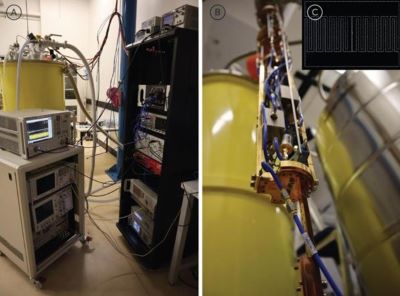
The state-of-the-art setup where the first quantum control measurements are being performed in Sydney, Australia, on Archer’s 12CQ qubit material.
Archer signed a new agreement with IBM during the period, which will allow it to retain membership to the global IBM Quantum Network and the associated IBM Quantum Startup Program.
It is also working with Max Kelsen, another Australian member of the IBM Quantum Network, on possible end-use cases for the 12CQ chip, including in AI and Big Data.
“At Archer, we are working with global leaders in computing and AI to develop and integrate the software required to enable the operation of our 12CQ chip and its proposed high impact end-use applications,” Dr Choucair said.
But it’s not just quantum computing in which Archer is intricately entangled.
It is also working on its biochip, which is a type of chip that serve to enable rapid and customised multi-disease detection and aid point of care disease management.
The lab-on-a-chip technology involves extreme miniaturisation of traditional laboratory functions for conducting analysis and testing for diseases on a chip, and Archer want to incorporate graphene, the thinnest material known, to provide an ultrasensitive interface for sensing and device integration.
They recently showcased some of their early-stage capabilities, reducing the size of key components and assembling them onto an area the fraction of the width of a human hair.
“This is what the future looks like,” Dr Choucair says.
“We are creating next-gen semiconductor devices, that could potentially spur on transformational solutions to so many global problems.
“There is so much power in building technology that can have a positive impact on the lives of so many people, and at Archer are part of that ecosystem, part of the solution.”
- Daniel Paproth