
KGL Resources Ltd (ASX:KGL) has intersected further massive sulphide mineralisation in two follow-up drill holes at Rockface deposit as it continues to enhance the Jervois Copper Project in Northern Territory.
Visual estimates of the core put the mineralisation at 35-40% sulphide minerals.
Follow-up drilling comes after the discovery of massive copper sulphide mineralisation in a hole (KJCD481D3) at the periphery of the high-grade orebody that indicated the potential to expand mineral resources and ore reserves at Rockface.
Consequent Downhole Electromagnetic (DHEM) surveying in that hole have outlined highly conductive target zones that are open and extend to depth with no indication of a lower limit or a reduction in conductivity.
“New exploration targets”
KGL managing director Simon Finnis said: “The results showing massive sulphides from the two most recent holes on the western side of Rockface, indicate considerable scale of the zone of massive sulphides intersected in previously announced hole KJCD481D3.
“The DHEM reinforces the drilling results by modelling highly conductive zones which are interpreted to be extensions of the overall Rockface North deposit.
“It is very pleasing to see the geophysical techniques we are using at Jervois continue to support our drilling program, and directing us effectively to extensions of known resources, as well as generating new exploration targets.”
Previous drilling
Last month KGL intersected massive sulphides containing significant copper minerals (chalcopyrite and bornite) on the western side of the Rockface North lode.
Hole KJCD481D3 was designed to determine the western edge of the mineralisation, therefore such strong intervals of copper were unexpected.
Processing of the drill-core covering the visually high-grade zone was afforded top priority, but assays have not been received and are not expected for some weeks due to congestion at the laboratory.
“High-grade potential at Rockface”
Finnis adds: “The drill intersections obtained so far will very likely result in an expansion of the currently envisaged mine plan.
“Deeper drilling, however, despite the inherent high-grade potential at Rockface, will compete in priority with other shallower targets which may be more cost-effectively drilled from surface.
“Once the current phase for drilling at Rockface has been completed, KGL intends to commence drilling a 370-metre-long 'gap' in the Reward structure, where recent drilling results, such as KJCD447 (4.47 metres at 3.81% copper and 4.22 metres at 3.18% copper) and KJCD448 (2.57 metres at 2.26% copper and 5.16 metres at 2.73% copper) have indicated the potential for high-grade shoots which would be readily accessible for early exploitation from the open pit or shallow underground.
“By now, KGL had thought to be able to provide assay results for the massive sulphide intersection in KJCD481D3 but these results have been delayed due to an industry-wide congestion being experienced by mineral laboratories”
DHEM modelling
The DHEM modelling indicated that the hole had intersected a highly conductive (>2000 Siemens) zone which lies mostly to the east of the hole but is interpreted to have a steeply plunging component to the west.
Based on this information a follow-up daughter hole, KJCD481D4, was drilled, which also intersected narrow copper-bearing massive sulphides amongst a wider mineralised zone 55 metres down-dip from the original intersection.
DHEM surveying was then carried out on KJCD481D4, and the processing of this data further expanded the range of the high-conductivity (>2000 Siemens) models.
Based on the updated models, which also show an interpreted westerly plunge, it was decided to drill KJCD481D5, which also intersected copper-bearing massive sulphide mineralisation, this time 32 metres down plunge from the original intersection in KJCD481D3.
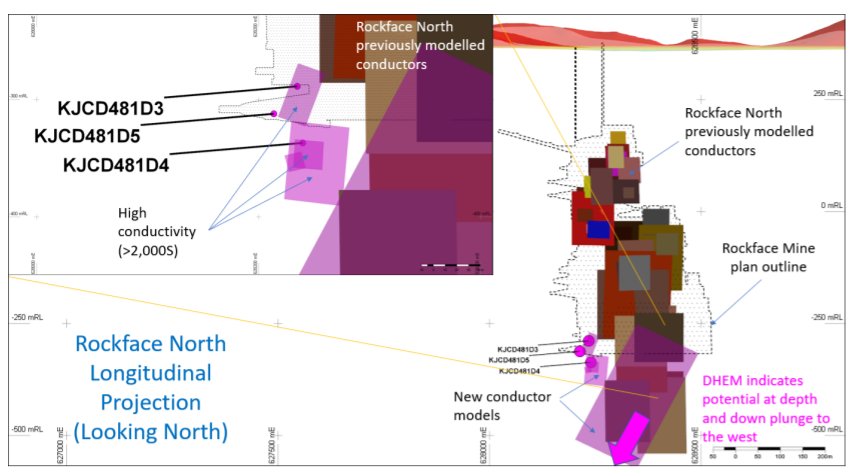
Longitudinal projection of the Rockface North Deposit as defined by DHEM conductors.
DHEM results
Through modelling and analysis of the DHEM data, KGL’s experienced consultant geophysicists, Mitre Geophysics, have concluded that the Rockface conductive bodies are open and extend to depth, with no indication of a lower limit or a reduction in conductivity.
Notably, this is positive for the ultimate longevity of the Rockface mine even though exploration of these deep levels will probably be best achieved by drilling from underground once the mine is established.