
WA Kaolin Ltd (ASX:WAK) continues with Stage 1 construction at the Wickepin Kaolin Project southeast of Perth in Western Australia as it aims to expand annual production to 400,000 tonnes in a two-stage strategy.
Work programs are progressing well with gensets installed and the large Stantil Engineering kiln, a central piece of equipment for the processing plant, now on-site.
Shipping delays
The ongoing effects of COVID-19 and resulting global delays within the shipping industry have impacted the company’s schedule with the commissioning of stage one likely to continue throughout the first quarter of 2022 and production expected in the following quarter.
Chief executive officer Andrew Sorensen stated, “As we enter Q4 2021, we are proud to advise that the Stage 1 build of the Wickepin Kaolin Project is nearing completion.
"The project timeline has slipped very slightly, impacted by supply delays being experienced due to interruptions within the global shipping industry (COVID-19 related).”
No impact on budget
"At this stage we anticipate commissioning to continue into Q2 2022, subject to any further delays in supply delivery. Whilst this small slippage in completion is unfortunate, it has no impact on the overall budget of the Stage 1 build,” he said.
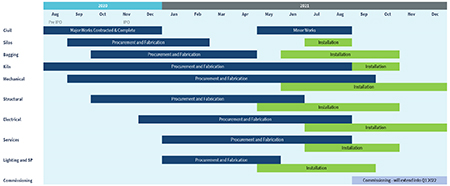
Stage 1 work program for the Wickepin Project.
Wickepin Kaolin Project, 220 kilometres southeast of Perth, contains an ore reserve estimate of 30.5 million tonnes of kaolinised granite included in a 644.5 million tonnes inferred mineral resource.
The company produces kaolin products for tier-one customers and aims to expand annual production from Wickepin to 400,000 tonnes in a two-stage strategy.
Towards production in 2022
Whilst all equipment for the project has been fabricated, the delivery of some equipment sourced from Asia is behind schedule due to container shipping delays, which will result in the Stage 1 Work Program commissioning continuing in the first quarter of 2022, with production anticipated in the second quarter of 2022.
A key item that has arrived on-site is the Stantil Engineering kiln with installation to be carried out this quarter.
"I am incredibly proud of my team and our contractors for their outstanding achievements to date as we near completion of the Stage 1 build, given current labour demand pressures and the ongoing impact that COVID has had on all facets of the development,” Sorensen said.
"Given the slight delay in the completion of commissioning, it is prudent for WAK to advise that first production from Stage 1 is now likely to commence in Q2 2022. WAK will continue to keep the market updated on any changes to this anticipated timeline.”
Water supply agreement
A 15-year agreement with the Western Australian Water Corporation for the supply of water to the project was signed recently.
The supply of freshwater via a new lateral pipeline connection to the existing Water Corporation pipeline running along the Williams-Kondinin Road is critical for the processing of kaolin, amenities at the mine site, fire management and dust suppression.
For the period of this agreement, the Water Corporation will make available up to 49kL of water per day or 343kL per week. WA Kaolin will pay a one-off upfront capacity contribution and then a monthly variable charge depending on volume used (rates subject to annual review) with no minimum monthly requirement.
The agreement will commence shortly after the installation of a metering point by the Water Corporation, which was expected to take place by the end of October.
Gensets tested
During Q3, WA Kaolin announced the purchase of three FG Wilson P550 generators (gensets) from AllightSykes. These are key components of the Stage 1 build, providing the main power source for the entire site.
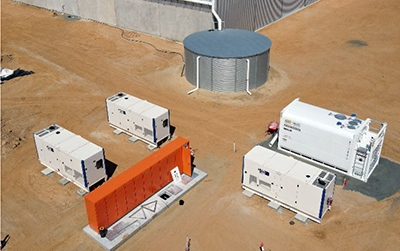
Gensets installed on-site at the Wickepin Project.
The purchase and subsequent successful testing of the gensets is a major milestone for WA Kaolin as it completes the entire utilities package for the Stage 1 build.
WA Kaolin will use USLD10ppm diesel fuel and service the diesel engines in accordance with the manufacturer’s recommendations for optimum performance and to minimise emissions.
The company also advised that it is its intention in 2022 to source renewable solutions which will include solar panels to reduce the fuel used in the thermal generation plant, the engineering for which will be based on the first six months of operating data from the kaolin beneficiation plant.
Bagging solution contract
Another key step in Q3 was the signing of a contract with Haver & Boecker Australia for the supply of equipment that will form the basis of a bagging solution for the company’s kaolin powder product, once production commences at Wickepin.
This equipment is designed to fill 700 valve bags per hour, each bag will be filled to 20kg, meaning WAK will have the capacity to pack more than half of the first stage design production capacity into 20kg bags.
The market price for kaolin packed in 20kg bags exceeds that of kaolin packed in bulk bags so the addition of the equipment will have a positive impact on WAK’s profitability.
Packing trials were successfully completed at Haver & Boecker’s technical centre, following which WAK signed a contract for the supply of valve bag filling machine with auto bag placement.
WA Kaolin’s order will see Haver & Boecker supply a kaolin bagging solution including the Haver M-Series 4W, a valve bag filling machine, the Haver valve bag placer for four spouts and a flat belt conveyor. Haver & Boecker are due to deliver in nine months and will train WA Kaolin personnel in use of the machinery.
Proprietary processing method
WA Kaolin has developed a proprietary dry processing method, known as K99, to turn raw material into a market-suitable feedstock for global customers, and constructed a small-scale commercial processing plant on 3 hectares of portside industrial land at Kwinana, WA.
The plant in Kwinana, together with the high-grade Wickepin kaolin resource, produces an ultra-bright, high-quality kaolin product at a low cost, in comparison to other methods which rely on chemical bleaching and multiple wet mechanical and magnetic separation methods.