
Strategic Elements Ltd (ASX:SOR)’s managing director has looked back on a busy September quarter in a recap to shareholders.
The pooled development fund, which is focused on backing innovation in Australia, has its eye trained on four technology themes: robotics and automation, self-charging batteries, transparent flexible memory and data-related tech.
Over the September quarter, the company made strides across its battery ink cell development, while subsidiary Stealth Technologies hit key milestones as it evolved its weed detection and autonomous security vehicle offering.
SOR ended the September quarter with A$6.9 million in the coffers to support its future investments.
Battery ink tech progress “phenomenal"
Reflecting on SOR’s activity in the September quarter, managing director Charles Murphy said” “Progress in power output of the battery ink technology has been phenomenal in Q3 2021.
“The company demonstrated a printed battery that produced more than a milliamp of electrical current solely from humidity in the air. This was in spite of restricted access to people, laboratories and specialised equipment.
Murphy also announced that access and operations at the University of New South Wales, where Strategic Elements is working on the printable battery ink cells, was ramping up this week.
“This will enable us to increase resources available to the development team for the quarter four milestone, allow us to further enhance our printing capabilities and investigate the performance of an expanded range of battery ink cells for applications in addition to electronic skin patches.
“This will also enable certain work related to the memory ink to commence in quarter one of 2022.”
What’s in the pipeline?
Essentially, Strategic is trying to create an alternative to the mainstream lithium-ion battery — these cells can be flammable and may not be environmentally-friendly.
Instead, Strategic hopes to develop wearable self-charging technology, powered by graphene oxide and recharged by humidity drawn from the air.
According to SOR, the graphene oxide (GO) component is key: graphene alone is costly to mass-produce, but GO is much cheaper and more readily available.
Basically, one battery ink cell hosts tens of thousands of GO nanosheets, able to harvest energy from moisture and heat.
Because of this, Strategic’s self-charging component could be incorporated into wearable tech, able to recharge devices thanks to the humidity of human skin.

The broader market
If this tech is commercialised, it could have huge implications for the electronic skin patch sector.
This space covers a range of wearable tech which can be used to monitor crucial metrics like cardiovascular health.
In 2019, the industry generated US$10 billion (roughly A$14.4 billion at the time) in revenue. By 2030, it could be worth as much as US$40 billion.
More broadly, the self-charging battery tech could fit right into the Internet of Things (IoT) market — between 2009 and 2025, the global battery market for IoT is forecast to grow from US$8.7 billion (around A$11.14 billion in 2009) to US$15.9 billion.
Murphy stated: “We have set a very aggressive target for the Battery Ink to demonstrate 5-milliamp current output and 220-milliamp-per-hour) capacity in quarter four, 2021.
“This level of power output is potentially enough to power a majority of skin patch applications.”
Stealth Technologies hits milestones
But Strategics’ interests go beyond the battery market.
The ASX-lister’s artificial intelligence and robotics spinout, Stealth Technologies, is working on weed detection technology that could one day protect crops around the world.
Financial losses attributed to rampant weeds are estimated in the tens of billions, while the pesky plants are becoming increasingly resistant to traditional herbicides.
To mitigate this, Stealth is developing technology that can sniff out the weeds and help farmers get to them before they disrupt crops.
An expanded tech trial, established across multiple paddocks, will be conducted during quarter four’s harvest.
The sensor tech is already built into another one of Stealth’s developments: an autonomous security vehicle (ASV) that it is working on with Fortune 100 company Honeywell (NYSE:HON).
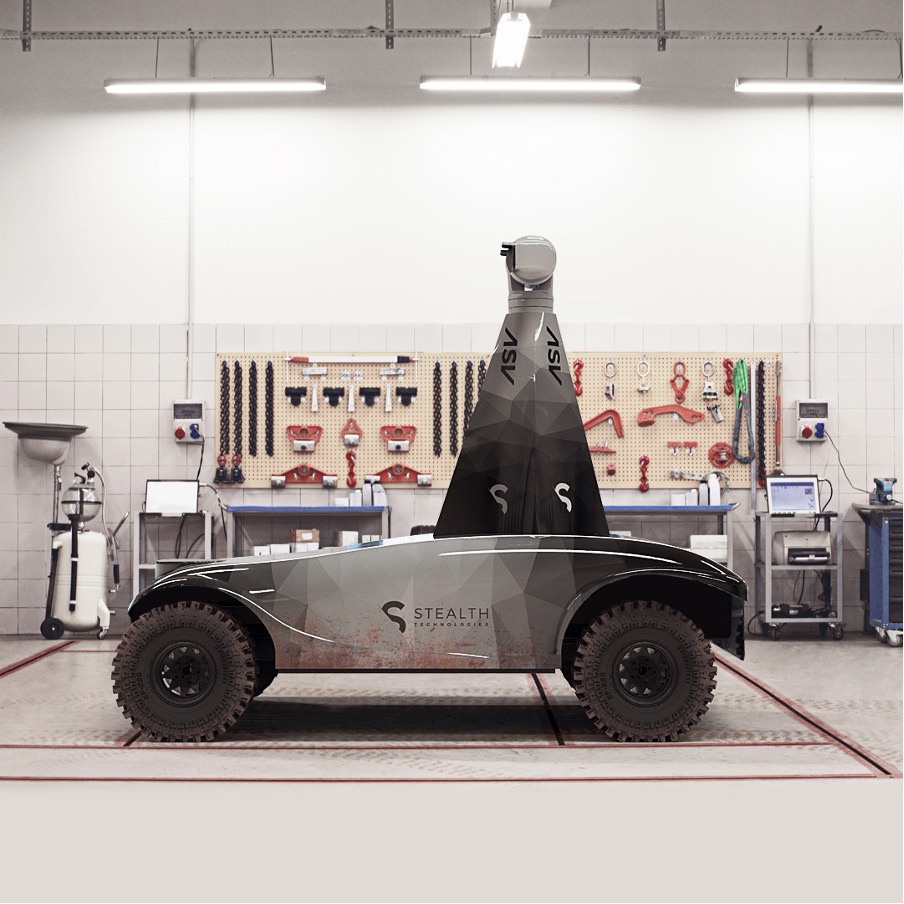
Stealth’s ASV is in the works.
Over the September quarter, work on an agreement to commercialise the ASVs with Honeywell (NYSE:HON) advanced.
Murphy said: “The company also continued successful operation of the world’s first automated perimeter security testing and surveillance vehicle at the Eastern Goldfields Regional Prison.
“The parties also actively worked together throughout quarter three to further integrate the Stealth ASV technology into the Honeywell EBI (intelligent building automation and enterprise management system with thousands of systems deployed globally).
On July 6, SOR also revealed its subsidiary would design and deliver an autonomous, drone-carrying vehicle that automates detection and sensing of chemical, biological, radiological and nuclear agents.
The company will collaborate with Defence Science Technology Group (DSTG), part of the Australian Department of Defence, and the University of Western Australia to build the solution and conduct a live demonstration to Army.
The Western Australian Defence Science Centre has agreed to part-fund the collaborative work.