
Bradda Head Lithium Ltd (AIM:BHL) received positive initial results from the GPRplus geophysical programme at the company's Burro Creek and Wikieup projects in Arizona.
Bradda Head said the initial results reinforced the original theory that the clay at Burro Creek East, where Bradda has a JORC resource of 185,000 tonnes of lithium carbonate equivalent (LCE), thickens towards the west and north-west towards Bradda's other claims.
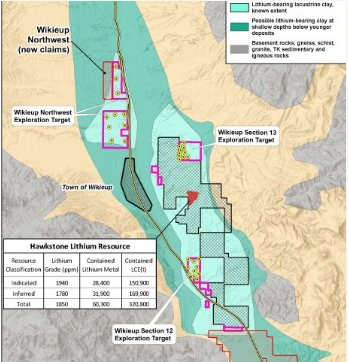
At Wikieup, where drilling is planned to commence this quarter at sections 12, 13 and Wikieup NW, all drilling areas show clay thicknesses of up to 90 metres, comparable to what is seen at Arizona Lithium's (formerly Hawkstone) Big Sandy deposit (1,850 parts per million lithium grade), which is adjacent to Bradda Head's Wikieup claims.
Bradda Head Lithium will use the results from the geophysical programme to plan future drilling programmes, and to help guide its imminent programme at Wikieup, thereby ensuring funds are conserved for drilling and not wasted on unnecessary drilling where no clay is present.
"These initial results are very promising not only because they strengthen our previous thinking as to the thickening of Burro Creek East Upper Clay zone to the west and north-west but also because they highlight the very exciting prospect of drilling starting this quarter at Wikieup where clay depths comparable to Arizona Lithium's Big Sandy deposit have been identified. Further to this, the wider potential of all our claims at Burro Creek has improved with the results,” said Charles FitzRoy, the chief executive officer Bradda Head.
"Only a very small portion (c.2% of 47km2) of our sedimentary claims have been drilled, these results will enable us to plan drill programmes more accurately and avoid unnecessary drilling costs, and importantly point to the potential for a large-scale resource across our sedimentary claims,” he added.