
Element 25 Ltd (ASX:E25) has taken a key step toward its goal of becoming a low-cost, zero-carbon manganese producer with a breakthrough in its processing flowsheet for the Butcherbird Project, resulting in optimisations to complexity and cost.
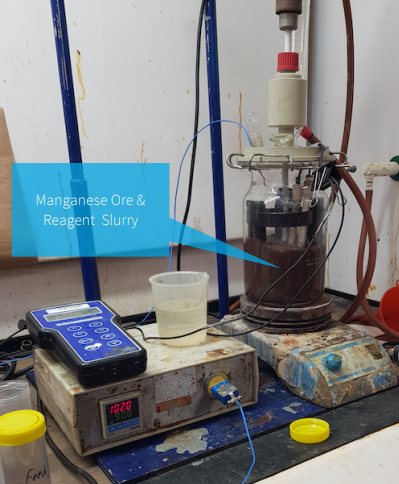
The High Purity Manganese Sulphate Monohydrate (HPMSM) development team made progress in optimising the leach process using an alternative organic, low carbon intensity reagent with reduced requirement for secondary reagents.
Optimised flowsheet
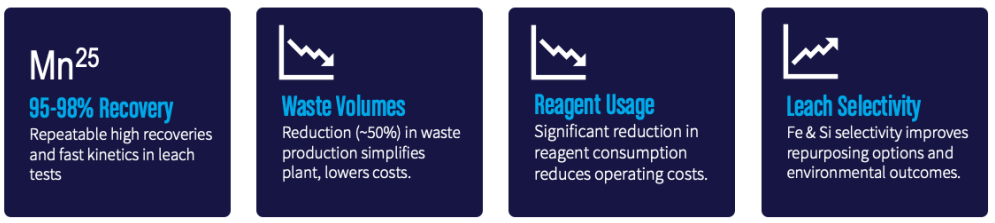
“The optimisation work completed in this phase represents a genuine breakthrough in terms of simplifying the flowsheet and significantly reducing reagent consumption and residue production both key drivers of production costs,” E25 managing director Justin Brown said.
“The composition of the residue stream has also been improved whereby the company is able to have meaningful conversations with parties around repurposing the residue for consumption in complementary processes rather than simply dumping the material in the landscape, an important improvement in terms of environmental outcomes.”
The development team has focused on producing HPMSM suitable for new energy vehicles from run-of-mine concentrate with the simple low-cost beneficiation process in use at the project, which has been further confirmed to produce suitable feedstock to produce high-purity manganese.
The company continues to achieve high extraction rates of up to 98% with this new method. The new reagent offers advantages in availability, cost, process simplification and carbon intensity.
Test results
Results from optimisation testing have shown significantly improved selectivity over impurities compared to previous reagent tests, with optimised extraction and impurity removal during the primary purification stage.
This has resulted in a big step towards optimising and minimising reagent consumption and simplifying the complexity of the process.
Changes to the flowsheet have also reduced the volume of solid residue streams, simplified solid-liquid separation and reduced the size and complexity of the mechanical equipment required.
The waste solids have a composition made up of mostly iron (41.0%), aluminium (10.2%) and silicon (36.1%) potentially providing opportunities to repurpose this waste material as feedstock in the manufacture of certain smelter products.
If this can be achieved, the E25 process will further reduce the environmental impact of the HPMSM conversion process, potentially enhancing the ESG credentials of the project.
The E25 team believes these optimisations are crucial in maximising the economics of the HPMSM facility and has decided to incorporate the changes with the aim of including them in the pre-feasibility study (PFS) work that is expected to demonstrate the commercial potential of the facility.
Timing of the PFS will therefore be delayed until 2022 as the results of this latest work are believed to be material by the company, and should be included in the final flowsheet design for the PFS.
The E25 business development team is considering publication of a scoping study to provide guidance with respect to the magnitude of the economic opportunity presented by the production of HPMSM from project concentrates.
This would be promptly followed by a PFS and subsequent feasibility study to add the necessary detail to underpin offtake and financing discussions.
About the company
Element 25 is developing a world-class manganese resource at the 100%-owned Butcherbird Project in Western Australia to produce high-quality manganese concentrate for export markets and especially for the growing electric vehicle materials market.
Based on the results of a pre-feasibility study completed in May 2020, E25 has published a maiden ore reserve for the project of 50.55 million tonnes in the proved and probable categories.
The robust economics and low capital hurdle for the first stage of development have allowed the company to deliver first production from the project in less than 12 months from the publication of the PFS.