
Aldoro Resources Ltd (ASX:ARN) is doubling down on a high-priority pegmatite loop target at its Wyemandoo Project in Western Australia.
The target zone is the epicentre of a lucrative pegmatite fairway, which contains highly anomalous lithium and rubidium rock chip samples.
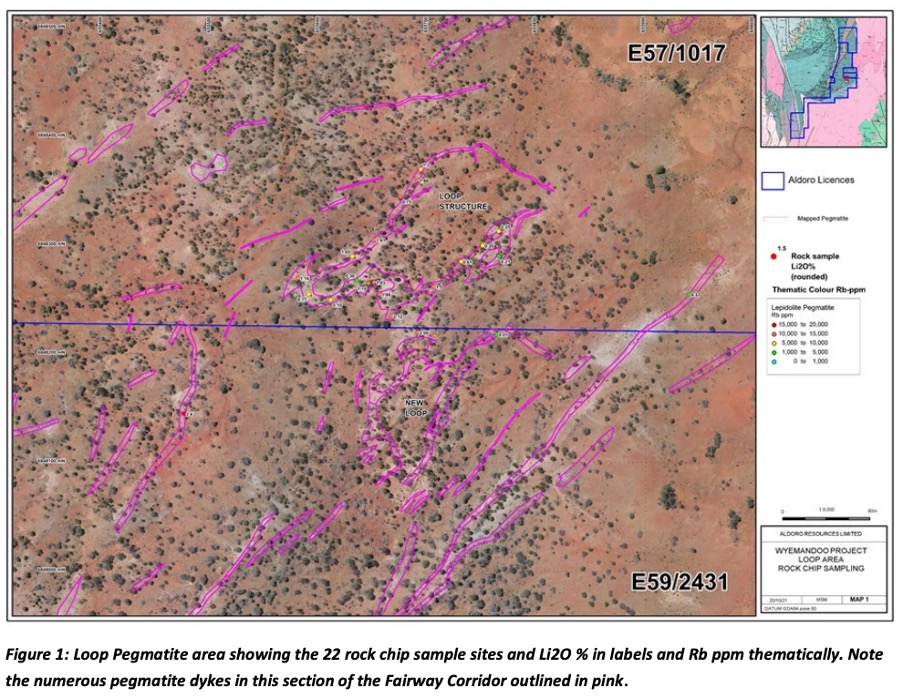
Earlier this week, Aldoro reported that 22 rock chip samples taken around the loop pegmatite averaged 1.06% lithium oxide and 0.94% rubidium, with samples reporting up to 2.6% lithium oxide and 1.7% rubidium.
What’s more, satellite imagery suggests a similar structure lies immediately to the south in a swarm of pegmatitic dykes.
As it works to better understand the pegmatite-bearing zone and its lithium and rubidium potential, Aldoro is gearing up for the next phase of rock chip sampling across the fairway pegmatite corridor.
It means the potentially world-class pegmatite field will remain under the microscope for several more months.
Unlocking pegmatite potential
An earlier review into the Wyemandoo Project’s pegmatites uncovered highly anomalous assays over nearly 9 kilometres of strike, paving the way for future exploration.
All up, the 52 pegmatite samples returned an average of 5,439 parts per million (ppm) rubidium, with one sampling reading 17,123 ppm.
In addition, the rock chip sampling program averaged 0.63% lithium oxide, with the highest result generating as much as 2.59%.
Wyemandoo’s pegmatite swarm appears to cover a large area — a northeast corridor over 10 kilometres long and up to six kilometres wide, where the full extent is masked by young alluvium and colluvium cover.
Promisingly, a large section of the pegmatite bearing zone has the potential to be highly fractionated and enriched with the lithium suite of metals.
The range of lithium values reflects the variation in lepidolite content across the small portion of pegmatites sampled in the very large, apparent pegmatite field.
Wyemandoo pegmatites generally trend northeast and can strike over 1,000 metres in length, varying from 1 metre to 20 metres in outcrop width with shallow to moderate dips.
The broader rare metals project sits just 80 kilometres south of Mount Magnet, covering 9 square kilometres.
It’s contiguous with another exploration tenement on the Narndee-Windimurra Igneous Complex.
So far, more than 20 pegmatite dykes have been mapped at Wyemandoo, of which 10 have been sampled.
Many more pegmatites cover the property, yet to be mapped or sampled.
What’s next?
Off the back of the rock chip results, Aldoro is finalising a larger systematic sampling program for the Wyemandoo Project.
The campaign should kick off later this month, sampling at a 40-metre interval along the extent of the project’s pegmatite outcropping.
Aldoro will also use an XRF tool to pinpoint rubidium mineralisation at the property.
This will assist in drill hole planning for future exploration.
Market outlook
Earlier this week, Aldoro also reported it was weighing up the pegmatite fairway’s economics.
It comes as the price for lithium concentrate proves favourable: currently, concentrate with 6% lithium oxide is securing between $2,100 and $2,200 per tonne.
That’s equivalent to $500 for a tonne of lithium oxide at 1.5%.
In addition, rubidium carbonate grading at 99.5% is generating between $1.4 and $1.5 million per tonne.
If the rubidium mineralisation has an average grade of just 1%, it bears an in-situ value of roughly $10,000 per tonne, without considering the mining and processing recoveries.