
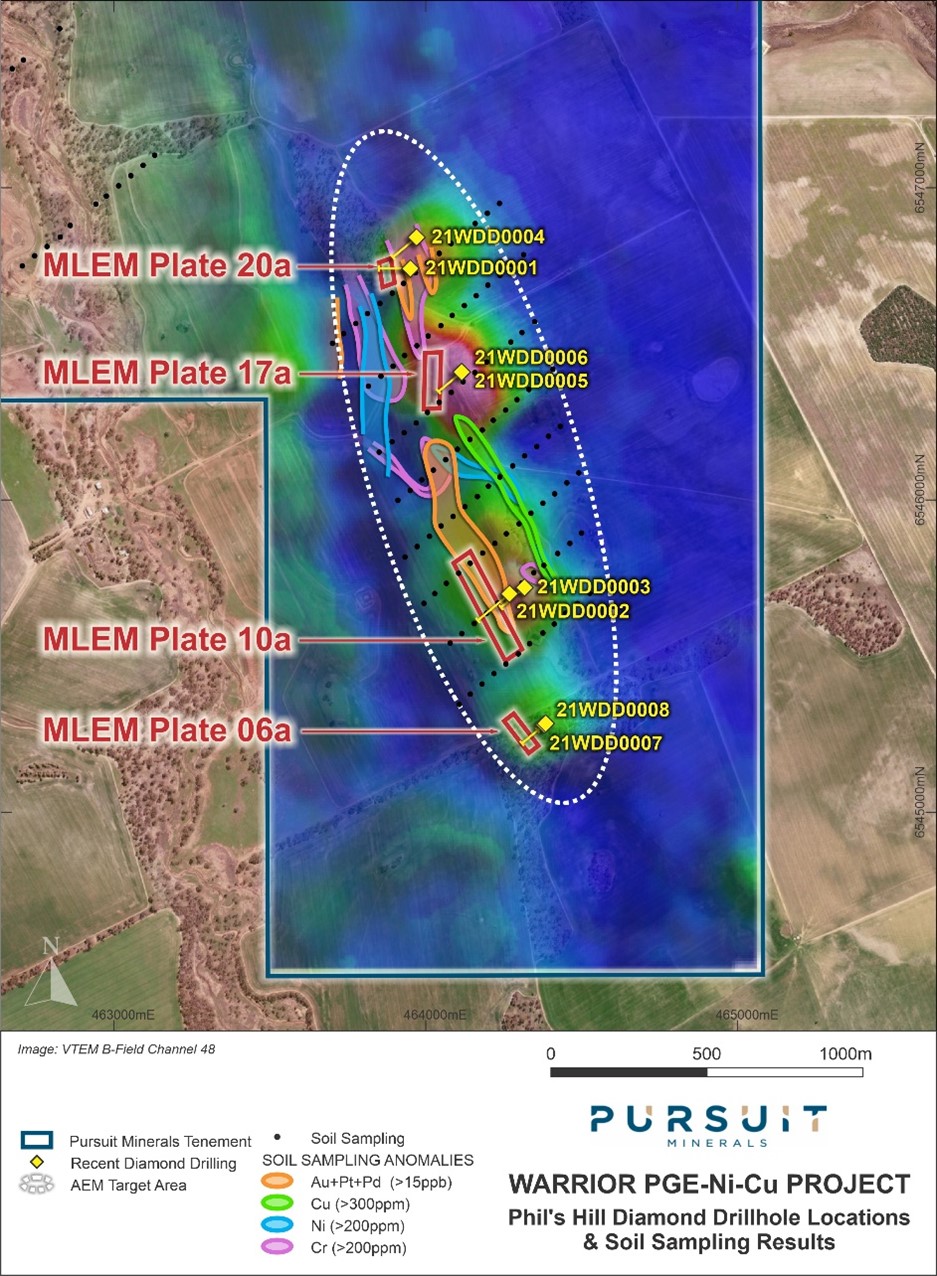
Pursuit Minerals Ltd (ASX:PUR) has extended known sulphide mineralisation at Phill’s Hill prospect of the Warrior Project in Western Australia to in excess of 1.6 kilometres of strike following a diamond drilling program of eight holes for 1,538 metres.
Assay results for the first four holes have been received, indicating silver mineralisation up to 6.96 g/t along with anomalous gold, copper and nickel.
"Strong encouragement"
“These assay results are very significant and give strong encouragement that the company has located a significant mineralising system at Phil’s Hill,” Pursuit Minerals managing director Mark Freeman said.
“Our technical team is now focused on finding the core of the system and will be working with geophysical and geochemical consultants to that end.
"The significant PGE anomalism in our surface soils remains is a strong driver for continued follow-up geochemical sampling.
"The company eagerly awaits assay results from holes 3, 6, 7 and 8.”
Shares higher
Investors have also recognised the significance of the results, driving shares 26.47% higher to 4.3 cents.
The complexity of mineralisation at Phill’s Hill necessitated a review by consultant geochemist Pathfinder Exploration, which used statistical techniques such as correlation and cluster analysis to highlight trends and elemental associations in the data.
Several mineralisation styles
Pathfinder’s analysis suggests Phil’s Hill could be reflecting several possible mineralisation styles, specifically:
- Gold-polymetallic mineralisation – containing gold-silver-copper-molybdenum, as found in gold or gold-copper mineralisation;
- Ultramafic/PGE – comprises an elemental association of chromium-magnesium-nickel-(palladium-platinum);
- Pegmatite – porphyritic intrusive association that includes elements such as rare earths;
- Lead-zinc mineralisation – lead-zinc-antimony-cadmium-manganese/cobalt, such as is found in Volcanic Hosted Massive Sulphide (VHMS) systems.
Mineralisation in all drill holes suggests there may have been an overprinting of at least two mineralising events at Phil’s Hill, and as many as four, explaining the complex mineralisation discovered on site.
Once all assay data are received Pursuit will review them with geophysical and geochemical consultants to plan new programs to search for the core of the mineralising system.
Sulphide results
Holes 1 and 4 were testing a conductor plate (20a) previously identified by electromagnetic (EM) surveying. Drill hole 4 intersected massive sulphides in the expected position of the plate, with assay results confirming silver mineralisation with anomalous copper and gold.
Mineralised intervals in hole 4 include:
- 0.32 metres at 3.96 g/t silver and 0.12% copper from 103.98 metres; and
- 3.7 metres at 3.19 g/t silver from 129.5 metres.
Deeper in hole 4 from 154.5 to 171.5 metres an anomalous ultramafic elemental association is noted with elevated platinum/palladium mineralisation to 24 parts per billion (ppb).
Hole 1 also intersected silver mineralisation of 1.3 metres at 3.09 g/t silver from 59.7 metres, including 0.3 metres at 5.14 g/t silver and 0.13% copper from 59.7 metres. The mineralisation intersected in Hole 1 is about 72 metres along strike of the massive sulphides intersected in Hole 4.
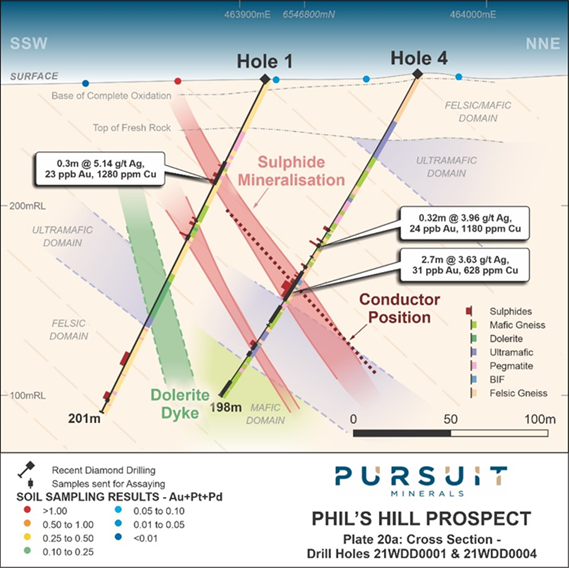
Clear patterns of geochemical anomalism are observed in the assay data. This anomalism suggests the mineralisation intersected in Hole 1 may represent ‘leakage’ of mineralisation along strike and up dip of the massive sulphide zone intersected in hole 4.
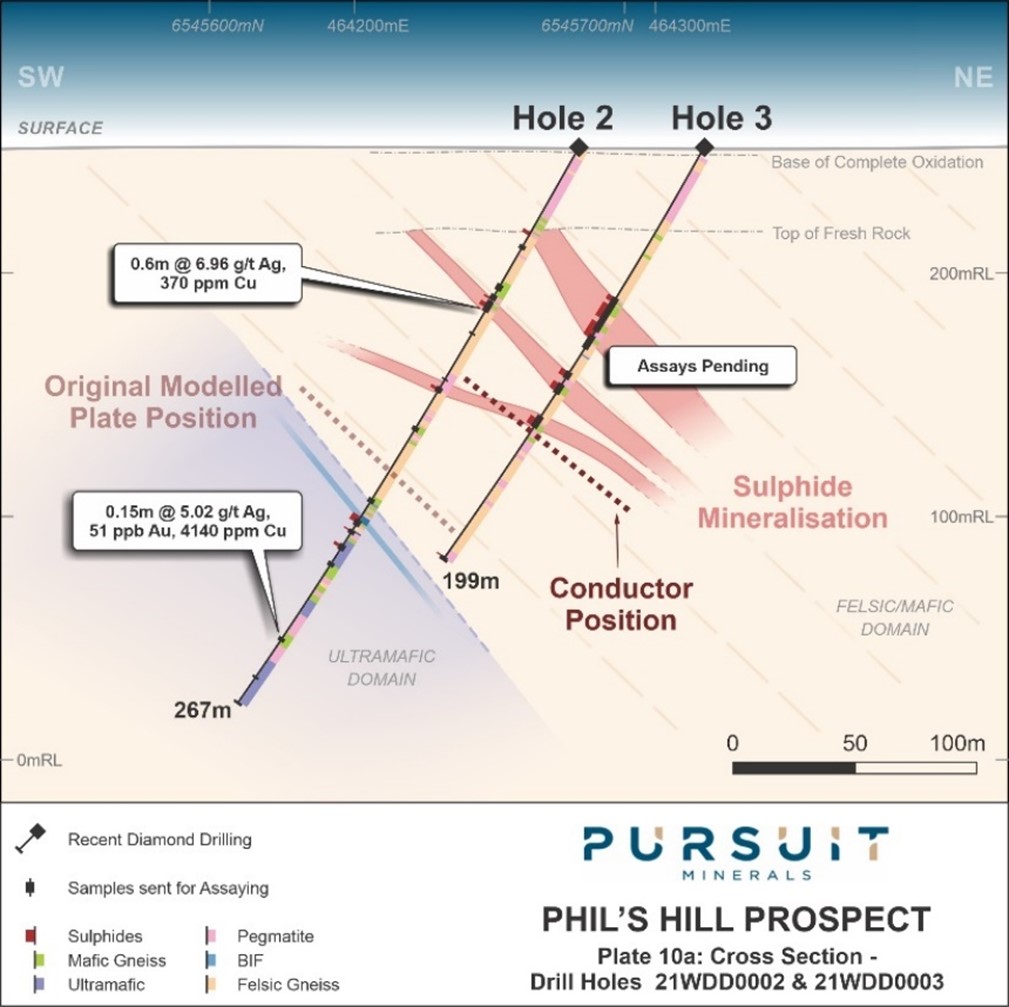
Results for Hole 3 are pending and intervals in Hole 2 include:
- 2 metres at 4.40 g/t silver from 74.6 metres, including 0.6 metres at 6.95 g/t silver and 0.03% copper from 75 metres;
- 1.4 metres at 2.19 g/t silver from 62.9 metres;
- 1.5 metres at 1.91 g/t silver from 69.2 metres; and,
- 1.15 metres at 3.45 g/t silver from 236 metres, including 0.15 metres at 5.02 g/t silver, 0.41% copper and 51 ppb gold from 237 metres
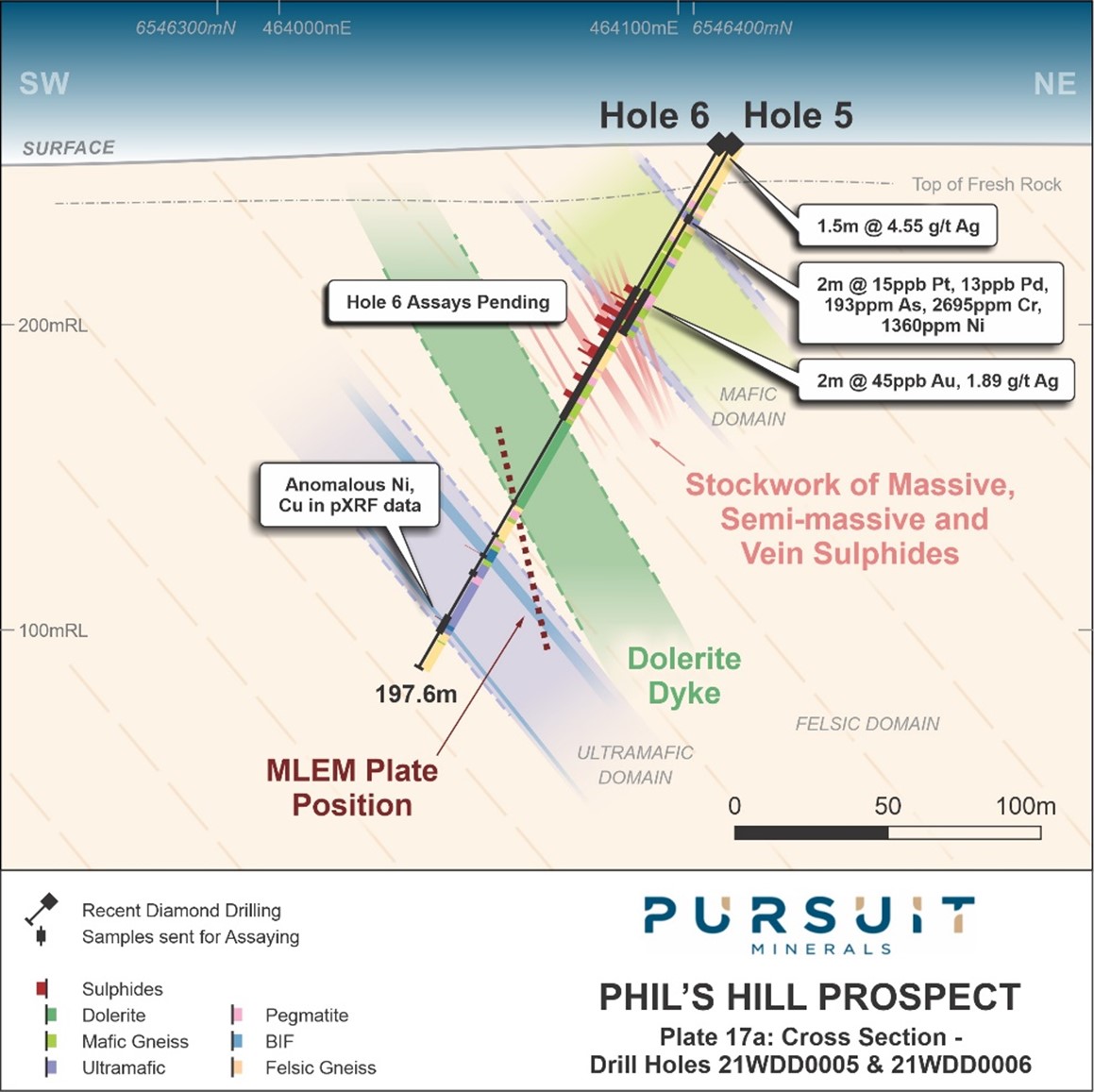
Hole 5 was abandoned at 71.4 metres following drilling problems and Hole 6 was a re-drill 3 metres to the southwest. Only selected zones in Hole 5 were sampled but silver, arsenic, platinum, palladium, chromium and nickel anomalism is noted high in the hole. Best results include:
- 1.5 metres at 4.59 g/t silver from 0.5 metres; and
- 7.8 metres at 1.30 g/t silver from 62.9 metres.
Hole 6 found massive and stringer sulphides from 54-94 metres with potential nickel sulphides observed at 180 metres.
Two holes were drilled at the southern plate 6a, holes 7 and 8. Hole 7 ended at 59.5 metres due to drilling problems and hole 8 was a redrill 5 metres to the northeast. Assay results are pending for these holes.
Logging of Hole 8 found massive, stringer and disseminated sulphides from 49-54 metres and 137-166 metres with apparent magmatic nickel sulphides over 0.8 metres at 172 metres downhole.
"A phenomenal job"
“The drillers and our exploration team have done a phenomenal job on-site with minimal disturbance to the crop and have ensured excellent relationships maintained and strengthened within the community in the district,” Freeman said.
Detailed analysis of past drill hole geochemistry at the Warrior Project by geochemical consultant GC Xplore has highlighted a number of anomalies and trends that warrant follow up once crops are harvested at the project area next January.
A drill hole electromagnetic (DHEM) data crew will be on-site this week to survey holes 3 to 8.
Next steps
Pursuit's next steps to progress its portfolio are:
- Expedite assays holes 3, 6, 7 and 8;
- Complete DHEM on all holes;
- Plan follow-up auger geochemistry at Phil’s Hill to expand coverage along strike N and S; and
- Initiate geochemical & geophysical surveys at Ablett Prospect.