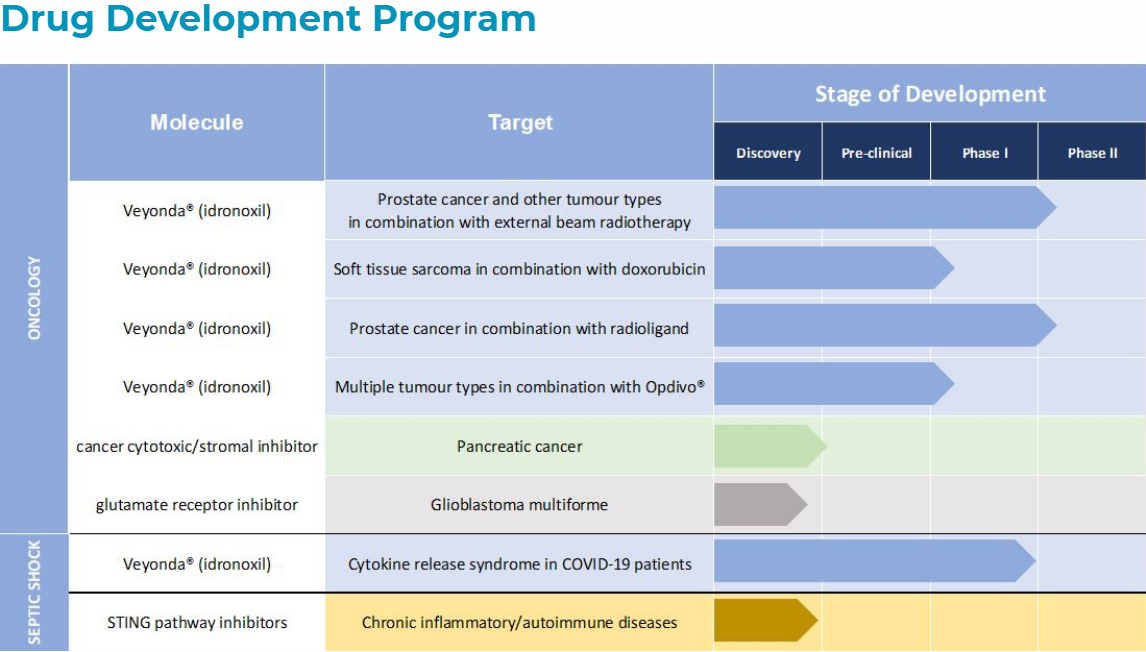
Noxopharm Ltd (ASX:NOX) has advanced its drug development program with the commencement of Phase I clinical trials in the Veyonda® and Opdivo® IONIC Study, supported by Noxopharm and Bristol Myers Squibb (BMS).
The IONIC-1 trial is a pilot Phase 1 trial in approximately 30 cancer patients, combining Veyonda® with the BMS drug, Opdivo® (nivolumab), for the treatment of a range of tumour types. The trial is being conducted at several sites in Australia and the first patient has already received their dose.
For the company, a positive outcome would result in Veyonda® increasing the patient types responsive to immune checkpoint inhibitor (ICI) therapy, increasing the range of cancers that can be treated with the therapy and opening up a multi-billion-dollar ICI market to Noxopharm.
Potential to improve cancer outcomes
ICIs such as nivolumab reduce cancer cell resistance to the body’s immune system, producing impressive results in patients with a limited range of cancer types, but remaining ineffective against many other cancers.
The aim of the study is to increase the activity of nivolumab by using Veyonda® to overcome tumour resistance to ICI therapy.
Noxopharm chief medical officer Dr Gisela Mautner said, “If we can improve the performance of ICIs by the addition of Veyonda, it could make a massive impact, improving outcomes for cancer patients worldwide. It is exciting that this study is now underway in Australia, and we look forward to updating the market as the study progresses.”
Expanding market
The Immune Checkpoint Inhibitors Market has current annual sales of US$20 billion and is projected to reach US$56.53 billion by 2025, registering a compounding annual growth rate (CAGR) of 20.1% from 2018 to 2025.
If Veyonda® can increase the types of cancer receptive to ICI therapy, the market would expand even more, placing any company with technology contributing to achieving that goal in an enviable position to capitalise on a growing market share.
The ICI market is dominated by two major global pharmaceutical companies, one of which is Noxopharm’s partner in the study, Bristol Myers Squibb.
ICONIC-1 trial
The study will comprise two patient groups under the stewardship of principal investigator, medical oncologist Professor de Souza, BScMed MB BS MPH PhD FRACP.
One group will consist of patients with cancers considered unsuitable for ICI therapy because of inherent resistance, while the second group will consist of patients who received ICI treatment but subsequently displayed resistance.
The trial endpoints are:
- Safety and tolerability of the drug combination;
- The therapeutic dose of Veyonda;
- Efficacy outcomes; and
- Effect on various blood biomarkers.
Noxopharm would consider the trial to be a success if the combination treatment succeeded in achieving stable disease or better in patients with progressive disease, as long as additional safety issues have not been introduced in the process.
How does it work?
Immune checkpoints are proteins expressed on the surface of cancer cells, forming a protective shield that stops the body’s immune system, and especially cell-destroying T-cells, from attacking them.
Immune checkpoint proteins are a key defence cancers use to camouflage themselves and avoid destruction by the immune system, allowing the cancer to overcome the body’s normal regulatory processes to survive and spread through the body.
Drugs such a nivolumab nullify this protein camouflage or shield, exposing the cancer cell to be destroyed by immune cells. Resistance to this class of therapy is thought to be derived from a lack of immune cells within the individual tumours, meaning the loss of its protective shielding has minimal impact in the absence of cells capable of destroying it.
Veyonda® is a first-in-class, selective inhibitor of sphingosine-1-phosphate (S1P). The S1P gradient is believed to be responsible for expulsion of immune cells from tumours, thus reversing it would allow for the repopulation of tumours with active immune cells, now capable of targeting cancer cells that have been stripped of their immune checkpoint protein protection.
The IONIC-1 trial is predicated on the basis that this so-called COLD to HOT conversion of tumours will prove to be the essential co-factor with nivolumab for effective immune control of cancer.
The use of Veyonda in this way is the subject of patent applications in numerous territories worldwide.
About Noxopharm
Noxopharm is an Australian clinical-stage drug development company focused on the treatment of cancer and cytokine release syndrome (septic shock).
Veyonda® is the company’s first pipeline drug candidate currently in Phase 2 clinical trialling. Veyonda® has two main drug actions – a moderating effect on ceramide/S1P balance and a reduction in the release of inflammatory cytokines, or STING signalling.
In other words, Veyonda® has the ability to enhance the effect and safety of standard oncology treatments, such as chemotherapies, radiation and immune checkpoint inhibitors. The molecule provides an anti-inflammatory and anti-cancer effect with radiation and chemotherapies, while also potentially blocking septic shock.
Noxopharm is running comprehensive drug discovery programs in both oncology and inflammation, and is the major shareholder of US biotechnology company, Nyrada (ASX:NYR) Inc, active in the areas of drug development for cardiovascular and neurological diseases.