
Great Boulder Resources Ltd (ASX:GBR) has identified a high-priority target immediately south of the current high-grade gold intersections at the Mulga Bill mineralised corridor within the Side Well Gold Project in Western Australia.
Interpretation of the recent high-resolution gravity survey combined with reprocessing of previous VTEM data has emphasised the scale of the Mulga Bill mineralised corridor, particularly a 3 kilometre-long section where coincident gravity and conductive features present a high priority exploration target extending to depth.
In parallel to this, recent assays from diamond core and a single RC (reverse circulation) scissor hole have confirmed the orientation of high-grade quartz veins such as that recently intersected in 21MBRC034 (14 metres at 36.12g/t gold from 91 metres, including 3metres at 149.89g/t gold).
“Potential for a very significant metal endowment”
Great Boulder managing director Andrew Paterson said: “This is a significant development in our understanding of Mulga Bill.
“The geophysical interpretation has sharpened our focus on the 3km zone between the two Proterozoic dykes.
“So far we’ve only drilled the first 900m of strike in this area with extremely high-grade gold intersections.
“Our new model suggests the most prospective area is further south, where we have gold and bismuth pathfinders in AC drilling but we haven’t yet tested it with any RC drilling.
“If we have a tabular subvertical zone over 3km long and 50m wide, open at both ends with strong copper-gold-silver enrichment and a stacked set of high-grade quartz-pyrite-gold veins, this deposit has potential for a very significant metal endowment.”
Drilling results
During the Phase 4 RC program, one hole was drilled between holes 21MBRC002 and 21MBRC034 in order to test Great Boulder’s theory that high-grade mineralisation is associated with stacked, shallowly west-dipping pyrite-rich quartz veins.
Hole 21MBRC050 successfully intersected 6 metres at 39.15g/t gold from 101 metres including 3 metres at 74.51g/t gold from 91 metres.
This appears to support Great Boulder’s theory, and additional test holes are being drilled to continue to build confidence in the company’s geological model.
Assays received to date for the diamond program completed in mid-August have also confirmed the high-grade vein-related mineralisation, with intersections including 0.65 metres at 42.20g/t gold from 253.2 metres and 0.61 metres at 41.30g/t gold from 289.09 metres in hole 21MBRCD042.
Assays have been received for the first four diamond holes, and those for the final hole are expected imminently.
Geophysical survey results
Geophysical consultants Terra Resources have reprocessed the company’s Side Well VTEM data and interpreted it in parallel with the recently completed high-resolution gravity survey.
By using the VTEM data to remove the overburden effect from the gravity data a much clearer image shows a high-gravity trend corresponding to the Mulga Bill corridor.
It is significant that this zone of elevated gravity is coincident with a zone of increased conductivity seen in the EM data, an effect that is also thought to be caused by pyrite.
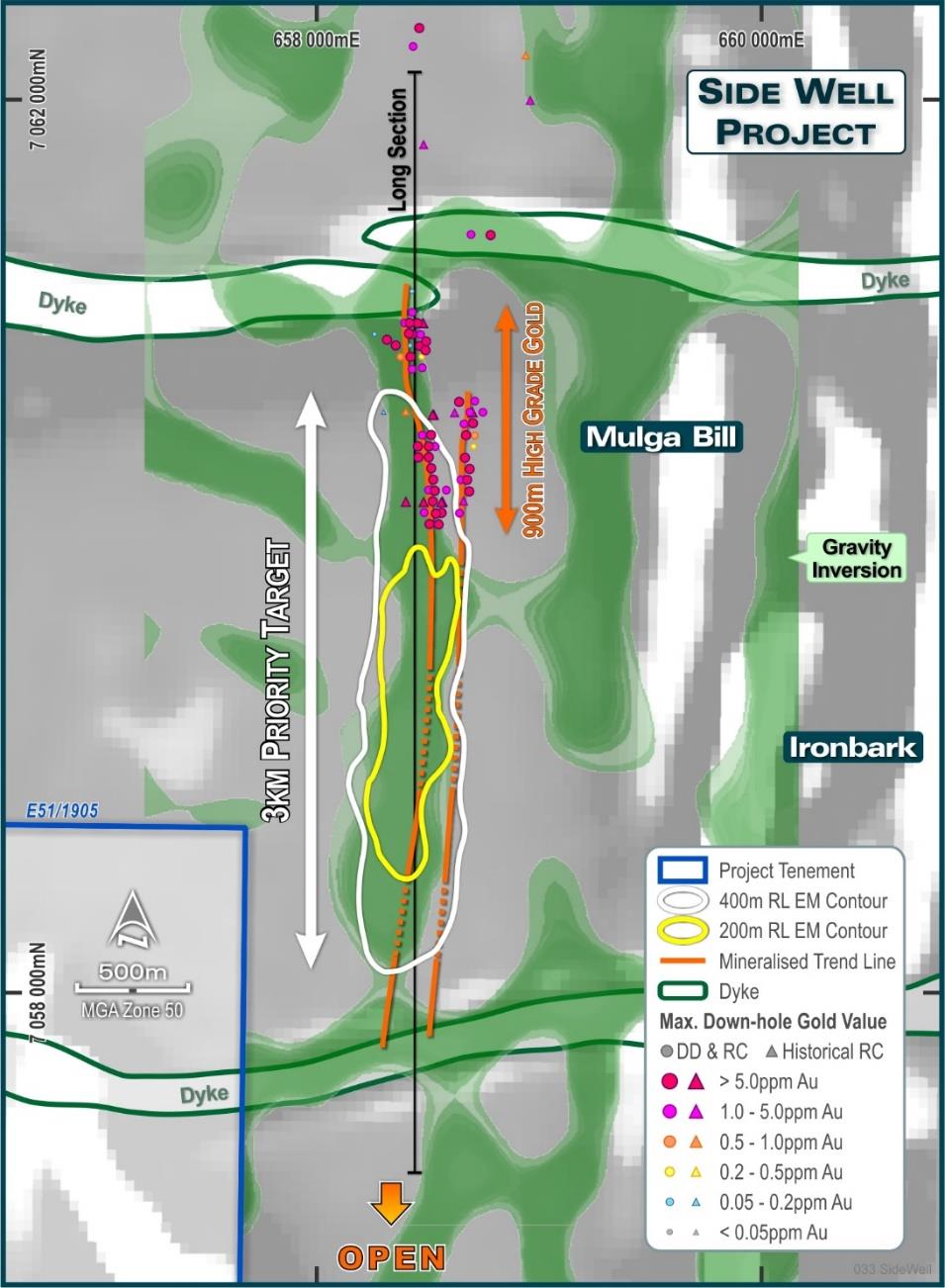
The gravity inversion (green) coincides with an EM conductivity corridor (contours) at Mulga Bill. The deepest EM zone is highlighted by the yellow contour in an area not yet tested by drilling.
Importantly, the geophysical data also indicates that this anomaly is strongest immediately south of the area drilled to date, extending to significant depth over a strike length 2 kilometres further south in an area not yet tested with RC drilling.
Next steps
Phase 5 RC drilling is progressing well and is scheduled to be complete in the next two to three weeks.
During this program, Great Boulder intends to start testing the deeper priority target as well as some initial test holes into the new Ironbark and Loaded Dog prospects.
The next phase of AC (aircore) drilling is now underway testing a range of targets on the Mulga Bill corridor as well as regional targets within the Side Well Gold Project.