
Buru Energy Ltd (ASX:BRU) subsidiary 2H Resources is making progress with its strategy focused on natural hydrogen and associated helium which have a role to play in driving the global transition to zero-emission fuels.
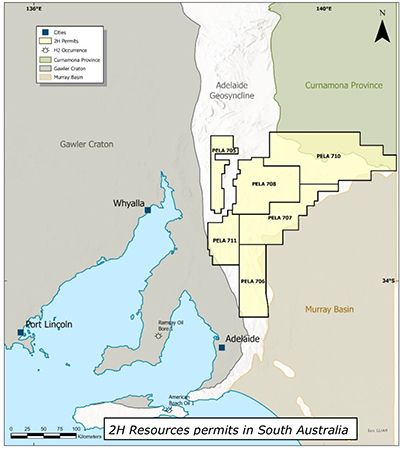
The initial focus of 2H Resources is in South Australia where it has recently been granted a large area of more than 29,000 square kilometres of permits that are on geological trend with legacy natural hydrogen discoveries.
2H Resources plans to undertake on-ground initial prospecting work on these permits using in-house capabilities and technology, including hydrogen measuring equipment, once appropriate approvals are in place.
Energy transition activities
As well as 2H Resources, considerable progress is also being made on Buru's other energy transition activities.
These include Geovault, a Carbon Capture and Underground Storage (CCUS) initiative, and Battmin that has a strategy encompassing battery minerals exploration in the Kimberley region of WA.
Buru will provide updates on these growth opportunities as they are advanced.
About natural hydrogen
Natural hydrogen is produced from underground accumulations in the earth and not manufactured, so it has the potential for supply of low cost and low carbon intensity hydrogen.
It is often associated with helium in the subsurface and both can be produced at the same time providing complementary value.
The potential of natural hydrogen has only recently been recognised and 2H Resources is at the forefront of the search for and exploitation of these valuable resources.
Natural hydrogen accumulations are formed in the earth by geological processes and have been observed and produced from seeps and wells (boreholes) around the globe.
2H leading the way
The processes that form potentially commercially exploitable accumulations are poorly understood and 2H Resources is leading the way in understanding these processes and identifying these accumulations.
The company has developed internal geological expertise in the search for natural hydrogen and is engaging with globally recognised specialists and consultants.
2H is assessing opportunities both onshore Australia and globally, and this may lead in due course to the establishment of activity in international jurisdictions that have established a regulatory framework for the exploration and production of natural hydrogen.
Discussions are also progressing with potential partners to further expand 2H’s activities and technical capabilities.
Canning Basin potential
While the primary focus of 2H is in South Australia, Buru Energy’s work in the Canning Basin onshore Western Australia also provides natural hydrogen and helium opportunities.
In addition to routine mudlog hydrocarbon gas detection and logging on current Canning Basin wells, a specialised hydrogen mudgas detection unit has been installed to monitor hydrogen and helium.
This unit measured a zone of up to 6% hydrogen percentage in mudgas over an interval of approximately six metres in the Currajong 1 well. It has also detected intervals with up to 4.9% hydrogen in the currently drilling Rafael 1 well.
The significance of these hydrogen indications needs to be further evaluated, but together with a number of legacy wells that encountered hydrogen, they demonstrate the widespread occurrence of natural hydrogen in the Canning Basin.
Low carbon intensity
Hydrogen is also the energy source that is most suited to using the existing large scale fossil fuel infrastructure to drive the transition to zero-emission fuels.
Production of natural hydrogen will be amongst the lowest carbon intensity fuel sources as the exploitation, production and transport will ultimately all be driven by hydrogen-fuelled infrastructure.
Natural hydrogen is likely to be similar in production cost to natural gas providing energy at about one-eighth of the cost of today’s other hydrogen production methods.