
Polymetals Resources Ltd (ASX:POL) hit a new record high on returning bonanza-grade gold intersections in a second phase drilling program at the Alahiné Gold Project in Guinea, West Africa.
Several key intersections are of sufficient quality to be considered bonanza-grade, including:
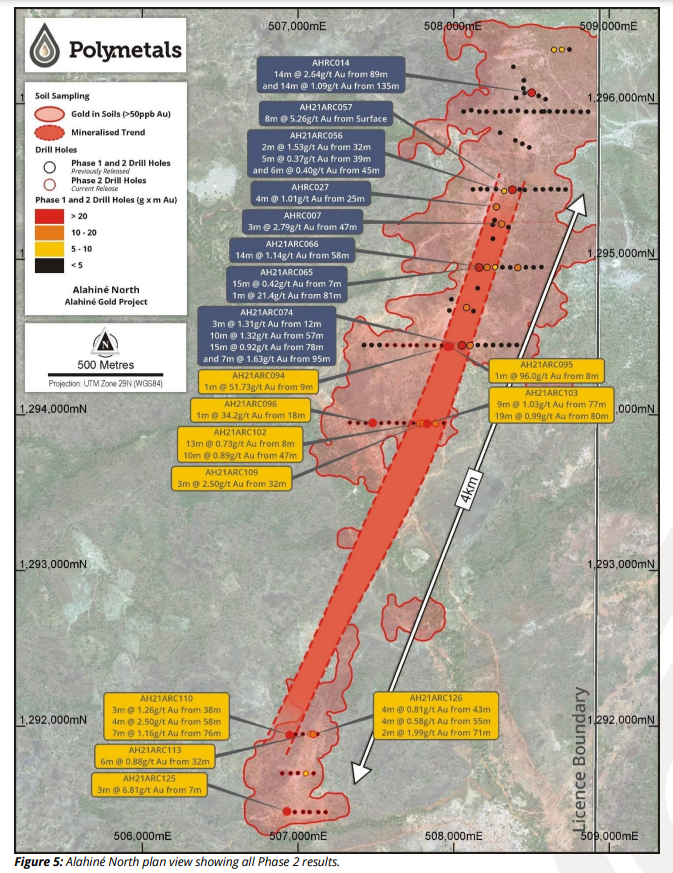
- 1-metre at 51.73 g/t gold from 9 metres;
- 1-metre at 96.00 g/t from 8 metres; and
- 1-metre at 34.2 g/t from 18 metres.
These results have confirmed the high-grade potential of the gold asset and have seen investors drive up the share price by as much as 70.4% to an intraday high of 23 cents, a new record for the company that listed in late June 2021.
The Phase 2 program of 98 drill holes for a total of 7,320 metres, comprised 94 aircore (AC) and four reverse circulation (RC) holes. It was designed to test prolific artisanal gold workings areas enclosed by a 40 parts per billion (ppb) gold-in-soil contour and new priority targets identified by the Polymetals exploration team.
All assay results have now been received and project site activities remain unaffected by recent political activity in Guinea.
Multiple targets open at depth
“We are very encouraged by what we have seen at Alahiné. The third batch of assays have confirmed our interpretation from batches 1 and 2, that there are a number of targets on-strike that require further extension drilling, and north-south step-out drilling,” Polymetals Resources CEO Alex Hanly said.
“As demonstrated in Figure 5, the strong north/northeast trend is clearly evident and as such, the Phase 2 drilling results have presented Polymetals with multiple targets that remain open at depth.
“The high-grade near-surface intercepts of 96 g/t, 51 g/t and 34 g/t provide potential for possible near-term gold production within the Alahiné licence.
“Further drilling of these shallow high-grade areas and the multiple undrilled zones of +100ppb gold in soils within the Alahiné licence will be systematically tested over the coming months.”
Drilling results
Other assays of note from the second phase of drilling include:
- 13 metres at 0.73 g/t from 8 metres and 10 metres at 0.89 g/t from 47 metres,
- 19 metres at 0.99 g/t from 80 metres, including 9 metres at 1.03 g/t from 90 metres with the hole ending in mineralisation,
- 3 metres at 2.50 g/t from 32 metres;
- 3 metres at 1.26 g/t from 38 metres, 4 metres at 2.50 g/t from 58 metres and 7 metres at 1.16 g/t from 76 metres; and
- 3 metres at 6.81 g/t from 7 metres.
Geological investigations of the Alahiné exploration licence are still at an early stage, but the broad strategy of the Phase 2 program was to investigate a well-defined north-northeast trending soil gold response in the eastern third of the licence area.
With a strike length in excess of 4 kilometres and with drill traverses spaced at 500-metre intervals, numerous anomalous responses remain untested.
Next steps
Polymetals Resources is an Australian mining and exploration company with a portfolio that holds geological potential for the discovery and delineation of a large gold inventory. The company recently acquired 100% of Golden Guinea Resources SARL which owns two exploration licences (Alahiné and Mansala) within the Siguiri Basin.
Ongoing follow-up work will initially focus on near-surface high-grade supergene gold deposits. This will involve drilling of several examples of this ore type identified by the Phase 2 drilling program.
Fieldwork will continue testing undrilled prospects which display significant (>100ppb) soil gold anomalies. Results from the Phase 2 drilling program suggest that soil values of this magnitude and higher are indicative of near-surface high grade supergene gold deposits.
The potential of such deposits to generate a substantial near-term cash flow makes their follow-up compelling.
Further preparatory fieldwork and laboratory studies will be carried out to confirm primary gold mineralisation targets within this well-endowed gold exploration licence.