
Australian Potash Ltd (ASX:APC) has made considerable progress in developing Lake Wells Sulphate of Potash Project (LSOP) in Western Australia and on the current schedule, anticipates that by the end of this quarter, 60% of the production borefield capacity, by volume, will be established.
Work is continuing on the development of the western and southern bore fields with a total of 11 new bores drilled in this current program and 76 new bores scheduled to be developed through the project construction.
Step rate testing of constructed bores is underway to confirm condition and efficiency at the project 500 kilometres northeast of Kalgoorlie and a specialist consultant has been appointed to provide technical expertise on operations development
“Independent technical expert review”
Australian Potash managing director and CEO Matt Shackleton said: “The current focus on the emerging potash minerals sector in Western Australia, arising primarily out of project execution issues encountered by two of the early developers in the space, has caused APC some delay.
"Having been required as a result of these external issues, and having now completed, a further independent technical expert review of our financial model and development strategy, commercial lenders have recommenced their credit processes.
"We welcomed this further review as another layer of confirmation of the strength of the LSOP development."
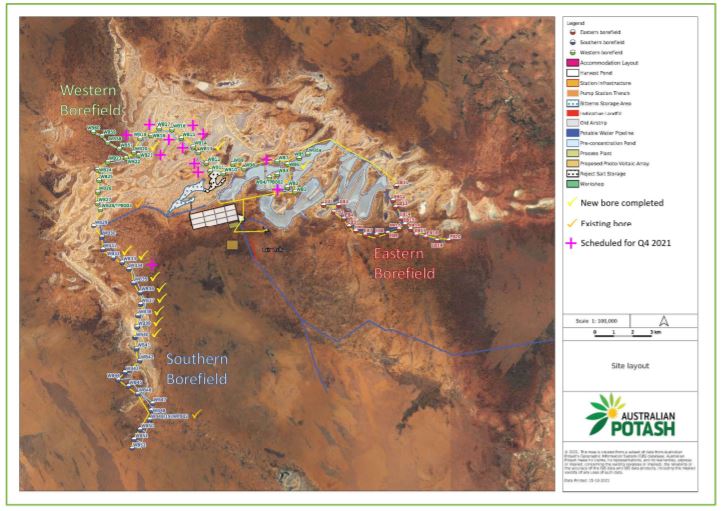
Borefield layout with existing, new and to-be-drilled bores.
Project development
A program of step rate testing begun in the past week to obtain information on the condition and efficiency of selected production bores drilled in this program with constant rate testing planned to assist in determining bore yields.
APC has engaged Corey Milne as a specialist consultant, specifically in the field of SOP production from brine.
Milne will provide an overview of both the LSOP’s development pathway and operational aspects and his expert knowledge will add considerable depth to the APC team and continue the de-risking strategy around the implementation and operation of the Lake Wells Project.
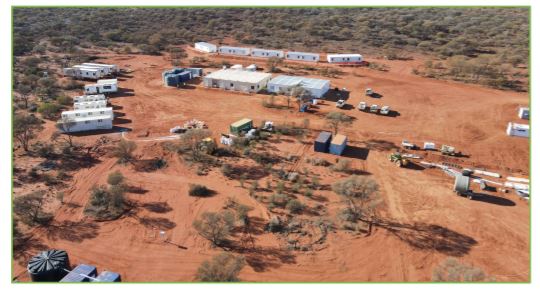
Aerial view of Lake Wells village.
“Economic scale”
Shackleton adds: “The LSOP has always had economic scale.
“The LSOP’s logistics solution, hybrid-renewable power station and process flow sheet are all efficient at 120,000 tonnes per annum, and we will produce 170,000 tonnes per annum.
"120,000 tonnes of this production will come from direct brine evaporation and a further 50,000 tonnes from the conversion of muriate of potash (MOP) to sulphate of potash using a low energy agitation process referred to as salt conversion.
“The MOP conversion unit process, a feature of the LSOP since the project’s inception, requires immaterial marginal capital expenditure.
“In essence, we will incur the cost of a 120,000 tonnes per annum processing plant but produce 170,000 tonnes. Relative capital intensity and debt service ratios across the early developers in the peer space attest to the efficiency of the LSOP development.”
Heritage survey
A heritage survey was conducted in the last week of September 2021 with heritage consultants and Traditional Custodians.
Building on the previous ethnographic surveys, this survey was conducted to assist with preparing site avoidance and management strategies, if and where applicable, at the LSOP.
No sites of cultural significance were identified across the proposed development areas surveyed.

Senior lawmen at the LSOP heritage survey.
Sandalwood harvesting
A program to salvage a large quantity of sandalwood where the harvest ponds will be constructed at Lake Wells was also conducted during September
The works were undertaken by Yonga Djena, a local indigenous company, with APC assisting with the works by providing ablution facilities and raw water supply.
Brine abstraction
Shackleton adds: “We have mobilised the test-pumping contractor to site. Since June, we have drilled and developed 11 production bores which brings to 14 the total number of developed production bores at the LSOP.
“In operation, we will abstract brine from 79 production bores.
“By volume, we anticipate having approximately 60% of the borefield capacity developed by the end of Q4 2021.
“It is noteworthy that recent publicly released revisions to development strategies in the early developer peer space comprise expansion to brine abstraction from additional borefield development.”
Funding
Discussions with the lenders (Northern Australian Infrastructure Fund (ASX:AIX), Export Finance Australia, commercial banks) are continuing in relation to progressing documentation and due diligence.
The finalisation of the debt facility has been delayed due to additional technical due diligence requirements in light of the development challenges of the company’s Australian peers.
This technical due diligence is now complete, with commercial bank lenders progressing to seek credit approval for the final tranche of the debt facility.
Next steps
On October 11, 2021, three Mining Leases (M38/1287, M38/1288, M38/1289) were granted to the company.
APC has scheduled the following activities this quarter:
- Continuation of bore drilling program;
- Earthworks relating to access and drill pad preparation; and
- Documentary close on the development debt program.
Shackleton adds: “The LSOP development strategy has always revolved around a large borefield development with no reliance on trenching.
“We remain committed to the same rigorous and methodical de-risking strategy in execution that we brought to the DFS and FEED study programs.
“Development of an efficiently scaled operation with 100% borefield brine abstraction, and a development schedule that allows the concentration pond network adequate time to crystallise the appropriate feeder salts have always been and remain central to the strategy.”