Patrys Ltd (ASX:PAB) welcomes data from a completed pre-clinical study that demonstrates that its’ full-sized deoxymab antibody, PAT-DX3, increases survival in an animal model of breast cancer.
This demonstrates that PAT-DX3 can be used as a targeting agent for antibody drug conjugates (ADC) to deliver anti-cancer drugs to tumours.
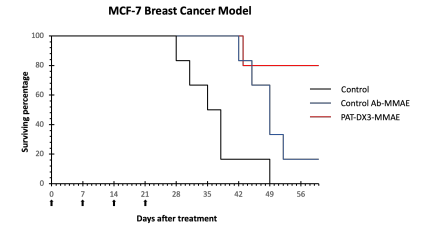
Data from the trial demonstrated an increase in survival rates from control. At the completion of the study (day 60) 80% of the animals treated with PAT-DX3 in conjugation with anticancer drug monomethyl auristatin E (MMAE) survived, compared to none from the control group and just one survivor from the control MMAE group.
Proof of concept
Patrys’ deoxymab platform is based on the deoxymab antibody that was first identified as an autoantibody in a mouse model of the human disease systemic lupus erythematosus (SLE). While most antibodies bind to cell surface markers, deoxymab penetrates the cell nuclei and binds directly to DNA where it inhibits DNA repair processes.
“It is very exciting to report such positive data from our proof-of-concept study showing that Patrys’ deoxymabs may have potential as targeting agents for ADCs,” Patrys CEO and managing director Dr James Campbell said.
“While most ADCs are based on antibodies directed against cell surface antigens that are specific for a particular tumour, our deoxymabs are attracted to the DNA that is released from most cancers as a result of the high rates of cell death and cell turnover in tumours.
“This preclinical study has shown that the affinity our deoxymabs have for DNA is sufficient for them to target the delivery of cancer drugs to tumours where they can inhibit tumour growth and improve survival. This exciting finding may open up new opportunities for deoxymabs as a basis for developing new therapeutic ADC products.
“Additional studies will need to be performed to better understand the potential impacts of on-target and off-target toxicity using this approach; however, the results from this study have clearly demonstrated the proof-of-concept.
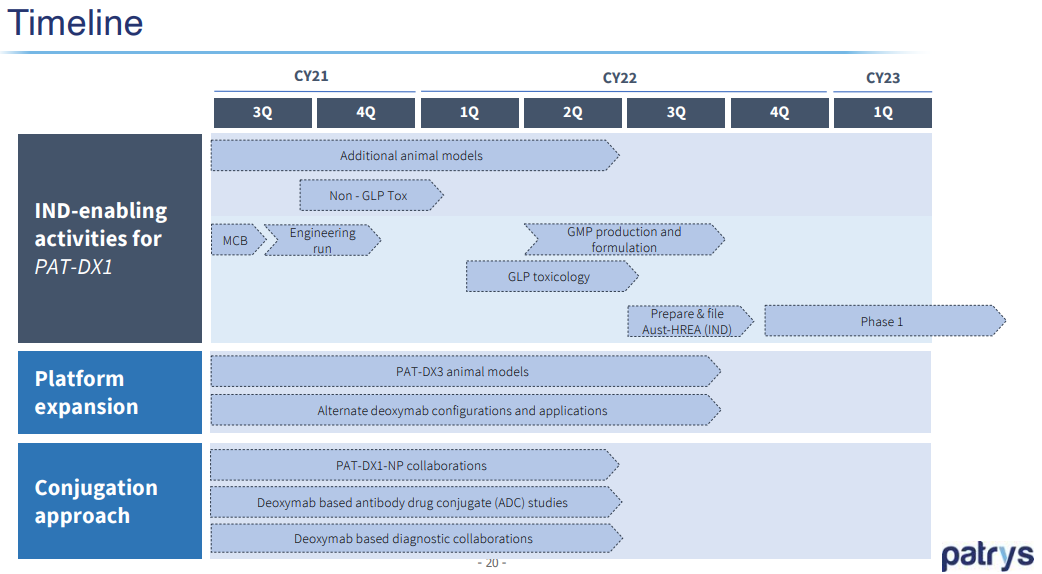
“We look forward to advancing this program as an adjunct to our planned first in human clinical study of PAT-DX1, which remains on track for late 2022.”
Pre-clinical trial details
PAB’s study involved the administration of PAT-DX3-MMAE to mice (six per group) on days 0, 7, 14 and 21 of the study. The control groups consisted of six animals receiving no treatment, and another six treated with a non-specific antibody conjugated to MMAE. The mice were implanted with xenografts of the human breast cancer cell line MCF7.
As stated, the trial resulted in an 80% survival rate 39 days after treatment for the PAT-DX3-MMAE group. In comparison, all the animals in the untreated control group had been euthanised because of tumour growth by day 60, and only one animal in the non-specific, control antibody group remained alive.
Traditional cancer treatments struggle to penetrate solid tumours to deliver payloads internally to cancer cells, inhibiting the efficacy of the treatments. PAT-DX3 can be conjugated (or chemically bonded) to cancer treatments such as MMAE, which ‘hitch a ride’ on its tumour-targeting abilities and are delivered to the heart of the cancer, drastically increasing effect while reducing impact on normal, healthy cells.
According to Patrys, differences in tumour growth inhibition and survival clearly show a targeting effect caused by the PAT-DX3 antibody.
Patrys' pipeline