
Maximus Resources Ltd (ASX:MXR) has heard the starting gun at its Hilditch West nickel target, with diamond drilling now underway.
The exploration program will target the epicentre of a strong, late-time conductor and a coincident magnetic high that sits along strike from the company’s recent nickel-copper-cobalt reverse circulation (RC) drilling.
Maximus is kicking things off with around 7,000 metres of multi-target diamond drilling and a maiden, 500-metre diamond hole at Hilditch, but there’s scope to expand the program if the results are promising.
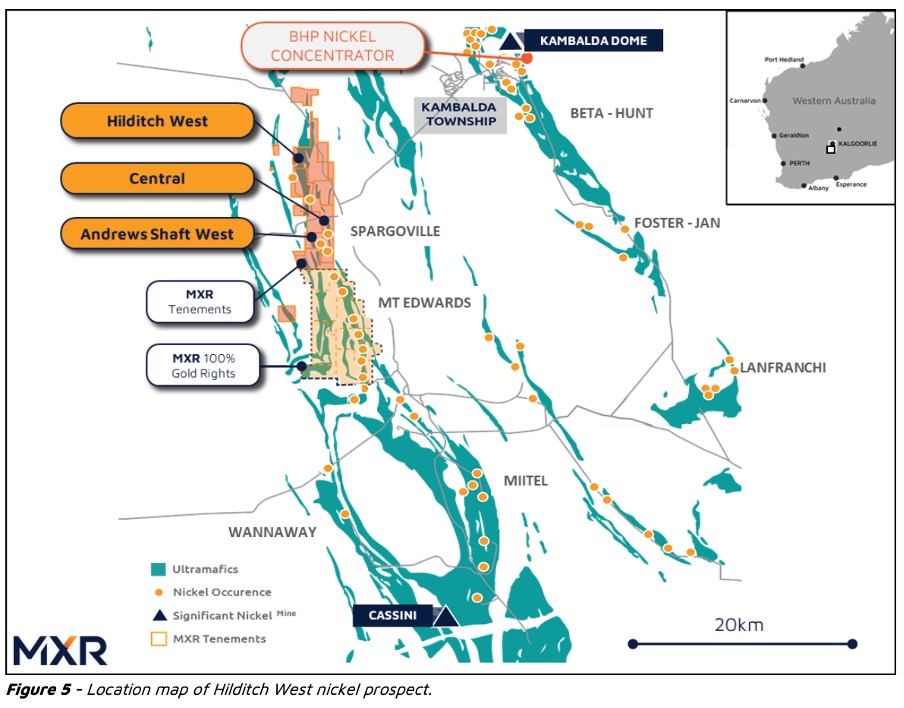
The Western Australian nickel target lies just 25 kilometre’s from BHP’s nickel concentrator in the world-class Kambalda nickel district.
“Very compelling target”
Commenting on the exploration program, Maximus managing director Tim Wither said: “The team is excited to commence our approximate 7,000-metre multi-target diamond drill campaign starting at the exciting Hilditch West nickel target, made possible following our strongly supported $12 million placement.
“Hilditch West is a very compelling target, having the key signatures of a magnetic high anomaly, a strong late-time EM conductor and in an area of proven nickel sulphide mineralisation, provides an ideal setting for a Kambalda-style nickel sulphide discovery.”
Shares have been as much as 6.2% higher to an intraday high of A$0.085.
Unlocking Hilditch West
To kick off the drilling program, Maximus is turning the soil with a 500-metre diamond hole.
This is designed to intersect the coincident peak magnetic response and epicentre of the conductive target plate, which lies roughly 340 metres below the surface.
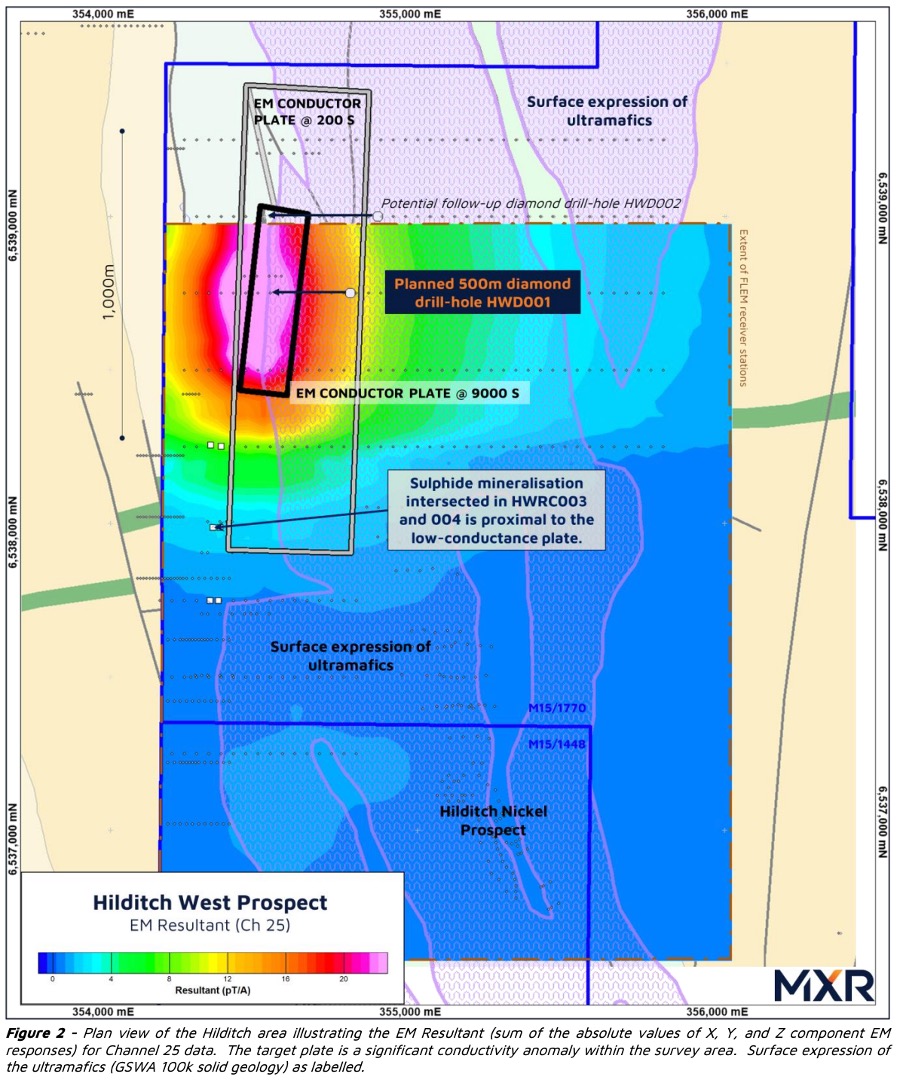
In the past, Maximus’ Hilditch West target has been mapped over roughly 1 kilometre of strike and is thought to run up to 30 metres wide.
The company’s maiden RC campaign in July 2021 intersected shallow, highly anomalous nickel-copper-cobalt and scandium hits across three drill sections, covering 500 metres of strike.
Importantly, a petrographic analysis confirms several nickel sulphide mineral types, which are consistent with sulphides that are typically observed in Kambalda-style nickel deposits.
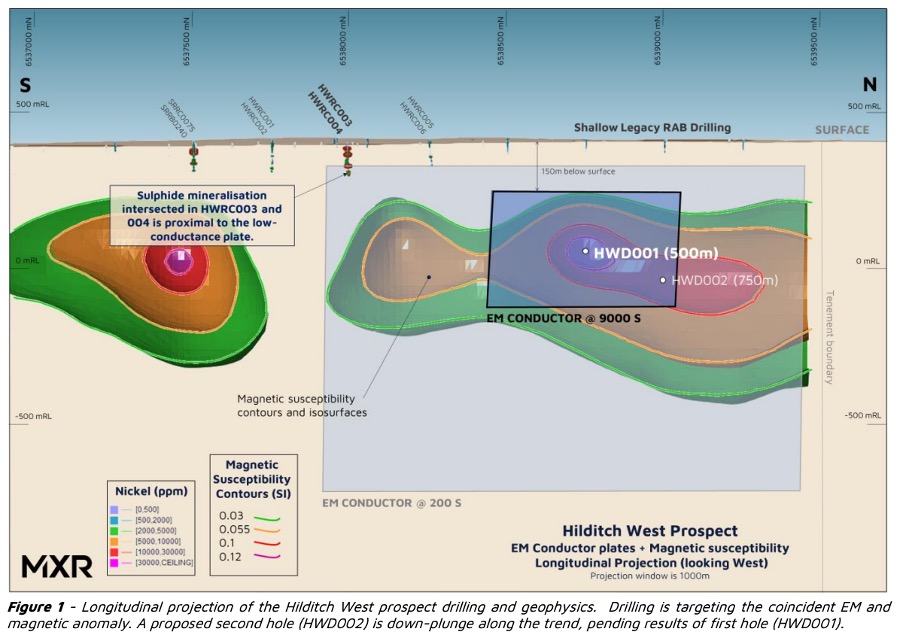
Asides from drilling, a fixed-loop electromagnetic survey has also passed over the nickel target, with modelling indicating a large, low conductance plate continues north from significant nickel-cobalt-copper-scandium intersects at Hilditch West.
The geophysical analysis also identified a discrete magnetic high is present in the 3D modelling.
Next steps
Once it completes the 500-metre diamond drill hole at Hilditch, a downhole electromagnetic survey will take place, designed to provide additional data for future drill testing.
The hole should take roughly a fortnight to complete, and results will be released to the market as they trickle through.
Commencement of drilling at Hilditch West is the start of a ~7,000 metre multi-target diamond drill program which also incorporates two WA Government co-funded EIS deep drill holes at Redback designed to test the down-dip plunge continuation of gold mineralisation.
After the maiden diamond hole, the rig will move to Redback for the two WA Government co-funded holes.
Each hole is designed to test the down-dip plunge continuation of gold mineralisation and has the potential to extend — or even double — the extent of mineralisation at Redback.
Further details surrounding the multi-target drill program will be made known as the campaign progresses through the targets.