
Shree Minerals Ltd (ASX:SHH) has secured approval from the Tasmanian Environmental Protection Agency (EPA) for its Development Proposal and Environmental Management Plan (DPEMP), an important step towards recommencing direct shipping ore (DSO) production at its Nelson Bay River Iron (NBR) Project.
Production was halted at the NBR Project in Tasmania's northwest in January 2014 in response to a sharp fall in iron ore price, with SHH placing it on care and maintenance until the market improved.
“Important milestone.”
SHH began actively working to re-permit and re-open NBR in 2018 with an improvement in ore prices.
The Tasmanian EPA has advised Shree Minerals that its DPEMP has been prepared in accordance with guidelines provided by the Board of Environmental Protection Authority under section 74(3) of the Environmental Management and Pollution Control Act 1994 and is taken to be lodged under section 27F(1A).
“The acceptance of the DPEMP by the EPA is an important milestone in the permitting process of the DSO project. It is the culmination of extensive technical studies by the company and its consultants and we look forward to advancing the NBR project.” Shree Minerals director Sanjay Loyalka said.
The Tasmanian EPA has advised the Circular Head Council to advertise permit application DA 18/059 and call for public representations. It understands that council intends to do so on or about October 23, 2021, for a period of 42 days.
Once public consultation has resolved, the company may be required to provide more information to address environmental concerns that may arise during this period.
Historical production
According to Shree, historical production from mining at NBR totalled 181,000 tonnes shipped with average grades of iron 57.5%, SiO2 7.7%, alumina 1.3%, phosphorous 0.07% and sulphur 0.04%. Iron ore from NBR was historically sold at a premium, in high demand due to its low impurities, specifically low in alumina and phosphorus.
NBR has a JORC-compliant global mineral resource of 11.3 million tonnes, including a goethitic-hematite resource of 1.4 million tonnes and magnetite resource of 7.8 million tonnes.
Historic costs during FY 2014 when the mine was last in production was approximately A$72 per tonne FOB at Burnie Port.
The company’s strategy has been to recommence the production of DSO resources from the existing open pit at NBR. To resolve legal issues with the existing permit, the company applied for a new Tasmanian environmental permit covering the DSO operations.
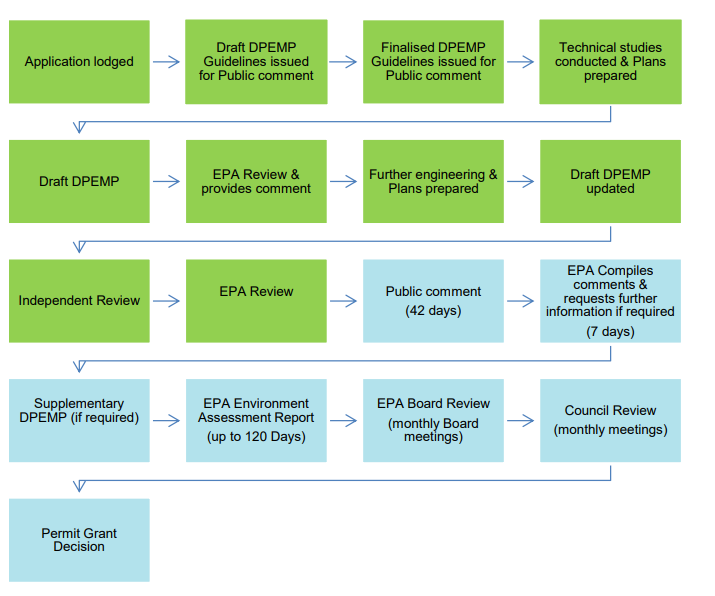
Shree Minerals understands the permitting process will include these steps:
Current progress
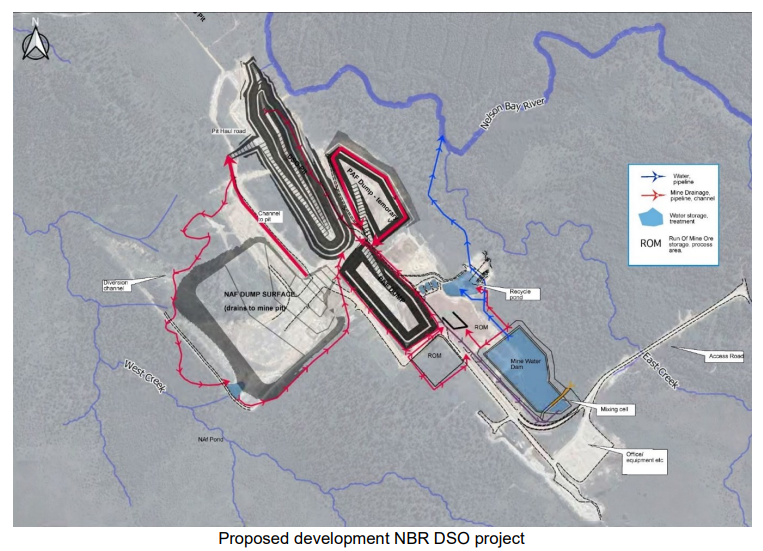
The DSO pit is about 25% complete, with waste rock materials being deposited in two dumps designated as the Non-Acid forming (NAF) waste rock dump and Potentially Acid Forming (PAF) waste rock dump.
The site’s main features currently consist of the DSO pit, waste dumps, mine water treatment dams, ROM (run-of-mine) stockpile area and the facilities area. SHH intends to clear an additional 3.15 hectares for a larger Mine Water Dam and ROM stockpile area in previously burnt-out bush (bush fire damage).
Following DSO pit completion, the company will target the north pit which holds the main magnetite ore body. There is an approximate 20-metre section of higher-grade ore – the beneficial oxide resource (BFO) – above the pit.
Next stages
BFO will require only dry magnetic separation in addition to crushing and screening before shipping. The BFO operation is a transition stage between the DSO operation and the magnetite production stage.
Shree Minerals believes the BFO circuit will require only a nominal capital expenditure of about A$1 million. The BFO section is fed by a -3mm size ore stream, which is upgraded by dry Low Intensity Magnetic Separation (LIMS).
Test work by crushing and passing the ore over a coarse LIMS unit at 600 gauss pass produced an upgraded product with grades iron 57.5%, silicon dioxide 11.5% and alumina 1.55% at 82.3% mass recovery.
For the magnetite project, the company has used surveying to produce a mine plan for an open pit that will extract ore for processing through a local plant.
The plant will include circuits to grind, mill and magnetically separate the product to produce high-grade magnetite concentrate for Blast Furnace Pellets (BFP) and Dense Media Magnetite (DMM).
Magnetite Pellets are considered premium compared to hematite iron ore as they are higher grade and allow for less energy consumption in a blast furnace.
Exploration targets
A study of ground magnetics by Shree and the Tasmanian Government’s airborne magnetic survey data suggests that the strike length of iron mineralisation at NBR extends to more than 2.3 kilometres. Mineralisation remains open along strike and down dip and in some parts extends to greater than 300 metres in depth.
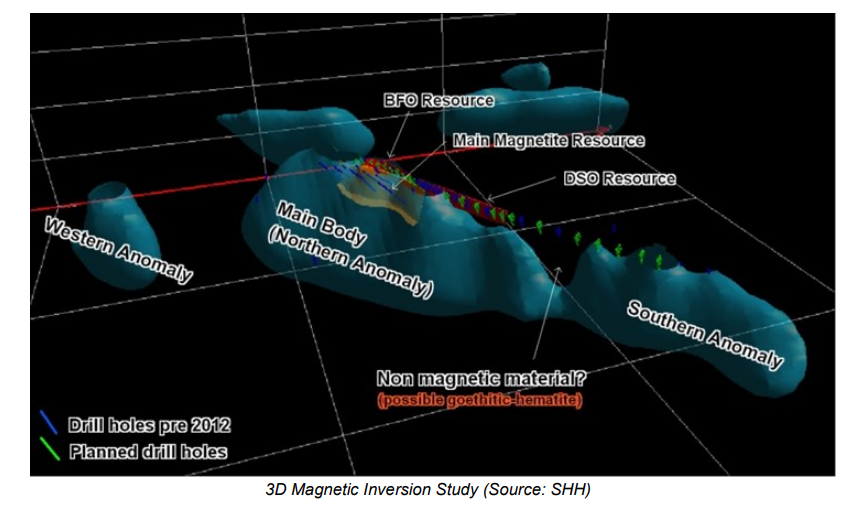
The 3D Magnetic Inversion study based on aeromagnetic data from Mineral Resources Tasmania suggests continuity between the Main Body (Northern Anomaly) and the South Anomaly, but with in-between areas of non-magnetic material that could be inferred to be oxide mineralisation.
Scattered detrital gossan fragments were noticed during recent reconnaissance in the Southern Anomaly area. The modelling indicates substantial continuation at depth of the magnetite-bearing ultramafic dyke.
According to SHH, this provides an exploration upside. In addition to the NBR deposit, four additional targets have been identified from airborne magnetic surveys on the project area and remain to be drill tested.
Shree Minerals is focused on exploring for gold and base metals, with a portfolio spanning the Lachlan Fold Belt, Albany Fraser Belt, West Kookynie, Arunta Region and, of course, the Nelson Bay River Project.