White Rock Minerals Ltd (ASX:WRM, OTCQX:WRMCF) is trading higher on encountering bonanza-grade gold during exploration drilling at its newly acquired Woods Point Gold Project in Victoria.
The new owner, which picked up the keys from merger target AuStar Gold last month, turned the soil on a suite of high-grade hits at the high-priority Kenny’s target — part of the underground Morning Star Gold Mine.
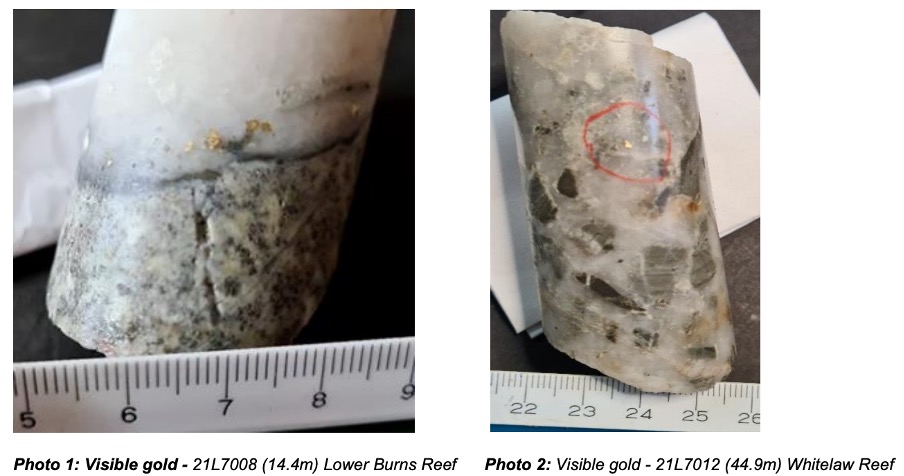
Drill rigs encountered high-grade mineralisation and visible gold throughout the program, with as much as 320 g/t returned from 14.2 metres as the company hit quartz vein reefs.
Shares bounced 12.5% into the green to an intraday high of A$0.315 per share.
Exploration upside
White Rock kicked off exploration drilling at the Kenny’s target in June as it finalised its merger with former ASX-lister AuStar Gold.
In a newsletter on Tuesday, managing director and CEO Matt Gill said White Rock was determined to investigate the Victorian gold play’s potential from the outset.
“In the background, we have been working away on implementing a program to unlock the opportunities we see with this great asset — both the underground exploration potential at the Morning Star gold mine and also the regional exploration potential within the 670-square-kilometre landholding of Victorian goldfields that came with the asset.”
All eyes on Kenny’s
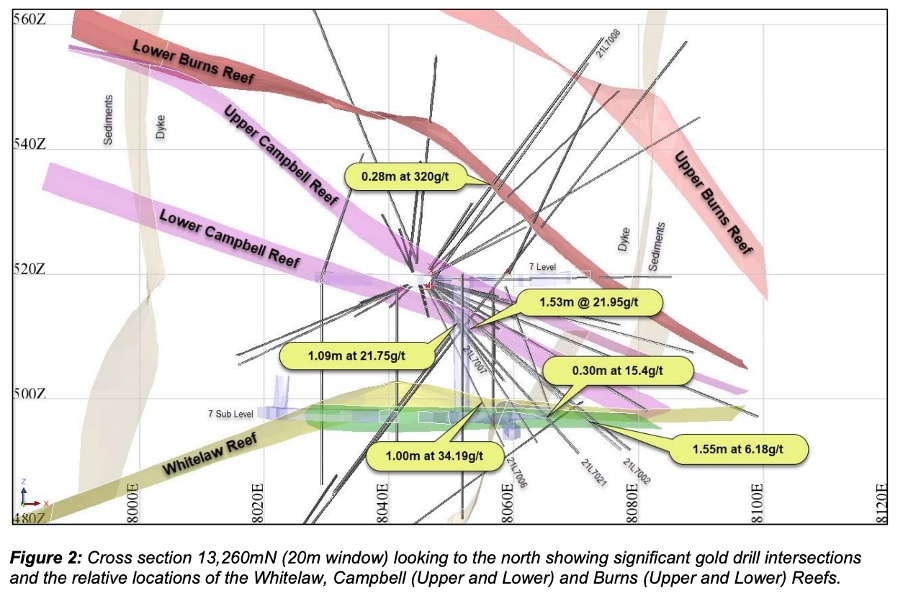
To begin exploration, WRM turned to the Kenny’s target area — the northern extension of the historic Whitelaw, Burns and Campbell quartz vein reefs.
This is where the reefs start to converge towards the northern end of the Morning Star dyke, which extends more than 75 metres in width.
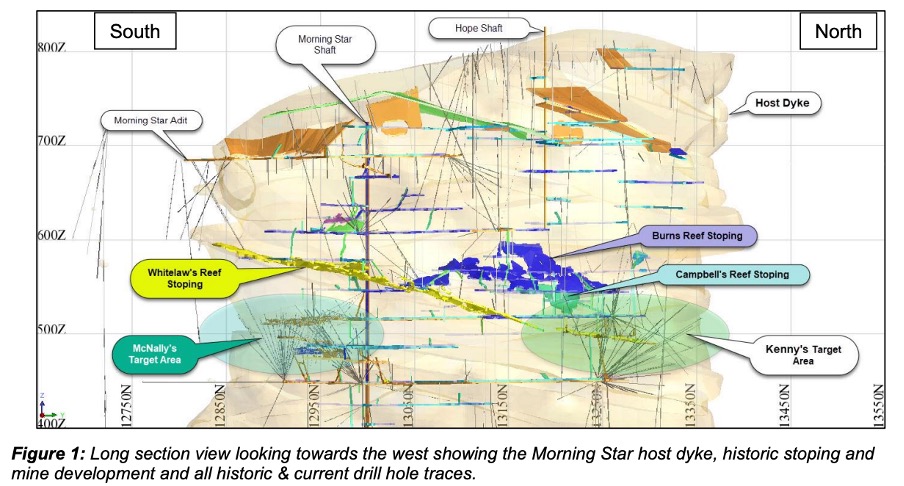
Roughly a century ago, production at the Whitelaw reef churned through 65,421 tonnes of resource at 31.2 g/t, generating 65,600 gold ounces.
Moreover, as historical mining extended north, the Burns and Campbell reef splays were also exploited.
Now, drilling is targeting the down-plunge extensions of each of these reefs beyond the northern limits of historic production.
The company stated: “White Rock’s vision is to ramp-up exploration drilling throughout the mine to define sufficient mineral inventory in multiple reef positions such as the Whitelaw, Burns and Campbell Reefs at the Kenny’s target area, prior to considering recommencement of production in 2022.
“Analysis of data to prioritise additional target areas is underway, with plans for additional diamond core drill rigs (surface and underground) to operate over the next six to nine months at the Morning Star gold mine.”
The program
So far, WRM has drilled 27 short holes, for 1,002 metres over the Kenny’s target area.
There’s abundant visible gold in the core, providing considerable encouragement that the Whitelaw, Burns and Campbell Reef extensions are capable of carrying high-grade gold “pay runs” that will provide a future focus for mine planning.
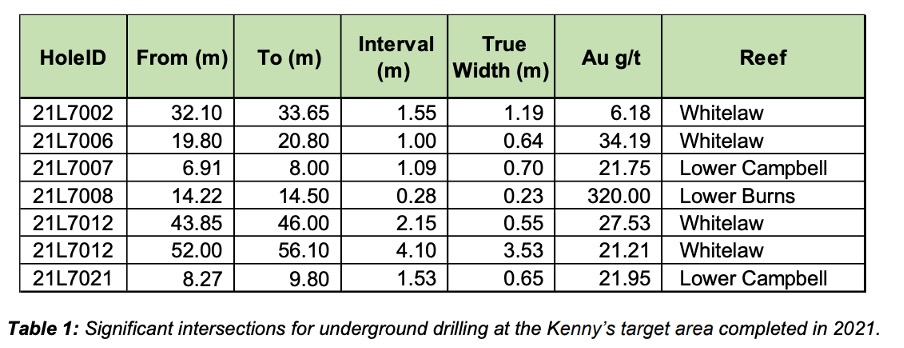
Assay results from the first 23 drill holes are in. Some of the best intersections include:
- 1 metre at 34.2 g/t gold from 19.8 metres, including 0.3 metres at 107 g/t from 20.2 metres;
- 1.1 metres at 21.8 g/t from 6.9 metres;
- 0.3 metres at 320 g/t from 14.2 metres;
- 2.2 metres at 27.5 g/t from 43.8 metres;
- 4.1 metres at 21.2 g/t from 52 metres, including 0.6 metres at 66.4 g/t from 52.6 metres and 0.7 metres at 60.6 g/t from 55.4 metres; and
- 1.5 metres at 21.95 g/t from 8.3 metres, including 0.4 metres at 64.6 g/t from 9.4 metres.
Promisingly, gold mineralisation remains open to the north, south and west.