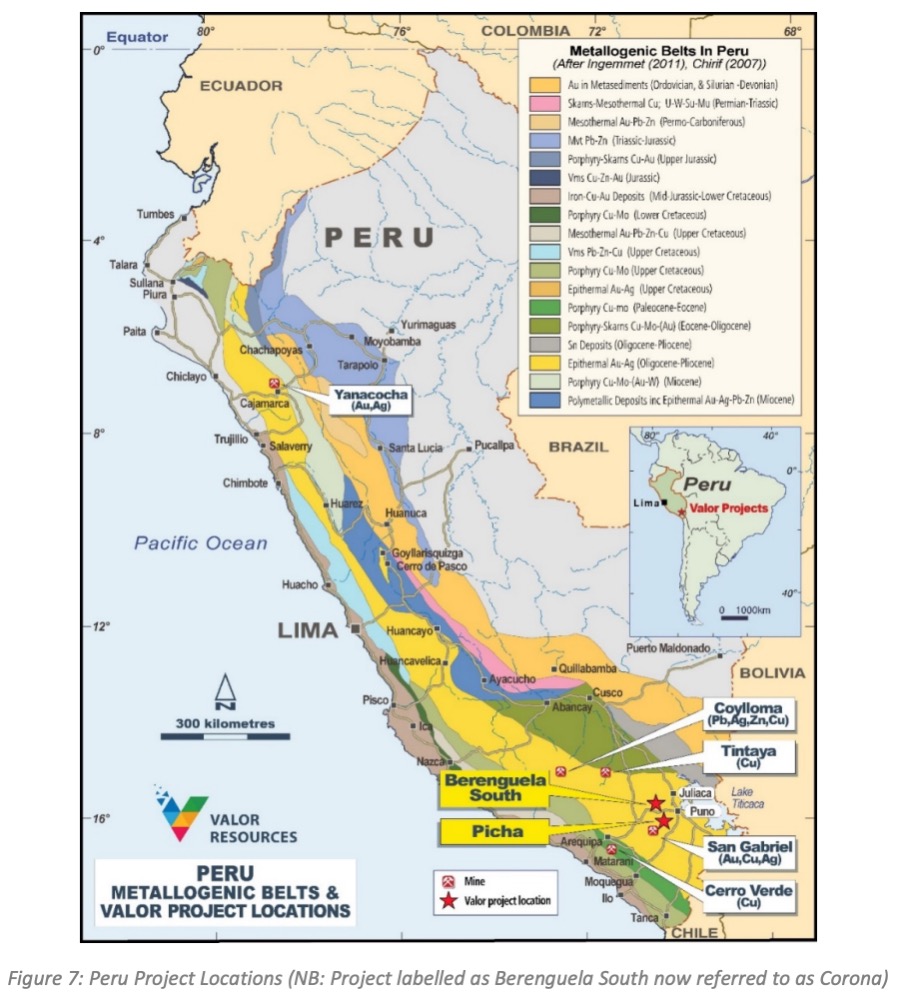
Valor Resources Ltd (ASX:VAL) has started to trace a copper mineralisation trail across two priority targets within its Picha Copper-Silver Project in Peru.
The explorer picked up a suite of channel and rock chip samples across the Cobreman and Maricate targets, with one 35.6-metre channel averaging 1.3% copper and 22.85 g/t silver at Cobremani.
In fact, several of the samples returned more than 1% copper while up to 13.4% copper was unearthed at the Maricate target area.
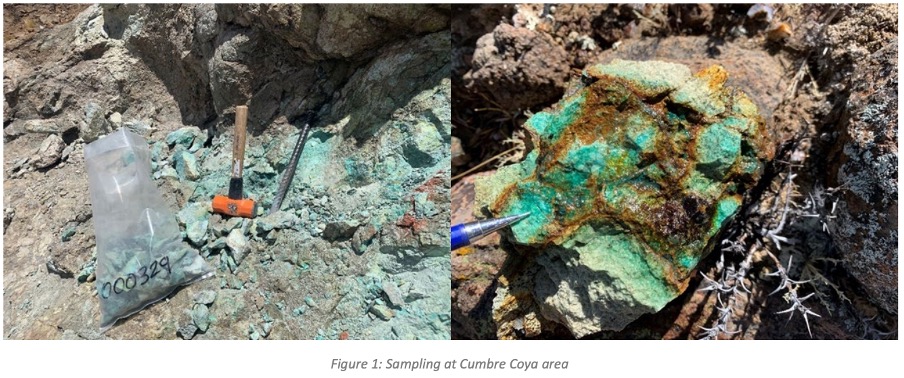
Now, half of the Picha Project has seen geological mapping and sampling activities, with more than 150 assay results anticipated across the Maricate and Combre Coya targets in the next fortnight.
Copper results "outstanding”
Valor Resources executive chairman George Bauk said the ongoing sampling program highlighted Picha’s copper mineralisation potential at the surface.
“The work completed to date by our team in Peru has confirmed widespread copper mineralisation across the property.
“We will follow up these outstanding copper results with ground-based geophysics then leading to drilling.
“Copper is a significant part of the clean energy future and is currently demanding over US$9,200 per tonne with significant commentary of a supply shortage.
“Peru has several world-class copper and silver deposits and is the second-largest producer of copper and silver in the world.”
Valor shares are 14.29% higher to A$0.016.
Exploring the Picha property
In August this year, Valor embarked on a geological mapping and geochemical soil sampling program across its entire Picha property.
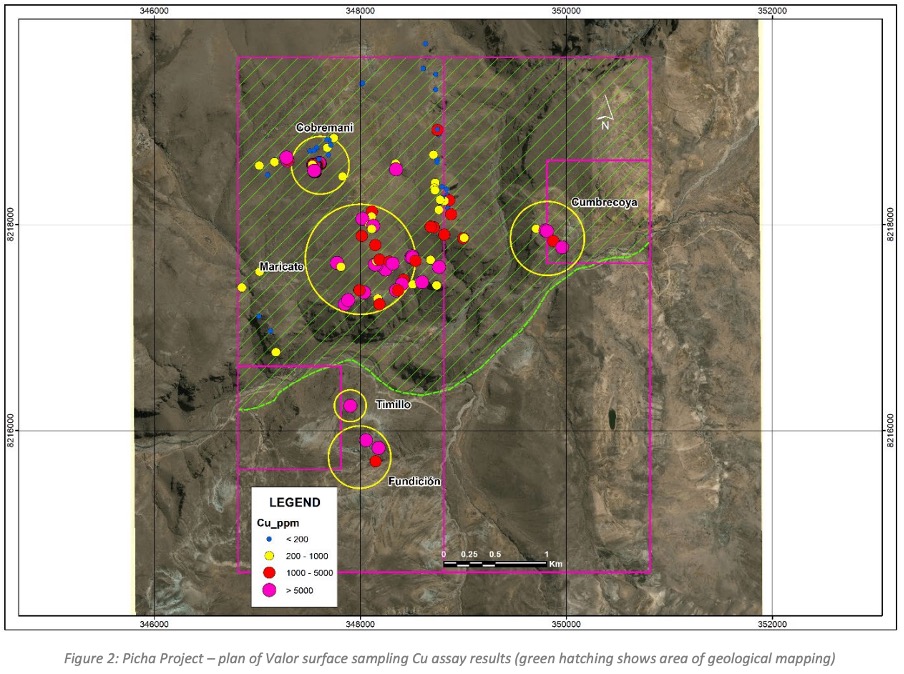
Since work kicked off, the ASX-lister has received results for 144 samples, with another 152 submitted for assay.
Out of the samples returned to date, 34 returned assays greater than 0.5% copper, while as much as 13.8% lead and 1.07% zinc was also identified.
Most of the samples to date come from the Cumbre Coya and Maricate target areas, where up to 13.39% and 3.8% copper were returned, respectively.
Cobremani target area
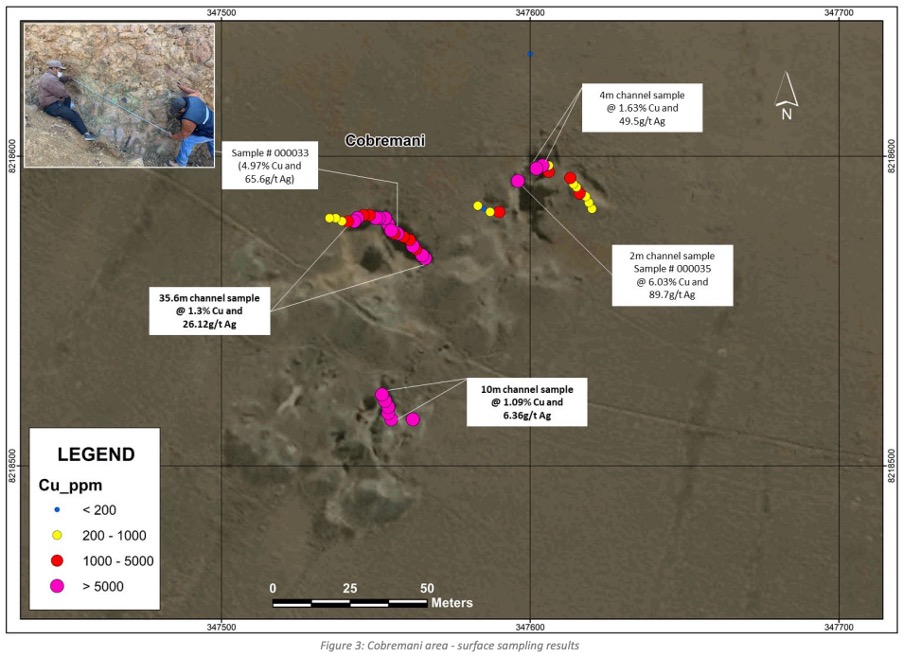
All up, 58 channel samples and selective rock chip samples were taken from the Cobremani area, with many of them taken from historical workings.
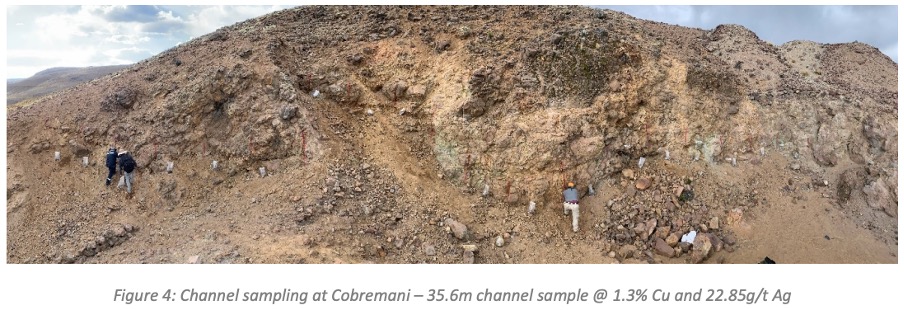
The assay results from Cobremani are highlighted by a 35.6-metre-long continuous channel sample, averaging 1.3% copper and 22.85 g/t silver.
This channel includes a 2-metre channel sample taken during the May sampling program, which returned 4.97% copper and 65.6 g/t silver.
A second, 10-metre channel sample was taken roughly 50 metres south of the existing channel, averaging 1.09% copper and 6.36 g/t silver.
Another channel sample, measuring 4 metres in length and around 45 metres to the northeast, returned 1.63% copper and 49.5 g/t silver.
In addition to the anomalous copper assays, there are also several samples in the Cobremani area with anomalous lead, molybdenum and zinc, with assays of up to 1.18% lead, 442 parts per million (ppm) molybdenum and 0.37% zinc.
Many of these samples occur in an area 150 to 200 metres north of the Cobremani workings.
Maricate target area
Meanwhile, 1 kilometre south of Cobremani at the Maricarte target, Valor picked up 37 channel and rock chip samples.
Fourteen of those returned more than 0.5% copper, while up to 13.39% copper came from a selective rock chip sample, which also assayed 99 g/t silver.
Numerous samples returned anomalous silver, lead and molybdenum, with assays up to 164 g/t silver, 0.64% lead and 160 ppm molybdenum.
Overall, mineralisation at Maricate is widespread over roughly 1 kilometre in an east-northeast direction and a northwest orientation.
Other target areas
Outside Cobremani and Maricarte, 49 samples have returned results.
Many of these samples were taken along a north to north-northwest trending ridge about 1 kilometre east of the two priority targets.
Although no assays greater than 0.5% copper were returned from this area, assays of up to 72.8 g/t silver, 696 ppm molybdenum, 13.8% lead and 0.69% zinc came back.
There are multi-element anomalies within this area, which are oriented in a north to north-northwest direction.
However, further work is required in this area to understand the significance of these geochemical anomalies and mineralisation.
What’s to come?
In the coming months, Valor hopes to:
- Complete detailed geological mapping over the entire Picha project area;
- Complete geochemical sampling across all targets to define the full extent of the mineralisation;
- Model the results including, lithology, alteration, structure, and mineral associations to aid in further target identification;
- Reprocess and re-interpret historical ground geophysics;
- Implement new detailed ground geophysical survey as required in specific target areas; and
- Select drill targets based on the above program and commence the drilling approvals process.