
Tempus Resources Ltd (ASX:TMR, TSX-V:TMRR)’s screened metallic analysis has revealed a 31% average increase in gold assay grades at its flagship Elizabeth Gold Project in British Columbia, Canada, when compared to the originally published assay results based on standard fire assay analysis.
The re-assaying was considered particularly vital to test the accuracy of the bonanza grade assays received and include 68.3 g/t over 1.5 metres from 123 metres against a previously reported intersection of 52.1 g/t in the same interval.
Importantly, the grade increase will have a positive impact on the overall grade and scale of the project when calculating an updated mineral resource estimate for Elizabeth in the Bralorne-Pioneer Gold District of southern BC.
"Take high-grade story even further”
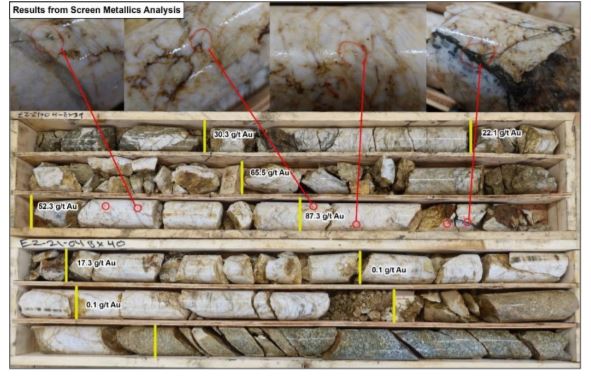
EZ-21-04 drill core showing gold grades from screened metallic analysis.
Tempus president and CEO Jason Bahnsen said: “The screened metallic analysis results take the ‘high-grade’ nature of the Elizabeth story even further.
“We have several more screened metallic analysis results pending.
“Drilling also continues on-site and we are now focusing on defining the potential new vein parallel to the South West Vein, identified with visible gold in drill-hole EZ-21-12 that was announced on September 27.”
Nugget effect
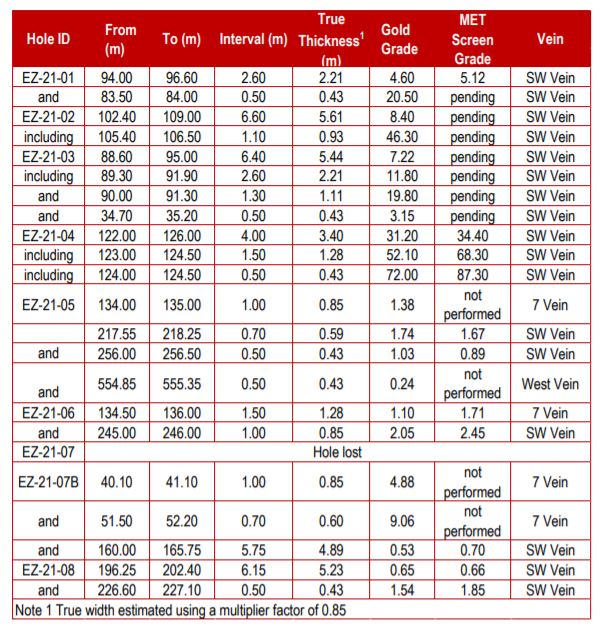
Comparison of gold grades between screened metallic and original standard fire assay results.
Screened metallic analysis was completed in consultation with the lab SGS Canada Inc due to the observation that Elizabeth gold mineralisation includes coarse-grained gold and assays completed using the standard fire assay method may have been underrepresenting grade, or otherwise less accurate than screened metallic analysis due to the ‘nugget effect’.
Values received from the screened metallic analysis will supersede the original assay results and based on information gained to date and Tempus technical staff will continue to use metallic analysis on quartz vein zones where higher gold grades are expected.
To date, Tempus has completed about 8,600 metres of drilling across 34 diamond drill holes with 11 drill hole assays pending at Elizabeth.