
Global Energy Ventures Ltd (ASX:GEV) has secured approval in principal (AIP) from the American Bureau of Shipping (ABS) for its pilot-scale compressed hydrogen transporter, sparking a strong investor response with shares up as much as 28.8% intraday to A$0.094.
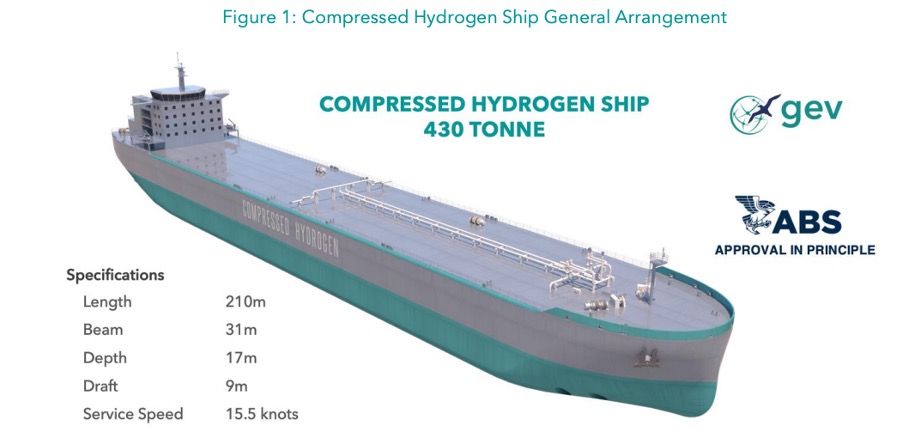
Approval for the proposed vessel, which is designed to carry 430 tonnes of hydrogen across the sea, comes after the ASX-lister received the ABS greenlight for a 2,000-tonne, full-scale model in March.
It’s hoped the pilot ship will help GEV capitalise on near-term commercialisation opportunities in the green hydrogen market as it works to develop an operating fleet of compressed hydrogen carriers by the mid-2020s.
GEV hopes to use the 430-tonne ship to facilitate supply and demand for green hydrogen between 2025 and 2030 — making this a world-first for scale hydrogen transportation by sea.
The new ship is forecast to enter construction in 2023 and first operate during the mid-2020s.
Ships to meet highest safety standards
Global Energy Ventures managing director and CEO Martin Carolan said: “GEV is pleased to report that we have received AIP from ABS for our pilot-scale 430-tonne hydrogen ship, which follows AIP received earlier this year for our innovative compressed hydrogen ship with a 2,000-tonne capacity.
“ABS is a leading classification society for gas carriers and GEV is looking forward to working with them to ensure that our compressed hydrogen ships continue to meet the highest safety standards.
“Marine storage and transport solutions are required for hydrogen to contribute to global decarbonization ambitions.
“Efficient, safe and cost-competitive marine transport solutions for high purity hydrogen are required before 2030 to enable the development of greenfield hydrogen supply chains at scale.
“GEV views the compressed hydrogen ship as a competitive carrier and the ideal scale to advance the commercialisation of several hydrogen greenfield export projects proposed or under development.”
New kind of hydrogen gas carrier
GEV’s pilot vessel will be a Handymax-sized gas carrier, meaning it’s relatively small and able to enter most ports.
The ship is equipped with an electric drive propulsion system and can also be equipped with a dynamic positioning (DP) system, which will support safe and efficient offshore loading.
GEV is also working with Ballard Power Systems to power the ships with marine fuel cells using 100% hydrogen, providing a zero-carbon shipping solution.
AIP de-risks commercialisation path
With approval in principle for the pilot ship in tow, GEV is a step closer to commercialising its green hydrogen transport vision.
Commenting on the proposed vessel, the AIP stated: “ABS has reviewed GEV’s design … and considers that the proposed conceptual design for the 430-tonne compressed hydrogen carrier is feasible.”
Ultimately, the next step — securing class approval for construction — represents GEV’s primary technical hurdle.
However, the AIP acts as the pre-cursor for ABS construction approval, meaning securing the key greenlight and accompanying road map to the construction approval has materially de-risked the path forward to a construction-ready milestone.
Transporting the new age of energy
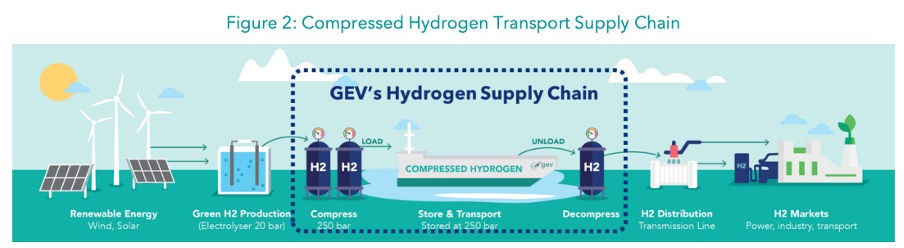
Global Energy is in talks with several hydrogen development projects, reinforcing its position that compression is one of the simplest and most energy-efficient ways to transport hydrogen by sea.
In March this year, the ASX-lister released its scoping study, establishing a platform for commercial and technical discussions with prospective clients.
The company stated: “We remain encouraged by the quality of organisations now making direct enquiries about compression as an alternative to other carriers being assessed for front-end engineering and design (FEED) selection."
HyEnergy Project
Recently, GEV announced it would collaborate with the HyEnergy project on Western Australia’s Gascoyne coastline.
The ASX-lister recently signed an MoU to evaluate HyEnergy’s technical feasibility, as well as how much it would cost to export green hydrogen to the Asia-Pacific using its compressed hydrogen marine supply chain.
The feasibility study, slated for completion mid-next year, will use the pilot ship as a base case to transport green hydrogen to the Asia Pacific markets.