
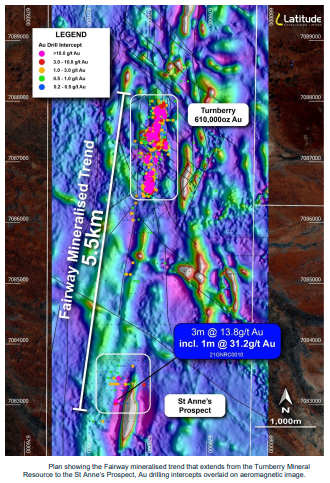
Latitude Consolidated Ltd (ASX:LCD)’s final assay results from Phase 1 drilling at St Anne’s within its Murchison Gold Project in Western Australia have returned up to 31.2 g/t gold.
Describing the “extremely high grades” returned at St Anne’s, the company is looking forward to expanding these results when drilling starts there later this quarter.
The final assay results relate to drilling completed at Judy North, Suzie North and results from 1-metre samples of previously reported 4-metre composite grades at St Anne’s.
Latitude Consolidated CEO Tim Davidson said: “With these results in hand we look forward to rapidly progressing our Phase 2 drill program and updating our shareholders as we begin to receive assay results over the coming months."
Important exploration target
“We are excited by the extremely high grades returned from St Anne’s, which is an important exploration target for us," he said.
“Importantly, St Anne’s is our second drill location during our recently commenced Phase 2 drill program and we look forward to expanding on these results when drilling commences there in the December quarter."
Recognising the strength of the results, investors have pushed the share price up 16.67% at the opening to 4.9 cents.
The St Anne’s mineralisation consists of quartz veining and pyrite alteration, as seen at Turnberry, and occurs on a geological contact between mafic dolerite and sedimentary shales.
Both rock type’s host mineralisation at Turnberry with the dolerite generally hosting better continuity of mineralisation and higher grades.
The final 1-metre sample results demonstrate the very high-grade nature of the mineralisation, which remains open along strike and both up and down dip at St Anne’s.
Extensions of this mineralisation will be targeted in the second quarter with the company’s recently commenced Phase 2 drill program.
The final 1-metre sample results from Phase 1 drilling at St Anne’s include:
- 3.0 metres at 13.82 g/t from 103 metres including 1-metre at 31.20 g/t;
- 1-metre at 3.68 g/t from 174 metres; and
- 11.0 metres at 0.74 g/t from 104 metres including 4.0 metres at 1.30 g/t.
Judy North results
“We are also pleased with the initial results from Judy North where we confirmed the northern extension of the high-grade mineralisation, which currently contains 141,000 ounces of gold in mineral resource,” Davidson added.
The consistency of width in all five holes from Phase 1 demonstrates the continuity of the mineralised structure and provides a strong target for Phase 2 drilling.
Judy North remains open to the north and the company intends to further test this high-grade mineralisation during the Phase 2 drilling program.
Phase 1 Judy North high-grade drill intercept:
- 5.0 metres at 2.96 g/t from 154 metres including 2.0 metres at 5.95 g/t
Phase 1 Judy North drill intercepts outside of the high-grade shoot:
- 5.0 metres at 0.42 g/t from 165 metres;
- 5.0 metres at 0.26 g/t from 155 metres;
- 6.0 metres at 0.25 g/t from 209 metres; and
- 4.0 metres at 0.14 g/t from 192 metres
Andy Well
Davidson commented further: “The Andy Well results also demonstrate the very high grade, but extremely nuggety nature of the mineralisation with screen fire assay results uplifting the grade of one intercept by 50% and the 1-metre sample for another intercept in the same hole returning a grade of 6.69 g/t, significantly higher than would be expected based on the 4-metre composite grade originally returned from the laboratory.
“With this in mind, future drilling of the very high-grade mineralisation at Andy Well will primarily be performed with diamond drilling to allow the geology team to better interpret and sample the mineralisation.”
Assay result from the 1-metre sample:
- 1.0 metre at 6.69 g/t from 84 metres (original results 4.0 metres at 0.66 g/t from 84 metres).
Screen fire assay results:
- 7.0 metres at 2.60 g/t from 121 metres including 1-metre at 14.45 g/t (original result 7.0 metres at 1.90 g/t from 121 metres including 1-metre at 9.59 g/t)