
Oar Resources Ltd (ASX:OAR) has supported initial observations of the strong prospectivity of Crown Nickel-Copper-PGE Project near Perth in Western Australia with petrology confirming the presence of ultramafic rocks containing copper sulphides.
Very fine disseminated sulphides including pyrite and chalcopyrite (copper sulphide) have been identified in samples from first phase mapping and outcrop rock chip sampling at Crown in the Julimar district exploration hotspot.
These samples are interpreted to be magmatic in origin and this is highly encouraging for the company because the geology is considered as a vital setting for the discovery of nickel-copper-PGM (platinum group metals) mineralisation.
Target ultramafic lithologies
OAR’s general manager geology Tony Greenaway said: “It is very pleasing to see that our initial field observations are backed up by the petrological work, confirming the presence of our target ultramafic lithologies in the area.
"It was also encouraging to see the petrology picking out the copper sulphide chalcopyrite in a few of the samples. While these are logged as trace amounts, we can now confirm that there is copper in the system.”
Detailed petrological analysis has been carried out on samples collected in the initial mapping and sampling program across the central and northern portion of the project.
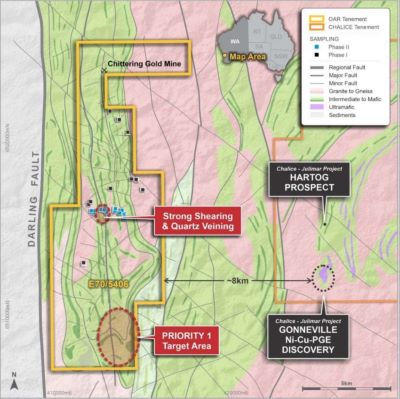
Crown Project is around 70 kilometres NE of Perth, WA.
Assays pending
A total of 74 rock-chip samples have been submitted for laboratory analysis for multi-element analysis, and field observations of collected samples continue to be positive with assay results pending.
This work confirmed that a suite of medium-grade metamorphic, amphibolite facies rocks including amphibolite, hornblende gneiss, quartzite and highly sheared biotite schist lithologies, are present throughout the project area.
Exploration approach validated
As well as being highly encouraging to OAR, it is similar to the lithology found at other projects in the Julimar area around an hour northeast of Perth and validate Oar’s exploration approach at Crown.
Results confirm initial field observations and the prospectivity of the project, which is just 8 kilometres west of Chalice Mining Ltd (ASX:CHN, OTCQB:CGMLF)’s world-class Gonneville discovery that is hosted in a layered mafic-ultramafic complex comprising serpentinites, pyroxenites and gabbro-norites lithologies.
The Crown Project contains numerous magnetic features interpreted to represent mafic volcanic rocks considered highly prospective for similar nickel-copper-PGE and gold mineralisation.
Oar believes the initial findings from the fieldwork are strong positive indicators of the project’s prospectivity.
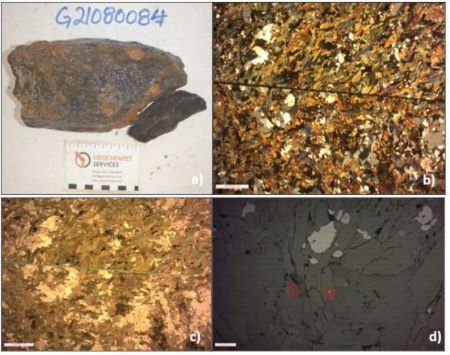
a) Supplied rock sample collected during Phase I sampling of the Crown Project ; b) Low magnification, transmitted cross polarised light image of part of amphibolite showing common hornblende, feldspar which is partly sericitized and quartz and opaques; c) Micrograph of same view taken at low magnification in plane transmitted light; d) Low magnification, transmitted plane light image of amphibolite fragment showing bright white magnetite grains with minor light grey ilmenite inclusions and a few yellowish specks of sulphide pyrite/chalcopyrite (circled in red) overprinting the matrix.
Second phase exploration
Buoyed by the initial work, the company has executed two additional land access agreements over priority-1 target areas in the southern portion of the Crown Project area.
This has allowed Oar’s geological team to begin the next phase of on-ground fieldwork at the priority targets in this area.
“The field team is now moving to the south of the project where we have access to a Priority 1 Target area to undertake our Stage 2 exploration, including soil sampling, additional mapping and outcrop sampling,” Greenaway said.
Initial interpretation by independent consultants Southern Geoscience highlights this area as a high priority target, with the geophysical signatures indicating a highly complex geological setting including potential folding, strong alteration and high intensity of structural features.
The Stage 2 fieldwork will cover a large area and is expected to be completed this month.
Systematic exploration
Oar is undertaking a technically driven, staged and systematic exploration approach at Crown in order to better understand the geological setting of the previously unexplored area.
This systematic approach includes three stages of ‘boots-on-ground’ work, including:
- Stage 1: Detailed geological mapping and outcrop mapping, aimed at identifying basement geology which has historically been poorly understood and mis-mapped;
- Stage 2: Systematic soil/surface geochemical sampling, aimed at defining drilling targets (this stage may include ground or airborne geophysical surveys); and
- Stage 3: Drill testing of identified anomalies.
The company is pleased with the progress being made on the ground at Crown and is working systematically toward identifying potential drill targets.