
Tamboran Resources Ltd (ASX:TBN) has recapped its work towards the global energy transition in a financial year characterised by capital raises, acquisitions and operational momentum.
Non-executive chair Dick Stoneburner and managing director and CEO Joel Riddle spoke to TBN’s full-year results on Monday, detailing the company’s progress across its exploration permits, the Sweetpea Petroleum Pty Ltd acquisition and its inaugural sustainability plan.
Tamboran is new to the ASX register: the energy stock made its debut in July 2021 following a $61 million initial public offering (IPO) — the largest IPO for an oil and gas explorer and producer in nearly a decade.
The ASX-lister ended the financial year with slightly more than $63 million on hand to progress its development strategy in the Northern Territory’s Beetalo Sub-Basin, a world-class shale gas resource.
Ultimately, Tamboran dreams of developing and commercialising natural gas resources with low levels of carbon dioxide (CO2) within its core Beetaloo holding.
It’s working to generate the energy sources of the future with a focus on zero-carbon gas production.
Developing affordable gas resources
Tamboran chair Dick Stoneburner kicked off the annual report with a letter to shareholders.
“I am proud to present you with the 2021 annual report, our first since the listing of the company on the Australian Securities Exchange,” he said.
“The Beetaloo Basin has been earmarked by the Federal and Northern Territory governments as being highly strategic for the future direction of Australian gas supply, with significant potential to convert multi-trillion-cubic-foot (TCF) resources into large 2P reserves.
“In line with this, Tamboran intends to accelerate the appraisal and commercialisation of its licences in the Beetaloo Sub-basin, to provide affordable gas to local Northern Territory markets and the east coast of Australia.”
Managing director and CEO Joel Riddle echoed Stoneburner’s sentiments and said: “The 2021 financial year was a milestone year for Tamboran as we advanced our strategy to de-risk and commercialise significant, low CO2 gas resources within the highly prospective core area of the Beetaloo Sub-basin, in the Northern Territory.”
What’s to come?
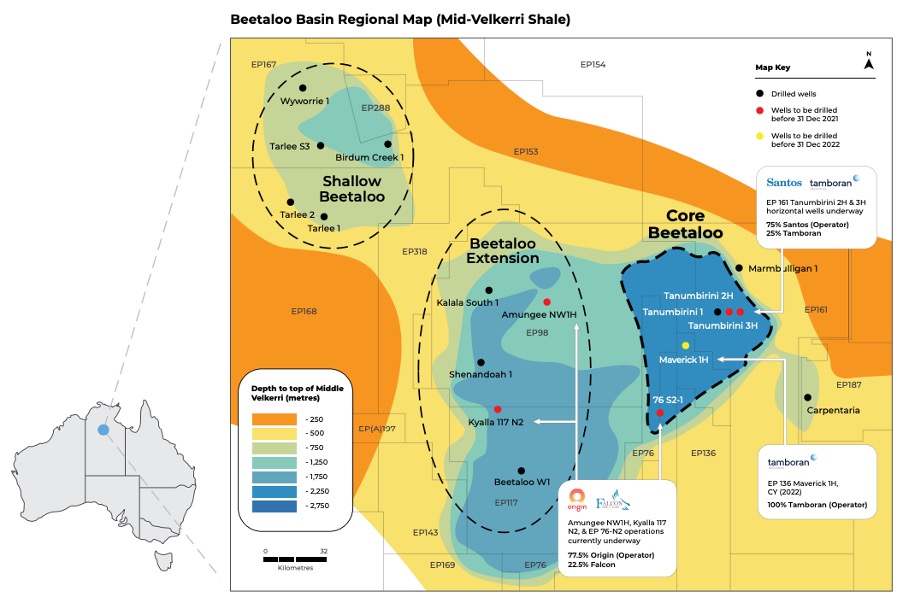
As it works to make its dream a reality, Tamboran is developing its core holding within the Beetaloo Sub-Basin, which forms part of the Greater McArthur Basin in the NT.
Here, the natural gas company’s key assets include a 25% interest in the EP 161 asset, which it’s developing with Santos QNT Pty Ltd, and a 100% stake in EP 136, Ep 143 and EP(A) 197.
In early 2021, Tamboran completed a vertical gas well fracture stimulation and flow test on the EP 161 asset’s T1 well, while drilling on the second and third wells has already commenced.
Stoneburner said: “Substantial activity is planned for the year ahead, including the fracture stimulation of the T2H and T3H wells in EP 161, aimed at confirming commercial flow rates, and the commencement of the seismic and drilling program on EP 136.
“Further work is also expected to take place on securing the pathway to commerciality for our Beetaloo Sub-basin gas.”
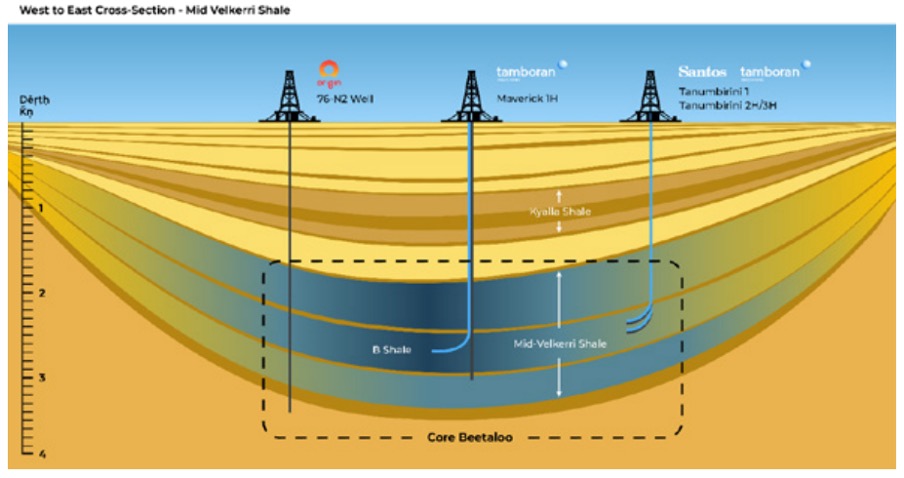
Riddle commented: “The learnings from the vertical fracture stimulation in early 2021 at T1 with our operating partner Santos were incorporated into the planning and design for the two horizontal well program, which is currently underway with the drilling of T2H and T3H.
“Santos successfully completed T2H on August 17, 2021, having achieved a total measured depth of 4,598 metres and included the drilling of approximately 1,000-metre horizontal section in the primary target MidVelkerri ‘B’ shale.
“T3H was spudded on August 23, 2021, and is currently being drilled to a similar depth and horizontal design.
“Following the completion of T3H well in October, both horizontal wells are expected to be fracture stimulated. We anticipate initial flow test results will be known before the end of calendar 2021, with testing aiming to confirm the potential for commercial flow rates.
“This is an exciting time for the company, as the results from the T2H and T3H wells will be the first time that the commerciality potential of the core area of the Beetaloo Sub-basin has been tested.
“Importantly, these results will ultimately set the trajectory for future development within EP 136, our 100% operated permit.”
The (financial) year that was
Perhaps the biggest financial achievement over FY21 was TBN’s capital raising activities.
The natural gas company raised $23 million prior to its IPO, as well as $61 million to support its float on the ASX.
It means the energy stock raised $84 million in FY21 to progress its Beetaloo exploration and appraisal program.
Not even an acquisition could dampen Tamboran’s cash balance.
The company acquired Sweetpea Petroleum through an all-share transaction that catapulted it to operator status and delivered its 100% interest in three of Beetaloo’s gas assets.
Nevertheless, as it works to commercialise its Beetaloo wells, TBN’s financials remain in the red.
The company posted a $23.8 million loss for FY21 — almost double FY20’s $14.5 million result.
However, its total equity moved from a $39.6 million negative to $104.4 million in the black, while liabilities reduced from $64.7 million to $8.2 million.
Payments to suppliers and employees remained roughly in line with the FY20 statistics.
Focus on sustainability
As it works to develop tomorrow’s energy sources, Tamboran continues to emphasise its sustainability measures.
During the reporting period, TBN purchased Voluntary Emission Reductions (VERs), a carbon offset that are used to offset emissions and are eligible under the Australian Government’s carbon-neutral certification, Climate Active.
And as part of its inaugural sustainability report, Tamboran established six pillars of development that align with the United Nation’s Sustainable Development Goals.
Looking ahead, the natural gas company also intends to commission a review into its carbon footprint to help manage its emissions.
Stoneburner commented: “A key differentiating feature of natural gas from the Beetaloo Sub-basin compared to other gas-producing basins in Australia is the relatively low CO2 content.
“Production tests of wells that have been drilled within and on-trend with the Tamboran assets in the Beetaloo Sub-basin indicate that the gas in the basin generally has a lower CO2 content than the industry average for gas fields currently in production or under development in the north-west of Australia.
“Tamboran is committed to minimising the carbon emissions related to the development of this resource further, by using advanced drilling and completion technologies and exploring options to integrate renewable energy, carbon capture and sequestration and carbon offsets.
“Tamboran’s vision is to become a producer of gas with net-zero emissions for our equity share of Scope 1 and Scope 2 emissions.”