
Meteoric Resources NL (ASX:MEI) brought its total gold bounty to more than 740,000 ounces at projects in Brazil and Western Australia with work programs during the 2021 financial year.
The exploration-based orogenic gold company acquired the Palm Springs Gold Project in mid-June, having made the decision to diversify its portfolio of assets to include an Australian project. The other core holding is the Juruena Project in Brazil.
Maiden resource estimates for Palm Springs in Western Australia have been fruitful; totalling 5.6 million tonnes at 2 g/t for approximately 357,000 ounces of gold.
The Butchers Creek tenement constitutes the bulk of the resource and drilling programs there will underpin mining and metallurgical studies crucial for the development of the project.
Any further evaluation of the deposit will require understanding mining and treatment methods necessary for the Butchers Creek orebody.
50% lift in Juruena resource
Meteoric also made strong FY21 progress at the Juruena Project in Brazil, where the mineral resource estimate was lifted 50% to 1.9 million tonnes at 6.3 g/t for 387,000 ounces of contained metal. A quality porphyry copper target was also identified.
The company is seriously assessing development scenarios for initial open pit mining followed by deeper underground mining.
Juruena's resource comprises three separate but adjacent gold deposits.
High-grade epithermal gold deposits at Dona Maria and Querosene:
- Indicated 286,000 tonnes at 17 g/t for 156,000 ounces; and
- Inferred 692,000 tonnes at 7.6 g/t for 170,000 ounces.
The Crentes Gold-Copper deposit hosted in the Juruena Fault:
- Inferred 943,000 tonnes at 2.0 g/t for 60,900 ounces.
COVID a factor in WA acquisition
Meteoric made the decision to diversify into Australian assets in part due to the challenges presented by COVID-19.
The company considered diversifying its geographical risk worth the investment, adjusting its development strategy to include the Palm Springs Gold Project in Western Australia as well as the Juruena Project in Brazil.
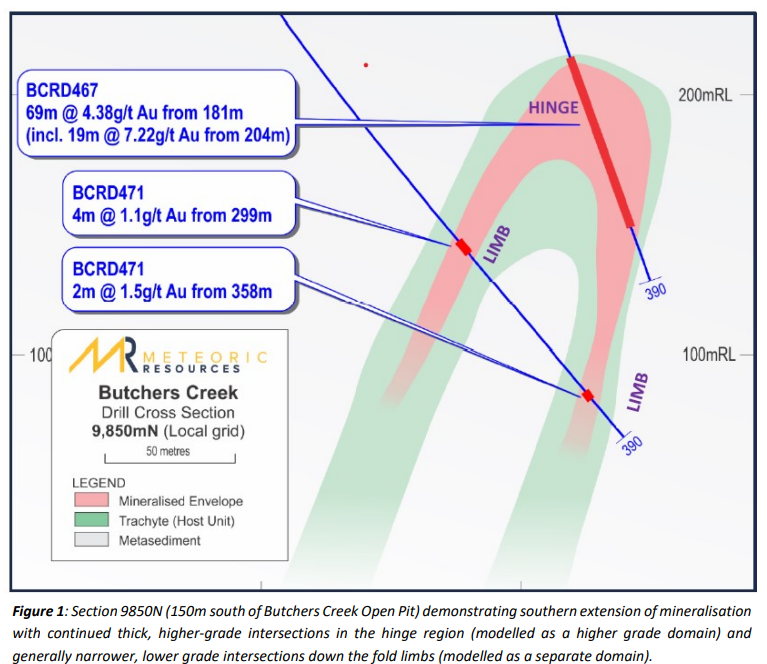
Palm Springs Project’s maiden resource drilling program revealed strata-bound gold mineralisation with a single thick syenite unit. The highest grade and thickest parts of the orebody occur within the hinge zone of a regional scale anticlinal fold hinge.
Results to date from the Anticlinal hinge zone intersections confirm large, robust intervals including:
57 metres at 1.6 g/t from 223 metres, including 18 metres at 3.1 g/t from 234 metres; and
32 metres at 1.4 g/t from 266 metres, including 4 metres at 6.0 g/t from 266 metres.
Read: Meteoric Resources uncovers thick mineralised gold zones during drilling at Butchers Creek