
Royalty companies are often a hidden gem in one’s investment portfolio – not many people understand what it is they do but they do often offer good value for money.
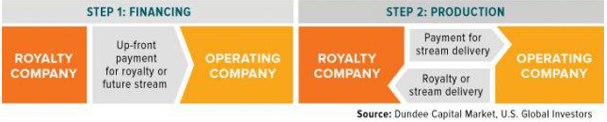
To put it in simple terms: A royalty company provides fundings to miners in exchange for a share of production revenues.
Investors can either invest directly in a commodity, a company that mines them or turn to a royalty company that owns royalties on that specific commodity or commodities.
A royalty company, therefore, stands between the commodity and the miner – and offers the least amount of exposure to risks directly in the commodity or the miner.
Role of royalty companies
Firstly why is there a need for a royalty company? To understand how it all works, let us look at the mining industry first.
Building a mine is an extremely expensive undertaking as it consumes capital and time from exploration to development and actual production and offtake.
The traditional way, as we all have in some way or other been involved in, is to borrow money through financiers. Alternatively, companies issue shares.
Financing can have its pitfalls through delayed payments or too much debt while the issue of new shares can be extremely dilutive to existing shareholders or impose an additional financial burden on existing shareholders to maintain their level of shareholding.
A royalty company can therefore be seen as a 'specialised financier' that helps fund exploration and production projects for mining companies.
In return, it is entitled to royalties on what the project produces, or rights to a 'stream' – an agreed amount of commodity.
What are royalties?
A royalty is a legally binding payment made to an individual or company for the ongoing use of their assets and can range from copyrighted works, franchises and natural resources.
The terms of the royalty payments are laid out in the agreement and are usually based on a royalty rate that benefits both the licensee (the company paying out the royalty) and the licensor (the company receiving the royalty).
Investments in royalties are often seen as less risky as they provide a steady income, compared to direct investment in traditional stocks and shares.
The royalties or 'stream', can be modified in the later stages of a mine’s life to push forward further exploration or mine-life extension.
Why royalties are good
In most cases, royalties are viewed positively because they:
➢ Are not subject to cash calls by the company and as such are considered lower risk as no additional funding is required in the future;
➢ Provide exposure to any upside in the commodity prices, in addition to any hikes in mineral reserves and production;
➢ May even provide interest in new discoveries on a property, creating added value; and
➢ Do not involve operational management, allowing the company to put together a large and diversified portfolio without significant corporate overheads.
Two most common royalties
There are two most common royalty types out there: revenue-based royalties and profit-based interest royalties.
Revenue-based royalties are based on the value of the production or net proceeds received by the operator with defined deductions outlined in the royalty contract.
Some forms of revenue-based royalties in the mining and energy industries include:
➢ NSR or net smelter return royalty and one of the most common in the metals mining industry;
➢ ORR or overriding royalty;
➢ GR or Gross royalty; and
➢ FH or freehold or lessor royalty.
First public mining royalty company
Franco-Nevada Mining Corp Ltd – a US company formed by Seymour Schulich and Pierre Lassonde with an initial capitalisation of US$2 million became the first public mining royalty business with the acquisition of the Goldstrike royalty in 1985.
It remained the leading public mining royalty company until 2002 when it was acquired by Newmont Mining for US$2.5 billion.
Streaming model gains ground
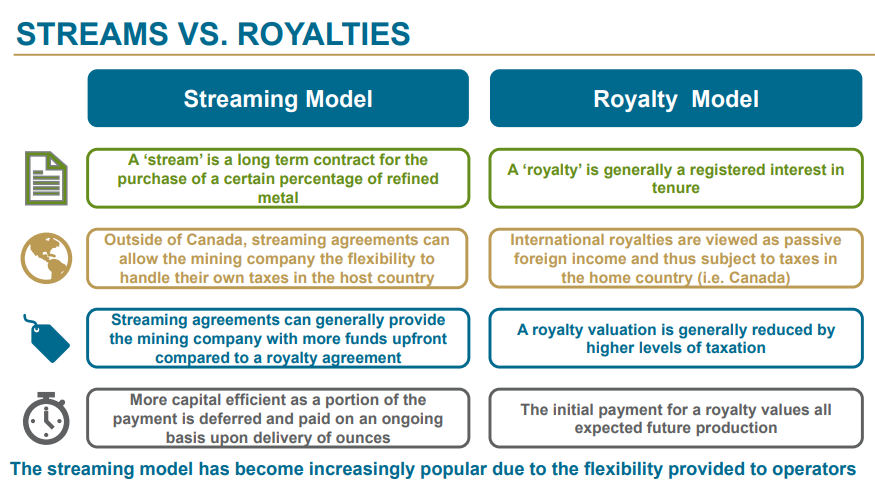
The streaming model has started to become more popular due to the flexibility provided to operators.
Streaming agreements can provide the mining company with more funds upfront compared to a royalty agreement because a royalty valuation is generally reduced by higher levels of taxation.
Further, the ongoing 'payments-on-delivery' are valuable as continued income to offset costs of production by a mining company.
Also, streaming is an ongoing long-term relationship that includes opportunities to adjust terms if necessary, as circumstances change over the life of a mine.
First streaming agreement
Wheaton River, a junior mining company created a new company – Wheaton Precious Metals - that was spun out in 2004 and championed precious metals streaming.
Wheaton River came up with the streaming model while seeking strategies to raise capital for its own core business of gold mining.
One of Wheaton River's properties, the San Dimas gold mine in Mexico, produced significant amounts of silver as a by-product, but the market gave it little value.
This presented an opportunity to crystallise that value and hence the streaming solution was conceived.
By 'streaming' the mine’s silver to a new subsidiary company - the beginning of the Silver Wheaton Group - the market value of the mine’s silver was crystallised.
In the world’s first streaming transaction, Silver Wheaton purchased the yet-to-be-produced silver from Wheaton River’s Luismin mining operations in Mexico (including the San Dimas mine) in consideration for an upfront payment, plus additional payments on delivery of the silver.
For the next 10 years, the company continued to grow as streaming became an important source of funding for all mining companies looking to raise capital.
Energy royalties
An active ASX-listed participant and specialist in royalties is High Peak Royalties Ltd (ASX:HPR).
READ: High Peak Royalties sees June quarter revenue jump 28% on back of sustained rise in oil prices
High Peak is committed to building a portfolio of diversified high-value resource royalties with exposure to projects in exploration, pre-production and producing phases.
It is primarily focusing on royalties in oil and gas in prolific Australian producing regions and is also participating in the 'green energy' sector.
READ: High Peak Royalties enhances green hydrogen project royalty agreement