
Chalice Mining Ltd (ASX:CHN, OTCQB:CGMLF)’s resource definition program at the Gonneville platinum group elements (PGE)-nickel-copper-cobalt-gold deposit has demonstrated continuity of high-grade zones beyond a depth of 600 metres.
Strong new drilling and metallurgical test-work results have been reported by CHN from ongoing exploration at its 100%-owned Julimar Project located 70 kilometres northeast of Perth, Western Australia.
Assay results from 132 diamond and 365 RC holes have defined new drilling targets for further exploration:
- The high-grade G4, G6, G7 and G11 zones at the eastern (footwall) contact between the Gonneville Intrusion and surrounding meta-sediments;
- Infill and down-dip extensions to the high-grade G1-G9 zones; and,
- The non-magnetic pyroxenite and leucogabbro-rich north-western part of the Gonneville Intrusion.
From 113 new drill holes CHN found 282 mineralisation intervals of over four metres width and at least 0.3 g/t palladium and a further 216 high-grade PGE-gold-nickel-copper-cobalt mineralised intervals of which 52 are of particular note, being greater than two metres in width and at least 1 g/t palladium and 0.5% nickel-copper.
1,000 metres still to be explored
“Drilling has delivered further new high-grade results, once again reinforcing the scale and significance of the Julimar discovery just weeks away from our maiden mineral resource estimate,” Chalice managing director and chief executive officer Alex Dorsch said.
“The exciting new results reported today show that the high-grade zones have a significant plunge extent yet to be tested, with approximately 1,000 metres of extent between the limit of drilling and the state forest boundary.
"There is still a significant amount of exploration drilling to be done before we understand the true scale of the Gonneville Deposit.”
Wide intervals of high-grade mineralisation were intersected during drilling, extending the G12 zone along strike, the G2, G4 and G6 zones down-dip and the G4 zone up-dip.
With mineralisation confirmed beyond 600 metres and 1000 metres of plunge still to be explored, deeper step-out drilling will continue beyond the maiden mineral resource estimate (MRE) in order to define the true depth and scale of the deposit.
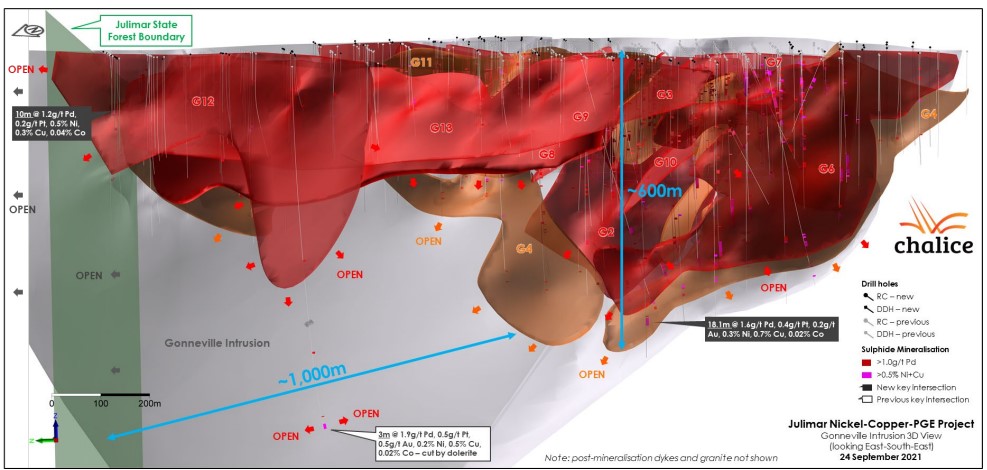
Gonneville Intrusion 3D View (looking East-South-East) – new key drill results and high-grade zones.
Results support updated geological model
New high-grade step-out and infill results have demonstrated the validity of Chalice’s updated geological model and emphasised the deposit’s prospective value.
New step-out results:
- 26 metres at 4.8 g/t palladium, 1.0 g/t platinum, 0.5% nickel, 0.3% copper and 0.04% cobalt from 286 metres – G2;
- 32 metres at 2.4 g/t palladium, 1.0 g/t platinum, 0.2 g/t gold, 0.1% nickel, 0.1% copper and 0.01% cobalt from 76 metres – G4;
- 10.2 metres at 1.6 g/t palladium, 0.4 g/t platinum, 0.1 g/t gold, 0.1% nickel, 0.6% copper and 0.01% cobalt from 299 metres – G4;
- 18.1 metres at 1.6 g/t palladium, 0.4 g/t platinum, 0.2 g/t gold, 0.3% nickel, 0.7% copper and 0.02% cobalt from 600.2 metres - G4;
- 13.4 metres at 3.2 g/t palladium, 0.9 g/t platinum, 0.1 g/t gold, 0.2% nickel, 0.1% copper and 0.02% cobalt from 149 metres – G4;
- 8.9 metres at 2.4 g/t palladium, 0.5 g/t platinum, 0.1 g/t gold, 0.9% nickel, 0.5% copper and 0.05% cobalt from 246.1 metres – G2;
- 7 metres at 3.9 g/t palladium, 0.7 g/t platinum, 0.8% nickel, 0.6% copper and 0.05% cobalt from 223 metres – G2;
- 10 metres at 3.9 g/t palladium, 0.7 g/t platinum, 0.1 g/t gold, 0.3% nickel, 0.3% copper and 0.02% cobalt from 225 metres – G4; and
- 10 metres at 1.2 g/t palladium, 0.2 g/t platinum, 0.5% nickel, 0.3% copper and 0.04% cobalt from 133 metres – G12.
Forty metre-spaced infill drilling across the deposit also returned high-grade results:
- 33.2 metres at 2.2 g/t palladium, 0.5 g/t platinum, 0.3 g/t gold, 0.2% nickel, 1.2% copper and 0.02% cobalt from 453.8 metres – G6;
- 17.7 metres at 4.7 g/t palladium, 1.3 g/t platinum, 0.4% nickel, 0.4% copper and 0.03% cobalt from 271 metres – G2;
- 9.9 metres at 5.8 g/t palladium, 1.3 g/t platinum, 0.6% nickel, 0.4% copper and 0.04% cobalt from 68.1 metres – G2;
- 20.1 metres at 1.8 g/t palladium, 0.8 g/t platinum, 0.4 g/t gold, 0.2% nickel, 0.6% copper and 0.02% cobalt from 51.9 metres - G6;
- 17.9 metres at 2.0 g/t palladium, 0.5 g/t platinum, 0.5 g/t gold, 0.1% nickel, 0.4% copper and 0.01% cobalt from 97.8 metres – G6;
- 15.8 metres at 1.8 g/t palladium, 1.0 g/t platinum, 0.3 g/t gold, 0.1% nickel, 0.5% copper and 0.01% cobalt from 118 metres – G6; and
- 9.8 metres at 2.5 g/t palladium, 0.3 g/t platinum, 0.9 g/t gold, 0.1% nickel, 0.7% copper and 0.02% cobalt from 23 metres – G6.
Wide-spaced step-out drilling is now targeting extensions of the G1-G6 zones along the interpreted NNW plunge direction.
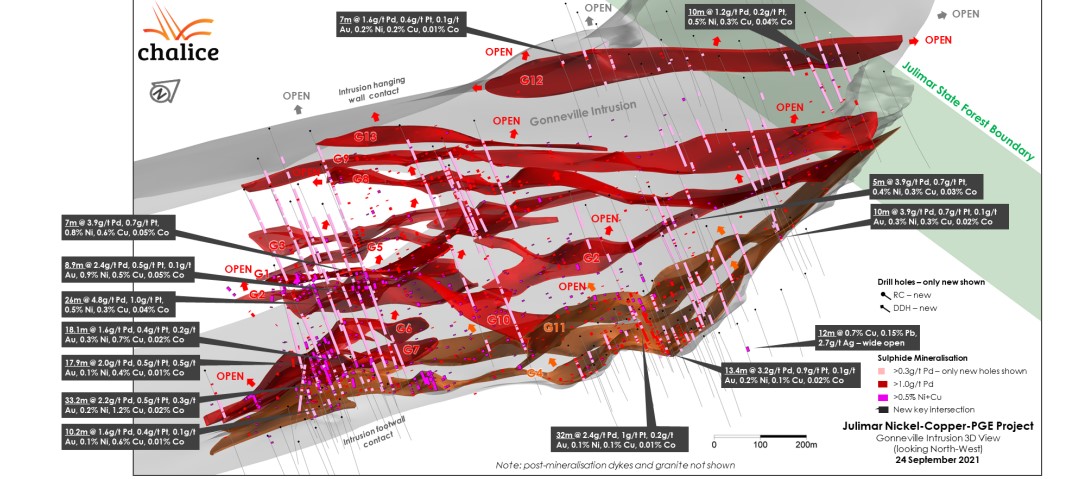
Gonneville Intrusion 3D View (looking northwest) – new key drill results and high-grade zones.
Maiden MRE expected Q4 2021
“We have now received all the assay results that will be included in the initial pit-constrained mineral resource estimate and work is underway with our consultants, CSA Global, with the maiden resource expected to be released in mid Q4,” Alex Dorsch said.
“Given the complexity of the geology and the range of mineralisation styles observed at Gonneville, we are looking forward to the results from the resource modelling process to determine where Gonneville currently sits in terms of scale and quality.”
A new style of copper-rich mineralisation was also intersected below the eastern footwall contact, with further drilling underway to understand its significance. The mineralisation is currently wide open and undefined.
Shallow zones require simple early processing
“Our initial metallurgical investigations also continue to deliver promising results, with the sequential flotation flowsheet for the high-grade sulphide zones firming as the preferred processing pathway,” Dorsch said.
“The shallow nature of the high-grade sulphide zones mean that the early stages of development will focus on processing this material with a relatively simple flowsheet. The focus now shifts to the disseminated sulphide material, with initial test-work now underway to determine the optimal flowsheet.”
Ongoing metallurgic test-work has continued to deliver promising preliminary results:
- Excellent palladium-copper recoveries (75-90%) and good nickel-platinum recoveries (60-75%) into separate copper-PGE-gold and nickel-cobalt-PGE concentrates from high-grade sulphide composites.
- Initial locked-cycle flotation tests on disseminated sulphide composites indicate good recoveries achieved into separate copper-PGE-gold and bulk nickel-copper-PGE concentrates.
State Forest drilling
“After lengthy consultation with the WA State Government, we are also pleased to see that our low impact approach to initial drilling in the State Forest is now close to being approved,” Dorsch said.
“We have received positive feedback on our approach to minimising disturbance and we are eagerly awaiting final approvals for drilling to commence at the >6.5-kilometre long Hartog Target in the coming weeks.”
The final Conservation Management Plan (CMP2) for initial drilling at the Hartog-Baudin Targets in the Julimar State Forest was submitted in early September after extensive consultation and approval is expected in the coming weeks.