
Patrys Ltd (ASX:PAB) is in the midst of an exciting period of development as it prepares for its first clinical trial program for its deoxymab platform.
Its primary focus is to move its lead asset, PAT-DX1, a small antibody fragment, to the first human clinical trial.
The company is confident it has the skills and resources to achieve this milestone in late 2022.
Its initial focus is on glioblastoma (GBM) and triple-negative breast cancer (TNBC), with plans to expand into other solid tumours in the future.
New approach for cancer treatment
New approaches for treating cancer Patrys’ deoxymab platform is based on a unique antibody called 3E10 that was originally isolated from a mouse model of the human autoimmune disease lupus.
The 3E10 antibody has several unusual biological properties not typically seen in antibodies.
Patrys has developed humanised versions of 3E10 in different antibody formats to make them suitable for human therapeutic applications.
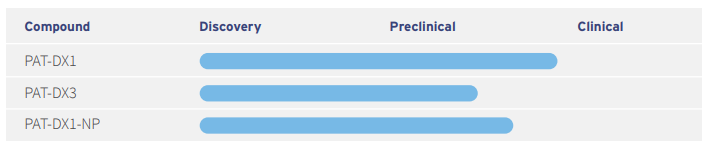
Properties that make deoxymab antibodies unique for human therapeutic applications include:
Cancer targeting
All cancers, regardless of their type or location, release DNA into the bloodstream as a consequence of the high rates of cell death that occurs within tumours.
Deoxymabs are attracted to this released DNA, allowing deoxymabs to naturally home in on both primary and secondary cancers, wherever they are located.
Patrys believes this may allow deoxymabs to be used as pan-cancer agents for the targeted delivery of cancer therapies or imaging agents.
Blood-brain barrier
The blood-brain barrier (BBB) is a natural, physiological barrier that prevents potentially damaging compounds from entering brain tissues but it can also prevent drugs and antibodies from crossing from the blood into the brain when needed.
Deoxymabs can cross the BBB and get to neural tissues, offering new approaches for treating cancers in the brain.
Cell-penetrating
Most antibodies only bind to antigens on the surface of cells but deoxymabs can penetrate the cell membrane and get inside of cells intact.
Patrys plans to leverage this to potentially deliver therapeutic payloads into the cell.
Inhibit DNA damage repair
Once deoxymabs get inside the cell nucleus, they bind to damaged DNA, preventing it from being repaired by the cell’s DNA damage repair (DDR) systems as cells with damaged DNA are not able to divide and usually end up self-destructing.
By using deoxymabs in cancers with compromised DDR systems or combining them with agents that damage DNA, such as radiation and many chemotherapy drugs, deoxymabs may offer much-needed therapeutic approaches for treating cancers.
Deoxymabs have the potential to be used in novel ways as a targeting agent in antibody-drug conjugates (ADCs) - antibody-delivered therapeutics, which have become one of the most exciting approaches of drug development.
The addition of PAT-DX3 to the pipeline has expanded these opportunities by providing the option to use a full-sized IgG antibody with more attachment sites and a different pharmacokinetic profile.
Expanding deoxymabs potential
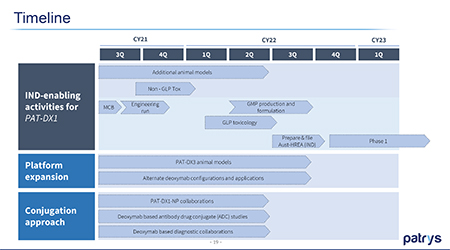
PAT-DXI production will be scaled up in the fourth quarter of 2021 and will be used for both rodent and primate toxicology studies, which will inform the Human Research Ethics Application (HREA) for the Phase 1 clinical study.
PAT-DX1 is initially going to be developed as a potential therapeutic for treating primary and secondary brain cancers due to its ability to cross the blood-brain barrier.
Given its mechanism of action of blocking DNA IPs, PAT-DX1 may also have utility for treating cancers with existing DDR deficiencies, or in combination with other DNA damaging agents such as radiation and many chemotherapy drugs.
PAT-DX3 was added to Patrys’ portfolio in September 2020 and studies have shown that PAT-DX3 has the same DNA-binding and DDR blocking properties as PAT-DX1 and is also able to cross the BBB.
However, due to its larger size, it is cleared from blood more slowly than PAT-DX1 and may show differences in tissue distribution.
The different pharmaceutical profiles of PAT-DX1 and PAT-DX3 may open up different clinical opportunities for Patrys' deoxymab antibody platform.
Further, through both its own internal R&D programs and a growing number of partnerships, Patrys is using PAT-DX1 to develop new clinical products based on the targeted delivery of nanoparticles carrying therapeutic payloads to the inside of cancer cells.
Patrys has signed a collaboration agreement with Imagion Biosystems to develop imaging agents that combine Imagion’s MagSense technology with PAT-DX1’s ability to cross the BBB and target cancers in the brain.
Successful preclinical trial
Patrys announced a successful preclinical study highlighting the potential for using its deoxymab antibodies as targeting agents in ADCs.
ADCs harness the targeting attributes of antibodies to deliver payloads specifically to the sites of disease, and are one of the most active areas of drug development
The study data confirms that it is possible to conjugate the anticancer drug monomethyl auristatin E (MMAE) to Patrys’ PAT-DX3.
MMAE conjugated to PAT-DX3 was shown to inhibit tumour growth by 99.7% in mice implanted with human breast cancer cells, showing that deoxymabs can be used to effectively target delivery to tumours in animals.
Basis for new ADCs
Patrys CEO and managing director Dr James Campbell said: “We are very excited by the potential of using our deoxymabs as the basis for new ADCs.
“This work has shown that deoxymabs can be used to target cancers and, by using a potent and validated ADC payload, deliver a drug.
“This study has clearly demonstrated the proof of concept and is expected to open up a range of potential development or partnering opportunities for the company.”
Dr Campbell added: “Patrys has an extensive portfolio of patents filed in major commercial markets, which currently includes over 13 active patent families, including seven granted and 32 pending.
“Our company operates in a highly competitive and strategic space, so protecting our intellectual property is a foremost priority.”
In March 2021, a new patent covering the use of Patrys’ deoxymabs in combination with radiosensitising agent(s) that damage DNA, or inhibit DNA repair, was granted in the US.
The company now has seven granted patents covering both forms of PAT-DX1 and PAT-DX3 and other dexoymabs; one in each of Europe, Japan, China, Australia and three in the US.
In total, Patrys has a further 32 pending applications across 13 different patent families in key jurisdictions, providing significant and material patent estate covering the use of its deoxymab antibodies as cancer treatments.
Attractive commercial landscape
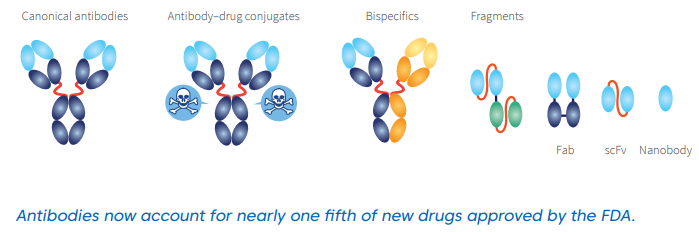
Antibodies are becoming one of the key foundations of modern medicine as they can precisely target different tissues or biochemical processes.
Antibodies account for nearly one-fifth of new drugs approved by the US Food and Drug Administration (FDA).
This provides a very attractive commercial landscape for deoxymab antibodies, which are being developed to treat cancer, and which have potential utility as targeting agents for the newest class of antibody-based therapeutics, namely ADCs.
“As far as we know, none of the 100 approved antibodies cross the blood-brain barrier – and thus, Patrys’ deoxymabs may prove to be one of the first antibody-based therapeutics that can be used to treat cancers in the brain,” Patrys said.
Partnerships?
Dr Campbell added: “The future for therapeutic antibodies is exciting. While our focus is on advancing to the first human clinical trial of PAT-DX1 in 2022, we are actively engaged in business development efforts to leverage the unique attributes of deoxymabs, and expand our portfolio of novel assets.”
While Patrys’ internal R&D is clearly focused on getting PAT-DX1 into clinical trials, there is plenty of opportunity for the company to enter into commercial partnerships for other applications for its deoxymab antibodies.
Industry partners are in-licensing assets at earlier stages and on commercially attractive terms.
Sufficient funds to expand deoxymab platform
During the past financial year, Patrys completed two capital raises for a total of A$11.7 million, providing the company with a strong balance sheet and sufficient funds to expand the deoxymab platform.
This includes completing the commercial-scale manufacture of clinical-grade material and the required preclinical studies for PAT-DX1 as well as initiate a first human clinical trial of PAT-DX1 in 2022.