
Amplia Therapeutics Ltd (ASX:ATX) has stormed ahead, shedding its ‘pre-clinical stage’ status to become a drug development company, with two potent candidates on the brink of two Phase 2 clinical studies for pancreatic cancer and pulmonary fibrosis.
The pipeline drugs were originally developed by the Cancer Therapeutics CRC (CTx), an Australian industry/academic collaboration that included leading cancer and medicinal chemistry researchers at Australia’s top cancer research institutes.
Amplia was established to advance these promising drugs into clinical development and commercialisation.
Pipeline
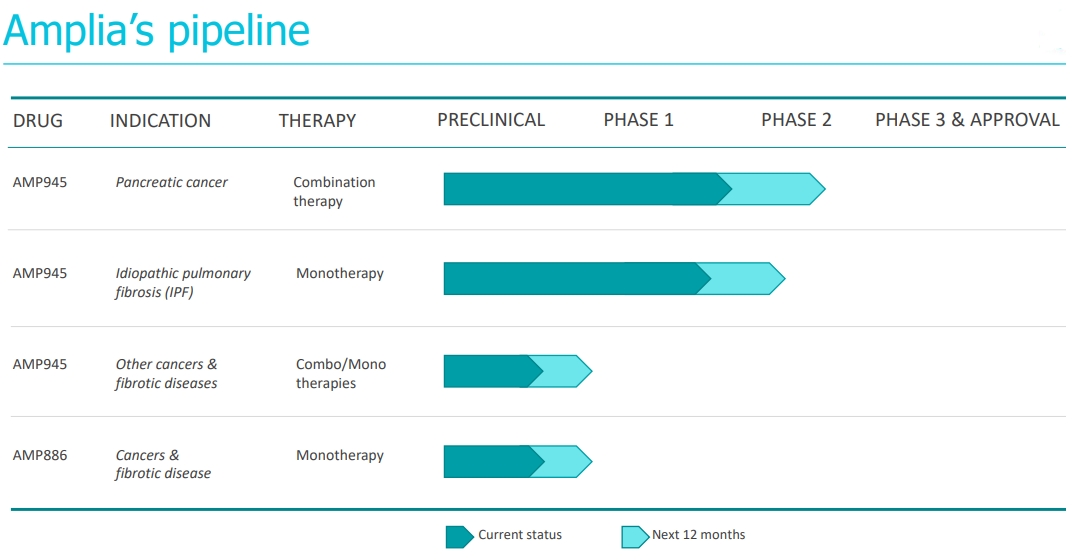
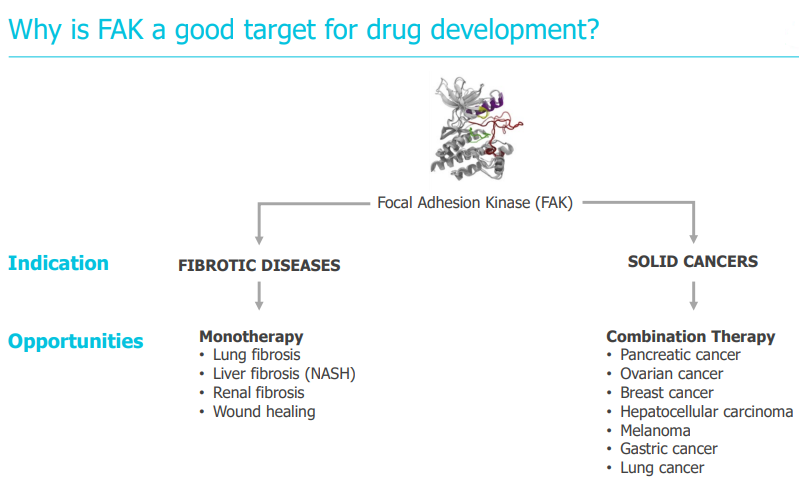
Amplia is developing two proprietary, orally available, small molecule Focal Adhesion Kinase (FAK) inhibitors as candidate drugs for the treatment of cancer and various fibrotic diseases:
➢ AMP945: a highly potent and selective inhibitor of FAK; and
➢ AMP886: a highly potent inhibitor of FAK that also inhibits two other validated disease targets (VEGFR3 and FLT3).
Amplia has successfully completed a Phase 1 clinical trial of AMP945 in healthy volunteers. On the back of positive data from this trial, Amplia is preparing for Phase 2 trials of AMP945 in patients with pancreatic cancer and idiopathic pulmonary fibrosis.
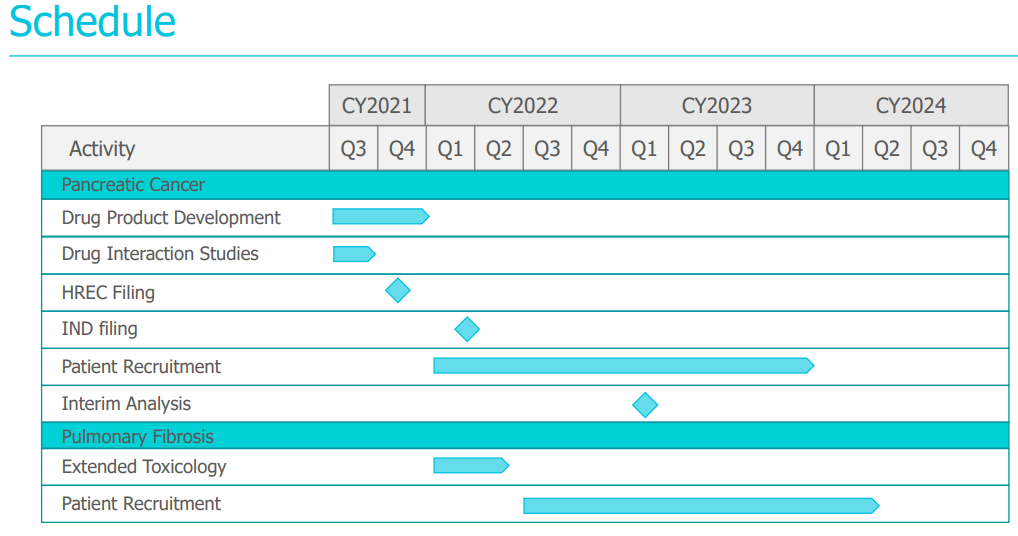
The Phase 2 trial in pulmonary fibrosis is expected to commence recruitment in the third quarter of 2022 while the Phase 2 trial in pancreatic cancer is expected to start recruitment in the first quarter of 2022.
Amplia is continuing to evaluate AMP945 and AMP886 in a range of animal models of different cancer and fibrotic diseases to identify future development, partnering and licensing opportunities.
Orphan drug designation
AMP945 was awarded Orphan Drug Designation by the US Food and Drug Administration (FDA) for use in treating idiopathic lung fibrosis in May 2020 and then for use in treating pancreatic cancer in March 2020.
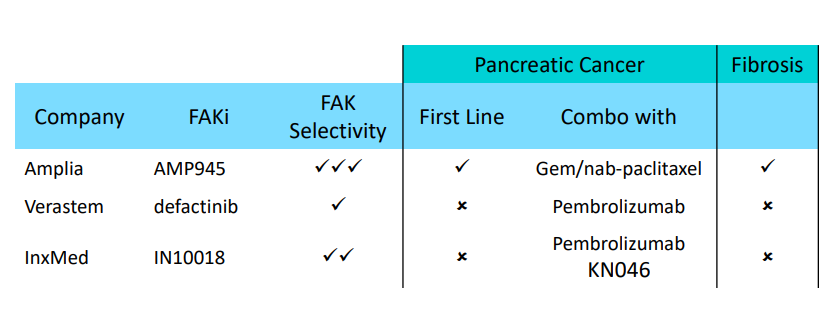
Amplia’s AMP945 is differentiated from its competitors by
➢ Exquisite FAK selectivity;
➢ Pairing with first-line therapy;
➢ Combination with gemcitabine/nab-paclitaxel, an approved pancreatic cancer therapy; and
➢ AMP945’s clinical safety profile is consistent with development in fibrosis indications.
Garvan Institute collaboration
Amplia entered into a collaboration agreement and research and licence agreement with the Garvan Institute of Medical Research in Sydney.
These agreements define the structure of an ongoing collaborative research and clinical development program to be undertaken with Garvan, focusing on the use of Amplia’s FAK inhibitor, AMP945, to treat patients with pancreatic cancer.
The collaboration provides Amplia with access to Garvan’s research strength in FAK biology and its extensive clinical research network.
Already, non-clinical studies conducted in the laboratory of Professor Paul Timpson, Cancer Research Theme Leader at Garvan, a world-renowned expert in FAK biology, have provided Amplia with valuable insights into the ability of AMP945 to inhibit fibrosis and significantly improve survival in an animal model of aggressive pancreatic cancer.
Amplia is incorporating these insights and using its access to Garvan’s clinical research network to assist with the design and planning of a Phase-2 clinical trial of AMP945 in patients with pancreatic cancer.
The terms of the final collaboration agreement also provide for expansion into other therapeutic areas.
Under the terms of the collaboration agreement, which has an initial term of two years, Amplia will receive first rights to participate in research projects relating to the use of FAK inhibitors in combination with other therapeutic products for the treatment of cancer.
As part of the research and licence agreement, Amplia agrees to fund studies of the use of AMP945 in combination with gemcitabine/Abraxane® for the treatment of cancer, with an initial focus on pancreatic cancer.
The company will also receive first rights to new intellectual property arising from the collaboration.
AMP945
Amplia has completed the design for a Phase 2 clinical trial of AMP945 in newly diagnosed patients receiving first-line therapy for pancreatic cancer and is on track for the first Phase 2 clinical trial in the first quarter of 2022 with patient recruitment at Australian sites.
The trial’s lead investigator from Sydney’s Westmead Hospital, Dr Adnan Nagrial, said: “Patients with advanced pancreatic cancer have very limited treatment options and we desperately need new therapies with novel mechanisms of action.
“Based on the evidence we have seen so far, FAK inhibitors deserve to be tested in the clinic and I am excited to be part of this trial”.
The Phase 2 trial of AMP945 will be an open-label single-arm trial conducted in two stages.
In the first stage, an optimal dose of AMP945 will be selected and a preliminary assessment of efficacy will be performed in around 40 pancreatic cancer patients.
In the second stage, up to an additional 24 pancreatic cancer patients will be recruited to increase confidence in the preliminary results.
The Phase 2 clinical trial will add AMP945 to chemotherapy with gemcitabine and nabpaclitaxel, which is a standard of care currently used to treat the majority of newly diagnosed advanced pancreatic cancer patients.
In the trial, designated AMP945-202, AMP945 will be administered orally to patients prior to each dose of their standard gemcitabine/nab-paclitaxel chemotherapy.
The trial design is based on studies conducted in collaboration with Professor Timpson’s group, where it has been shown that intermittent dosing of AMP945 makes tumours more responsive to standard chemotherapy treatments in animal models of pancreatic cancer.
Largest relevant patient population
Conducting the Phase 2 clinical trial in first-line patients is expected to expedite recruitment for the trial and provides the best opportunity to detect any efficacy signal from the addition of AMP945 to chemotherapy.
The ability to test AMP945 in a first-line setting is also made possible by the excellent safety and tolerability profile demonstrated in Amplia’s recent Phase 1 clinical trial.
Amplia expects recruitment will take 18-24 months but it is working with vendors to accelerate key aspects of the trial.
The primary endpoint for the trial will be based on the objective response rate from treatment compared to historical controls.
Further, multiple other signals of efficacy will be assessed in the trial’s secondary and exploratory endpoints including duration of response, disease progression rates, survival and effects on biomarkers of disease.
Pancreatic cancer
There are 60,000 new diagnoses and 48,000 deaths from pancreatic cancer in the US each year.
It is a difficult-to-treat cancer that is often surrounded by a protective, fibrotic stromal layer.
Less than 20% of patients are eligible for surgery, with chemotherapy being the main treatment.
The company noted that few new therapies have been approved and most patients are treated with cytotoxic chemotherapy drugs.
In 2021, the total addressable market (TAM) for pancreatic cancer was $2 billion and is forecast to grow to $5.4 billion by 2029, according to GlobalData.
Treatments are expected to evolve with kinase inhibitors becoming a more significant drug class in this indication.
Idiopathic Pulmonary Fibrosis (IPF)
IPF affects 130,000 in the US and around 3 million people worldwide.
It is a devastating, progressive disease caused by the build-up of fibrotic tissue in the lungs.
Only two drugs have been approved, which slow the disease progression but they are unable to stop the disease.
With treatment, the median survival time is 3-5 years.
In 2021, the TAM is $2.2 billion and is forecast to grow to $4.6 billion by 2027, according to ResearchAndMarkets.