Caspin Resources Ltd (ASX:CPN) continues to deepen its understanding of a large-scale, mafic-ultramafic intrusive complex through exploration at its flagship Yarawindah Brook platinum group element (PGE)-nickel-copper project in Western Australia.
So far, the mineral exploration company has completed 3,000 metres of reverse circulation (RC) drilling at the Yarabrook Hill prospect, a key target within the broader Yarawindah asset.
Prior to the drilling program, Caspin completed a gravity gradiometer survey over the Yarabrook tenement, providing further insight into the nature of the mineralised intrusive.
With results from the first 3,000 metres of drilling on the way and survey interpretation ongoing, Caspin believes the intrusive complex at Yarabrook could be much larger than previously thought.
Assays from the first round of RC drilling are expected early next month.
Drilling activity at Yarawindah Brook
As part of its latest exploration campaign, Caspin has drilled 11 RC holes for 3,000 metres over the Yarabrook Hill target.
Back in July, the explorer set out to drill around 5,000 metres, using an RC rig to turn the soil at the multi-element prospect.
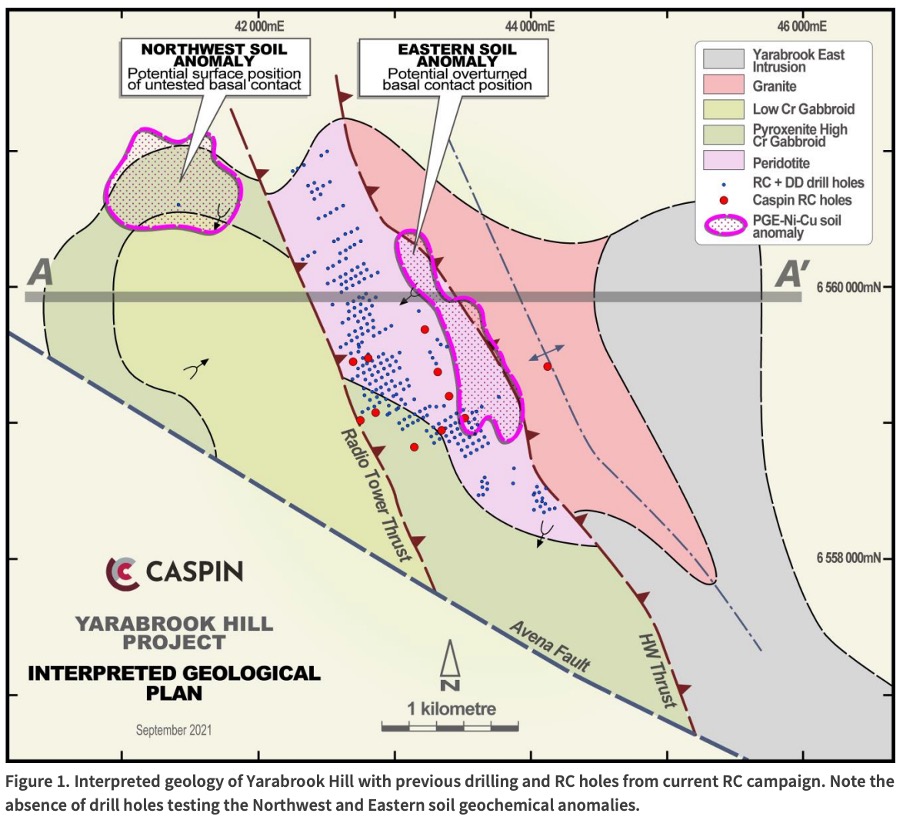
Essentially, the company’s latest exploration campaign is designed to test bedrock extensions of the target’s PGE-nickel-copper sulphides following a gradiometer survey.
In the past, drilling has only tested a small portion of the project’s intrusive body, with historical exploration focused on areas where the mineralisation comes to the surface.
The company’s maiden drilling campaign at Yarawindah commenced in April this year, when a diamond drill rig uncovered broad sulphide zones at the XC-29 prospect.

Fast-forward to today, and just as it reached the 3,000-metre mark at Yarabrook, Caspin was forced to halt its RC drilling campaign due to wet ground conditions.
As long as the situation improves and a drill rig is available, the explorer hopes to restart the RC program in late October.
Beyond that, Caspin is preparing for a follow-up diamond drill program at the multi-element target, a campaign partially funded by the WA Government’s Exploration Incentive Scheme.
If all goes to plan, this diamond drill program should also kick off late next month.
Survey says
Between drilling campaigns, Caspin flew a gravity gradiometer survey over Yarabrook Hill in June.
Combined with recent drilling data, the explorer believes the survey deepens its understanding of the large-scale intrusive’s geology.
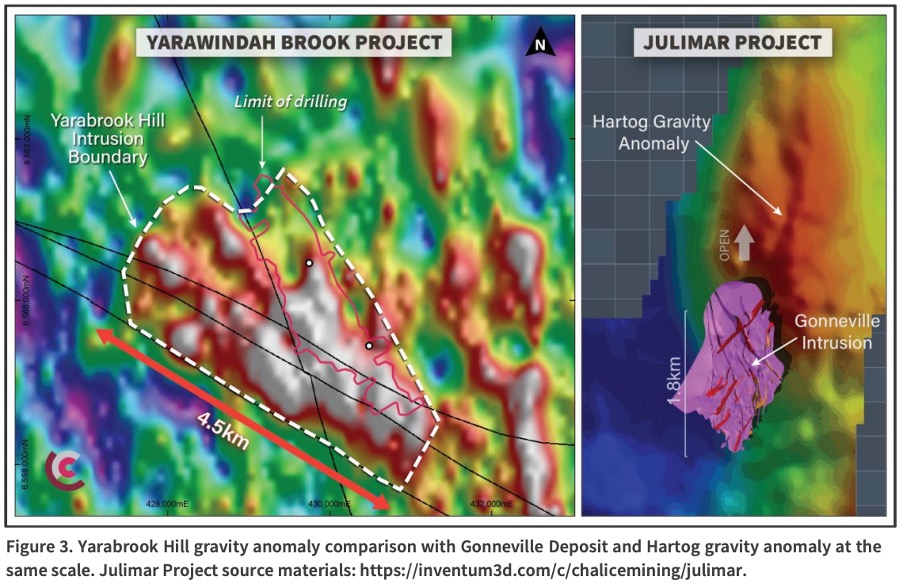
Essentially, the survey outlined the extent of the Yarabrook Hill intrusion, covering at least 8 square kilometres — a fourfold increase on the current mapping and exploration zone.
“This supports our belief that the intrusion is largely unexplored and that exploration to date has been focused only on easily accessible surface exposure,” the company said in mid-August.
“Yarabrook Hill is now demonstrated to be a large intrusive mafic/ultramafic system, which bodes well for the discovery of economic deposits of PGE-nickel-copper sulphides.”
With this in mind, Caspin reports the survey indicates the intrusion is comparable in size to the Gonneville and Hartog footprints, as well as gravity anomalies that host Chalice Mining Ltd (ASX:CHN, OTCQB:CGMLF)’s Julimar Project.
Next on the agenda
When it’s able to turn the soil at Yarabrook again, Caspin has lined up a suite of high-priority targets for drill testing.
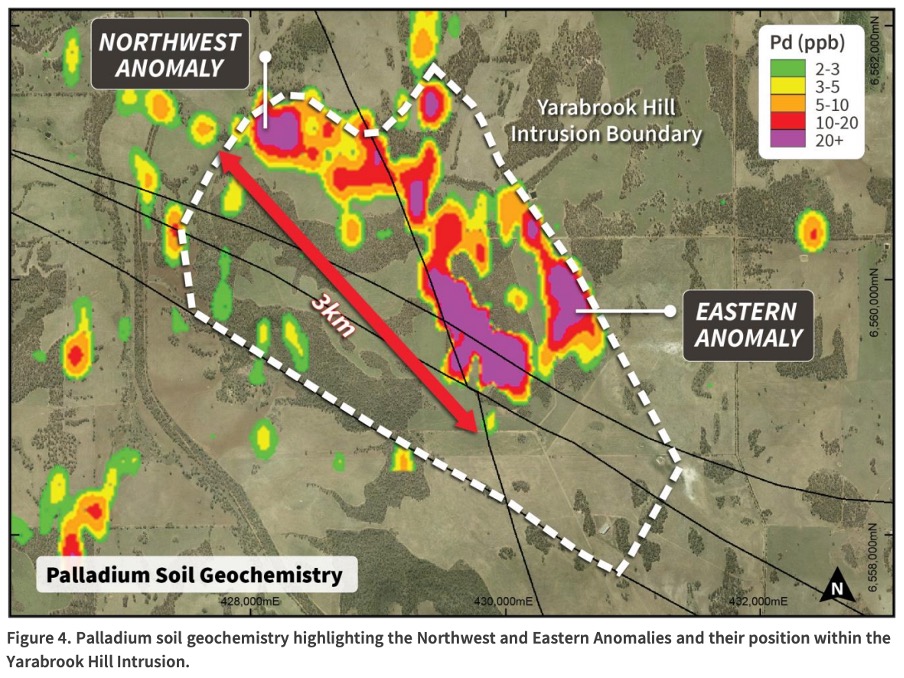
First on the list are two geochemical soil anomalies to the east and northwest, which lie within the intrusion’s 3-kilometre footprint.
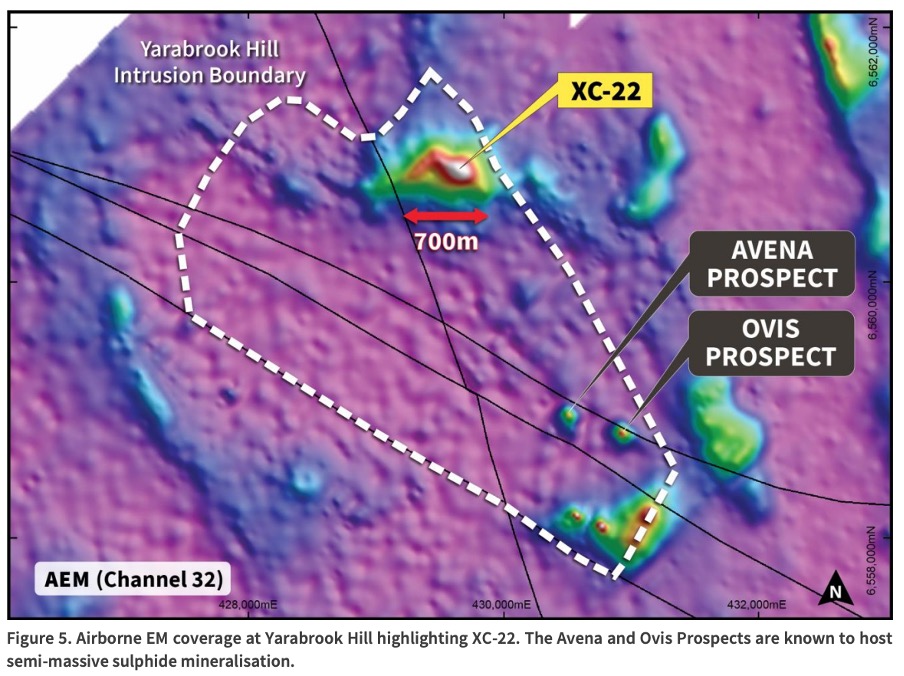
The company also hopes to target the XC-22 airborne electromagnetic anomaly, which is coincident with a magnetic high and gravity low.
This combination of anomalies is most likely to represent serpentinised ultramafic rocks which are commonly associated with PGE mineralisation, just like the Gonneville Intrusion at the Julimar Project.
Importantly, the size of the gravity low anomaly suggests this area may be the most significant area of ultramafic within the Yarabrook Hill intrusion.