
Blackstone Minerals Ltd (ASX:BSX, OTCQX:BLSTF, FRA:B9S) has intersected 8.5 metres of massive sulphide vein (MSV), semi-massive sulphide vein (SMSV) and net textured sulphide (NTS) from infill drill hole KS21-34 at the King Snake prospect within Ta Khoa Nickel-Copper-PGE Project in Northern Vietnam.
Several assays have also been received from drilling at King Snake with highlights including:
- KS21-18: 1.18 metres at 1.73% nickel, 1.09% copper, 0.06% cobalt & 1.07g/t PGE1 from 190.62 metres;
- KS21-19: 4.90 metres at 1.09% nickel, 0.97% copper, 0.04% cobalt & 0.89g/t PGE1 from 133 metres including 1.88 metres at 2.66% nickel, 1.92% copper, 0.1% cobalt & 2.13g/t PGE1 from 134.68 metres; and
- KS21-29: 1.16 metres at 1.06% nickel, 2.21% copper, 0.04% cobalt & 3.7g/t PGE1 from 42.34 metres.
- 1 platinum+palladium+gold
“Solid foundation to commence mine planning”
Blackstone managing director Scott Williamson said: “King Snake is one of three advanced massive sulphide opportunities that Blackstone has progressed within the Ta Khoa Nickel-Cu-PGE district.
“Blackstone’s initial geophysical assessment has been confirmed with mineralisation extending over a strike length close to one kilometre, while continuing to plunge deeper to the west.
“We are pleased to have committed to the next phases of development at King Snake, which includes infill drilling.
Importantly, the results to date provide a solid foundation to commence mine planning and incorporate the King Snake target into our upcoming UBU PFS.”
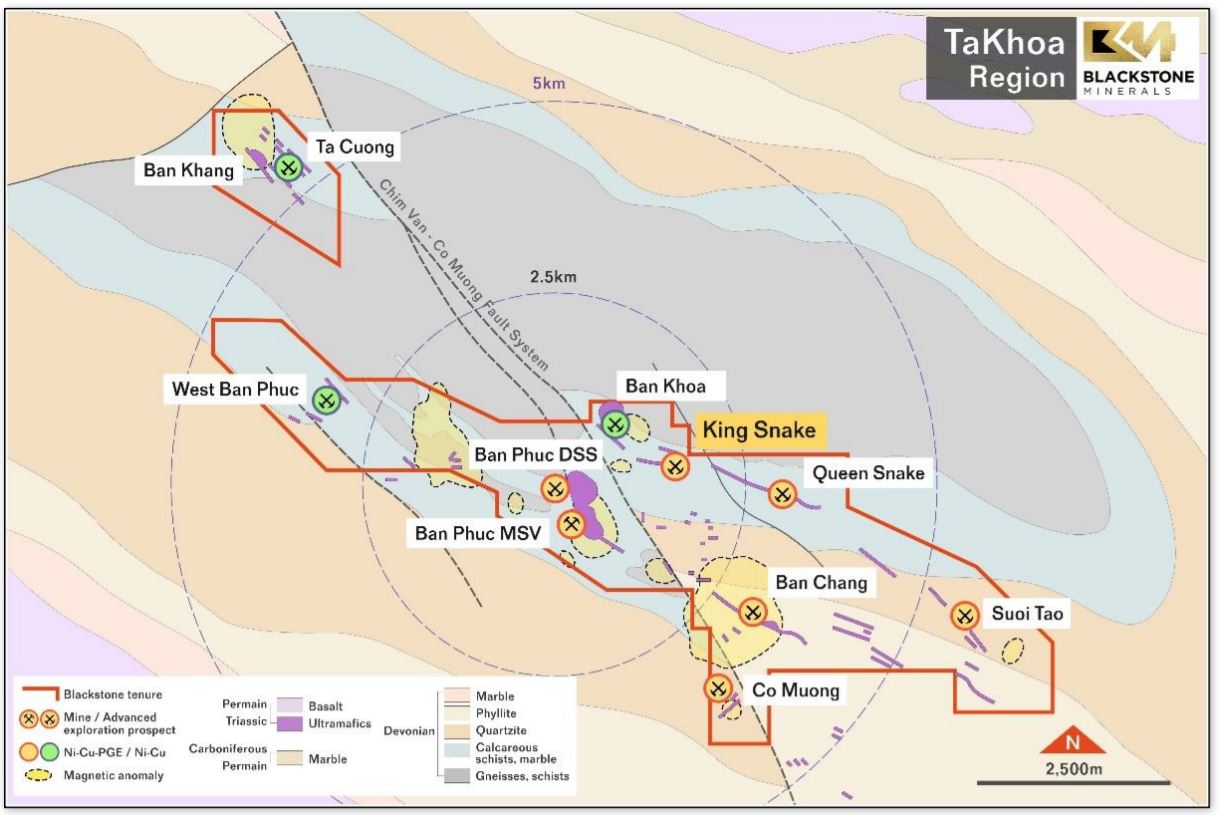
King Snake is an MSV prospect located 1.5 kilometres north-east of the processing facility.
At King Snake, MSV and high-grade brecciated nickel-copper-cobalt-PGE sulphides and gossans are associated with tremolite-altered mafic-ultramafic rocks.
Blackstone's drilling at King Snake has been focussed on electro-magnetic (EM) targets which extend down plunge to the west of historical drilling.
Assay results indicate greater thickness of sulphide mineralisation down plunge of historical drilling.
The higher power surface EM targeting has accurately guided the down plunge drilling hundreds of meters from the historical surface showings.
In addition, downhole EM (DHEM) has further directed investigations to wider higher-grade zones throughout this consistent, high grade and highly planar massive sulphide vein.