
Australian Potash Ltd (ASX:APC)’s premium sulphate of potash (SOP) product has been cleared for use in organic production and food processing in the US under a key certification.
The company’s K-Brite™ compound, which provides all-important potassium for growing plants, secured the stamp of approval from the Organic Materials Review Institute (OMRI), an international non-profit that determines which input products can be used in organic production and processing.
With the certification in tow, K-Brite™ will appear on the OMRI Products List, a directory of more than 8,000 products that comply with the US Department of Agriculture’s National Organic Program standards.
The accreditation comes as global SOP prices continue to grow amid the agricultural market’s recovery and increased demand for premium potassic fertilisers.
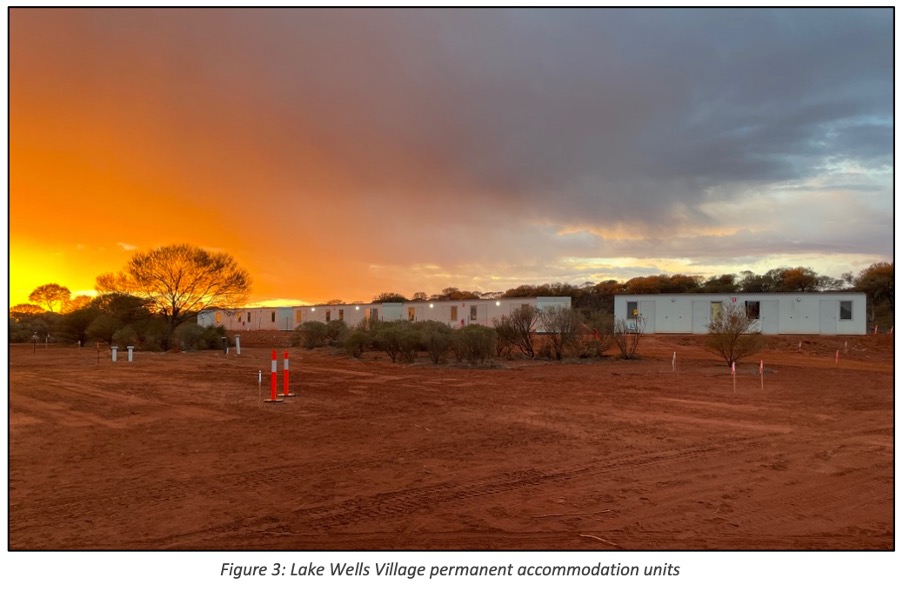
The newly-built accommodation village, part of the site where APC will produce its K-Brite™ compound at the Lake Wells SOP project.
Towards organic food production
Speaking to the broader SOP market, Australian Potash managing director and CEO Matt Shackleton said: “There are several themes working through global fertiliser demand curves – increasing population and decreasing use of arable agricultural land being pre-eminent.
“To these macro-trends is added a shift towards organic farming in many jurisdictions.
“In Sri Lanka, for example, there is now a ban on the import of chemical fertilisers, and in China, there is an action plan to replace the use of chemical fertilisers with organic fertilisers.
“APC has offtake positions in both of these jurisdictions and is well-positioned to respond to the trend towards organic food production across the world’s major SOP markets.”
Delivering potassium to crops
Essentially, potash refers to potassium-bearing minerals or compounds — a combination of salts that act as a fertiliser and provide nutrients to growing crops.
Potash can take a few different forms, the most common being muriate of potash (MOP).
This potassium and chloride fertiliser mix usually comes from a ‘hard rock’ potassium deposit, from which the ore can be processed to make MOP.
On the other hand, potash that comes from water that’s saturated with salts can produce another type of fertiliser, sulphate of potash, also known as potassium sulphate.
This is what APC generates from its flagship Lake Wells SOP Project, which is scheduled to enter production from mid-2023.
From here, the company will create its premium K-Brite™ SOP compound, a fertiliser that provides key nutrients like potassium for the agricultural markets.
There are three ways to produce SOP, two of which include transforming MOP into potassium sulphate.
However, the last of these — known as the Mannheim method — is highly energy-intensive and generates hydrochloric acid waste.

Source: Australian Potash.
SOP demand on the rise
As the world’s economies begin to recover from the pandemic, demand for sulphate of potash fertilisers is on the rise.
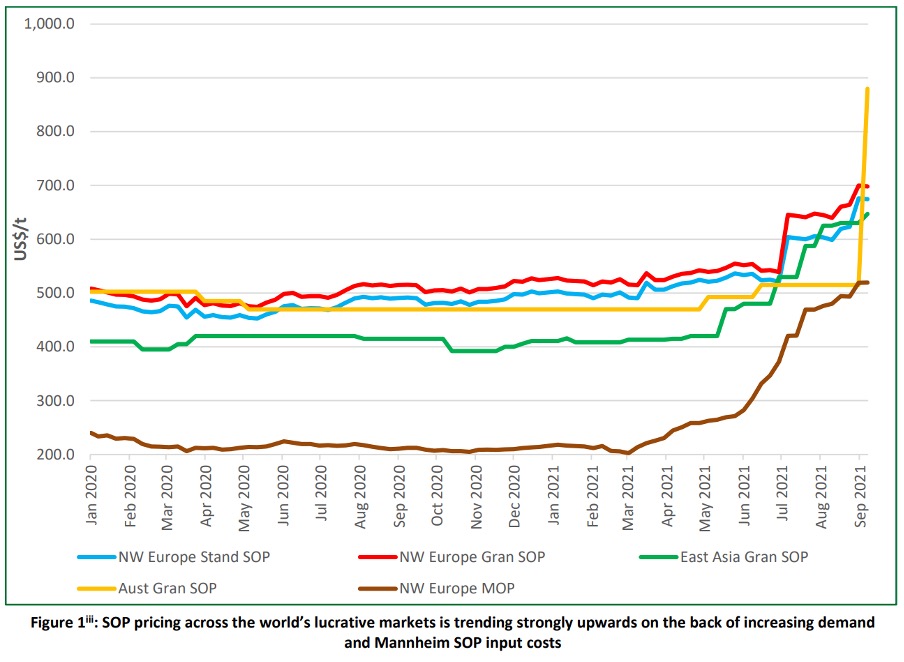
Shackleton continued: “While affected by higher-than-average ocean freight costs, there is a significant demand-pull effect in SOP pricing, particularly in those markets where premium quality produce continues to command a premium price point.
“Commentary around the forward contracts being negotiated in China for the supply of MOP through 2022 suggest a marked increase in the price of MOP.
“There is historically a lag effect in SOP price increases vis-a-vis MOP price increases as Mannheim SOP producers pass increased costs of production through to their consumers.
“Spot pricing in the South-East Asian and South American markets confirm this upward trend in MOP pricing."