
Blackstone Minerals Ltd (ASX:BSX, OTCQX:BLSTF, FRA:B9S) has intersected more massive nickel sulphide during infill drilling at a key target within its Ta Khoa Nickel-Copper-Platinum Group Element (PGE) Project in northern Vietnam.
The base metal explorer hit 5.35 metres of massive nickel sulphide within a broader 11.4-metre intersection at Ban Chang, the most advanced massive sulphide vein (MSV) target within the multi-element asset.
This intersection comes as infill drilling approaches completion and Blackstone prepares to table its Ban Chang maiden resource and incorporate the results with an upcoming pre-feasibility study (PFS) for an upstream business unit.
The pioneer resource estimate for the eastern and western portions of the target is expected in the December quarter of 2021.
Progressing through mine development
Blackstone Minerals managing director Scott Williamson said: “We look forward to presenting a maiden resource at Ban Chang and incorporating the successful outcomes of infill drilling into a mine plan as part of our Upstream Business Unit PFS.
“Drilling at Ban Chang is tightly spaced and has consistently intersected massive sulphide mineralisation, providing a high level of confidence as we progress through the next phases of mine development.”
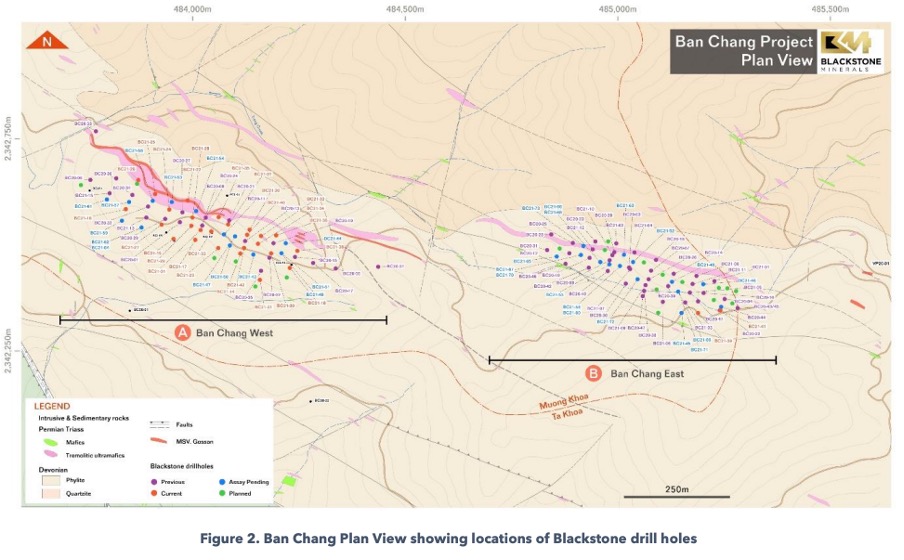
Ban Chang drilling
Blackstone has reported on several assays from the final infill drilling program at the Ban Chang target.
Highlights include:
- 3.8 metres at 1.13% nickel, 0.59% copper, 0.06% cobalt and 0.52 g/t PGE from 92.5 metres, including 1.6 metres at 2.49% nickel, 0.65% copper, 0.14% cobalt and 1.01 g/t PGE from 93 metres;
- 1.83 metres at 1.57% nickel, 0.32% copper, 0.09% cobalt & 0.96 g/t PGE from 82.39 metres, including 1.27 metres at 2.01% nickel, 0.42% copper, 0.12% cobalt and 1.13 g/t PGE from 82.39 metres;
- 1.52 metres at 1.95% nickel, 0.42% copper, 0.1% cobalt and 0.78 g/t PGE from 51.02 metres;
- 13.85 metres at 0.51% nickel, 0.33% copper, 0.03% cobalt and 0.3 g/t PGE from 56 metres, including 4.13 metres at 1.16% nickel, 0.72% copper, 0.07% cobalt and 0.67 g/t PGE from 65.72 metres;
- 3.6 metres at 1.15% nickel, 1.1% copper, 0.07% cobalt and 0.7 g/t PGE from 38.3 metres, including 2 metres at 1.85% nickel, 1.57% copper, 0.1% cobalt and 1.1 g/t PGE from 39.6 metres; and
- 6.1 metres at 1.07% nickel, 0.63% copper, 0.06% cobalt and 0.94 g/t PGE from 43.9 metres, including 1.37 metres at 1.63% nickel, 0.62% copper, 0.09% cobalt and 1.41 g/t PGE from 48.63 metres.
The MSV target
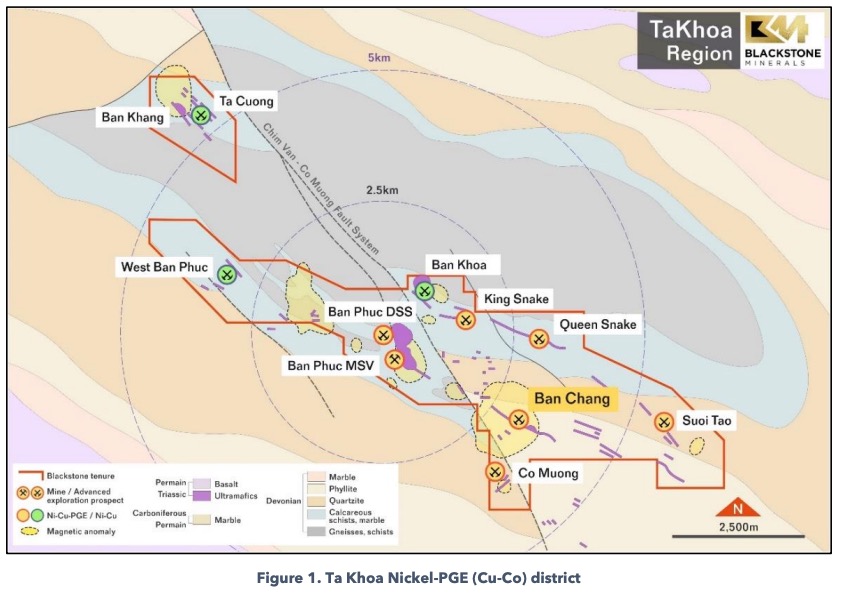
Ban Chang is 2.5 kilometres southeast of the existing processing facility and the Ban Phuc disseminated sulphide (DSS) deposit, which is next to the Chim Van-Co Muong fault system.
The prospect geology consists of massive and disseminated sulphide hosted within a tremolitic dyke swarm which intruded into phyllites, sericite schists and quartzites of the Devonian Ban Cai Formation.
The known dyke swarm spans roughly 900 metres in length and varies between 5 and 60 metres wide. The dykes and massive sulphide are interpreted to be hosted within a splay off the major regional Chim Van-Co Muong fault system.
Drilling at Ban Chang has identified multiple massive sulphide lenses, which are often associated with broader disseminated sulphide zones.
Preliminary mining studies suggest that Ban Chang is amenable to modern, mechanised underground mining.
Next on the agenda
As part of the ongoing work for the upstream business unit PFS, Ban Chang is being assessed as an ore source for the existing 450,000 tonnes-per-annum concentrator and/or as a feedstock that complements the processing of disseminated sulphide ore for the larger proposed concentrator.
Meanwhile, the focus of Blackstone’s most recent drilling and planned drilling campaign will be at Ban Chang East.
A maiden resource estimate for both Ban Chang East and West is slated for completion next quarter, the outcomes of which will be incorporated into Blackstone’s upcoming PFS.