
Global Energy Ventures Ltd (ASX:GEV) has secured funding from the Western Australian Government under round two of the WA Renewable Hydrogen Fund.
As much as $300,000 has been earmarked for the ASX-lister’s compressed hydrogen vision as part of a $900,000 investment into three prospective renewable hydrogen projects in WA.
GEV’s cash injection will advance a feasibility study for the HyEnergy Project, an exploration asset that could one day form a renewable green hydrogen play in Western Australia’s Gascoyne region.
In tandem, the energy stock is designing the world’s first large-scale compressed hydrogen ship to support zero-emission gas transportation — a move that could help decarbonise heavy greenhouse gas-emitting industries.
First green hydrogen export project in WA
Global Energy managing director and CEO Martin Carolan said: “GEV is delighted to be one of three applicants chosen for feasibility funding from the WA Renewable Hydrogen Fund and would like to thank and acknowledge the Western Australian Government for their support and recognition of our plans to export green hydrogen from the Gascoyne region.
“One of the strategic focus areas for the WA Government’s Hydrogen Strategy is export.
“GEV, together with the HyEnergy Project partners, aims to harness WA’s world-class renewable energy resources and proud history of exporting energy to international markets, to develop the first green hydrogen export project using our compressed shipping supply chain.”
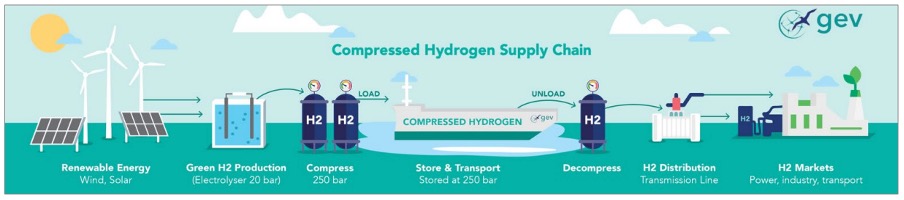
GEV is working to establish a compressed hydrogen supply chain.
Evaluating HyEnergy’s capabilities
Under an MOU with fellow ASX-lister Province Resources Ltd and private company Total Eren, GEV is working to determine the technical and economic feasibility of a compressed hydrogen export project in Western Australia.
The study evaluates the potential to develop up to an 8-gigawatt renewable power facility and downstream hydrogen plant in the Gascoyne.
GEV has now completed early preparation work and a site assessment that will lead to the appointment of key technical and environmental advisors.
The scope includes the transport of hydrogen from the onshore compression facilities to an offshore ship loading buoy and then on to nominated Asia-Pacific markets utilising GEV’s compressed hydrogen ships.
The company will make further progress updates to shareholders through the next two quarters as it works to complete the feasibility study in the first half of next year.
Scoping study underway
Since March, Province has also collected data to inform a scoping study on the proposed green hydrogen play.
In concert with the data collection, the HyEnergy partners have worked to model the project’s Phase 1 development stage, considering the expected green hydrogen market price and cost of production involved with various sized projects.
HyEnergy’s partners are also working closely with State Government departments as the legislature starts to firm up surrounding green hydrogen’s role as a key future industry in WA.
This includes working closely with the state government to secure Lead Agency Status, which will help facilitate progress across the project’s environmental and other permitting requirements.
Government’s $61.5 million investment
In addition to the $900,000 for industry-led feasibility studies, the State Government has announced a $61.5 million investment to supercharge the region’s growing renewable hydrogen industry.
A new $50 million fund, included in the McGowan government's 2021-22 budget, will be used to stimulate local demand for renewable hydrogen in transport and industrial settings and to drive investment into renewable hydrogen.
The government has also committed $7.5 million for an access road into the Oakajee Strategic Industrial Area in a bid to activate the precinct and establish a major renewable hydrogen hub in the Mid-West.
An additional $4 million has been earmarked to boost the state government’s renewable hydrogen unit and to progress an activation plan for Oakajee.
The existing $15 million Renewable Hydrogen Fund forms the foundation of GEV’s $300,000 grant, while BP Australia and APT Management Services also secured funding under the program.