
Rumble Resources Ltd (ASX:RTR) has welcomed news that joint venture partner AIC Mines Ltd has begun drilling at the Lamil Gold-Copper Project in Western Australia’s Paterson Province.
AIC has embarked on the 10,000-metre campaign to test four high-priority target areas, as well as three newly defined targets that have never been drilled.
Moving ahead, the Lamil project will be advanced under a $10 million farm-out with AIC, wherein it can earn a 50% stake by spending $6 million on exploration over a four-year period.
Thereafter, the fellow ASX-lister can nab a further 15% by expending $4 million within 12 months if Rumble elects not to start contributing.
Drilling campaign underway
As it works to unlock Lamil’s gold and copper potential, AIC is honing in on four known targets and three new prospects with no drilling history.
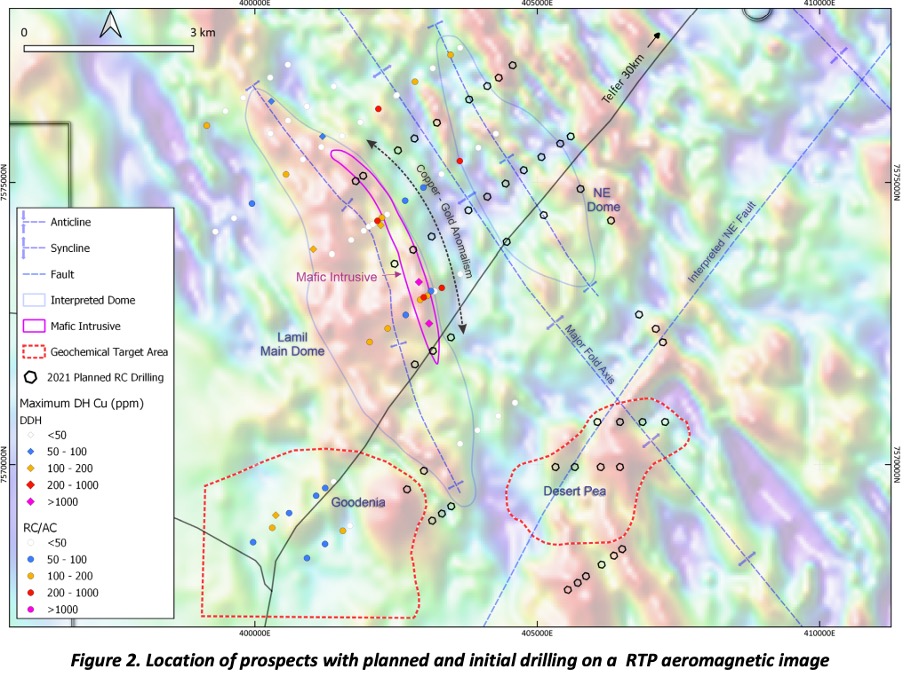
At the Lamil Main Dome’s eastern margin, the ASX-lister will conduct infill drilling over 800-metre by 400-metre spacing, targeting gold and copper mineralisation associated with a mafic intrusive and sodic alteration.
This geology formed the basis of an anomalism unearthed during the company’s maiden reverse circulation (RC) and diamond drilling program last year.
In the current campaign, the explorer will follow up on these anomalous results with reduced drill spacing as it aims to vector into a mineral system.
More broadly, the central axis of the larger Lamil Dome target and the southern extension of the NE Dome target will also be drilled, with these prospects considered a favourable position for Telfer-style mineralisation.
Meanwhile, the Desert Pea target is defined by a magnetic anomaly developed in close proximity to a regionally significant northeast-trending fault, coincident with a surface copper geochemical anomaly.
Wide spaced drilling is designed to intersect the interpreted position of a northeast fault and the majority of the magnetic anomalism over a 4-kilometre trend.
Spotlight on Goodenia and Hovea
In addition to the Telfer-style prospects, 400-metre by 200-metre spaced RC drilling will test two undrilled base metal targets straddling the regionally significant Table Top-Camel fault zone – the Goodenia and Hovea targets.
Goodenia is described as a conceptual base metal target, defined by co-incident magnetic and gravity anomalies located on the eastern margin of a soil copper-lead-zinc geochemistry anomaly.
The target has only partially been tested by two lines of RC drilling in 2020.
Back then, the two RC holes closest to the target returned elevated zinc and lead in carbonaceous sediments, interpreted as part of the Isdell Formation, but the magnetic and gravity feature remained undrilled.
Elsewhere, Lamil’s Hovea target is defined by a coincident magnetic and gravity anomaly at a prominent flexure in the north–northwest-trending stratigraphy.
It lies near the Table Top-Camel fault zone and a northeast-trending cross fault.
The target is interpreted as hosted within the Broadhurst Formation and represents a Nifty-style, sediment-hosted copper target.
Exploring Lamil Gold-Copper Project
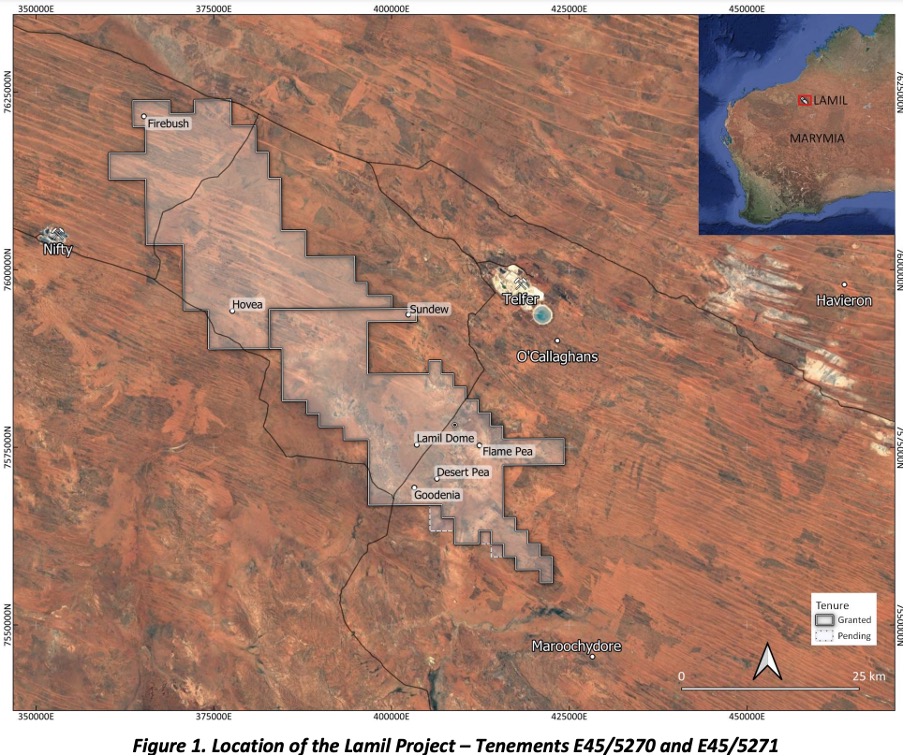
Situated 500 kilometres east of Port Hedland, the Lamil Gold-Copper Project represents a key precious and base metal target for Rumble in northern Western Australia.
Rumble Resources struck up its joint venture agreement with AIC in July 2019, establishing a pathway for exploration in the years to come.
Home to the Lamil asset, the famed Paterson Province is one of the most highly endowed yet under-explored mineral provinces in Australia.
It hosts the world-class Telfer gold-copper mine and the Nifty copper mine, with the 1,280-square-kilometre Lamil project situated midway between these two mines.
Recently, discoveries by Rio Tinto PLC (LSE:RIO) at Winu and by the Newcrest Mining Limited (ASX:NCM)-Greatland Gold PLC joint venture at Havieron have confirmed the prospectivity of the region.
The Lamil Project captures a covered belt of Yeneena Supergroup rocks, which host mineralisation at both the Telfer and Nifty mines and is bound by two deep penetrating, belt parallel, north–northwest-trending structures.
In the southern tenement, the project is also influenced by regionally important northwest-orientated faults, as well as a series of major northeast-trending cross faults that are mappable across the entire belt.
All these structural features are considered important for developing major mineral deposits in the Paterson, as they represent critical, vertically accretive plumbing systems for circulating and trapping mineralising fluids.