
PVW Resources NL (ASX:PVW) has pinpointed further rare earth element (REE) potential at its Tanami project in Western Australia during a fieldwork campaign over the Killi Killi East prospect.
Recent observations indicate that rare earth mineralisation is present over a 2.2-kilometre-long strike length, while regional potential for REE minerals exists along the 18-kilometre-long Watts Rise-Killi Killi trend.
As the exploration campaign continues, PVW is advancing an airborne magnetic and radiometric survey to identify new REE and gold targets at the project.
In the meantime, the ASX-lister intends to expand its Tanami landholding, filling tenement applications for potential REE and gold prospects in the area.
Fieldwork informs tenement applications
PVW Resources executive director George Bauk said: “The field program has highlighted the extensive REE mineralisation at the Killi Killi East prospect.
“While historical drilling in the early 2010s intersected REE mineralisation, the style of mineralisation was not recognised or well understood at that time.
“Following the outcomes of the field program led by consulting geologist Robin Wilson, PVW has applied for a further three tenements in the Tanami region that are prospective for REE mineralisation.
“Samples are in the lab and we look forward to the results which will provide us with valuable information.
“We also look forward to the mineralogy report which will provide us with important information from an exploration and metallurgical perspective.”
Killi Killi East
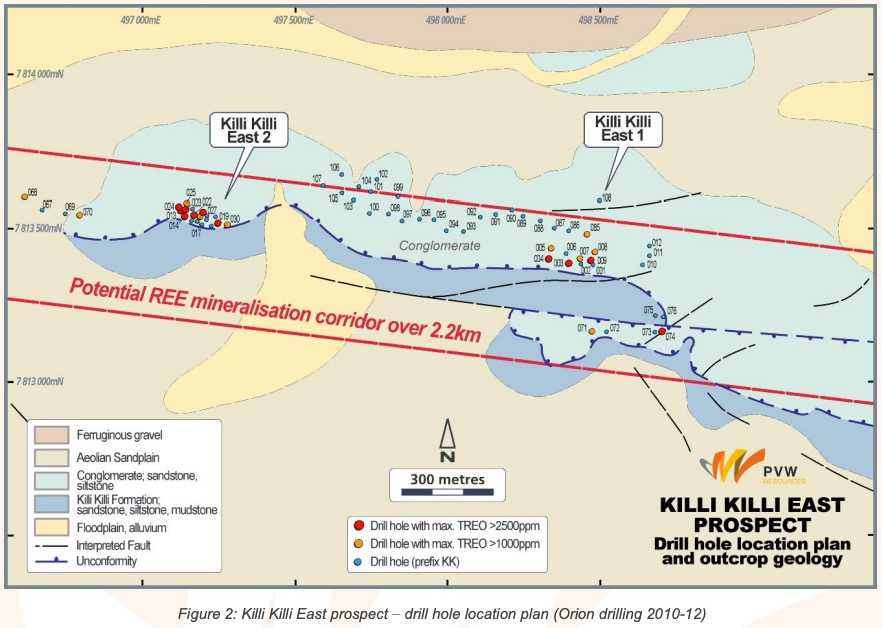
As it works to unlock Tanami’s REE potential, PVW has completed an on-ground review of the surface geology and mineralisation at Killi Killi East prospect.
In the past, Orion Metals Ltd (ASX:ORM), the previous tenement holder, conducted gold and REE exploration at the target between 2010 and 2012.
Since then, PVW has compiled a detailed drilling data review to support its future exploration endeavours.
To date, the ASX-lister has identified REE mineralisation over a 2.2-kilometre strike with elevated portable X-ray fluorescence (XRF) measurements of yttrium, a rare earth element that is typically a good indicator of rare earth minerals such as xenotime.
The REE mineralised corridor at Killi Killi East strikes roughly west-northwest, with cross-cutting structures possibly acting as structural traps for mineralisation along this trend.
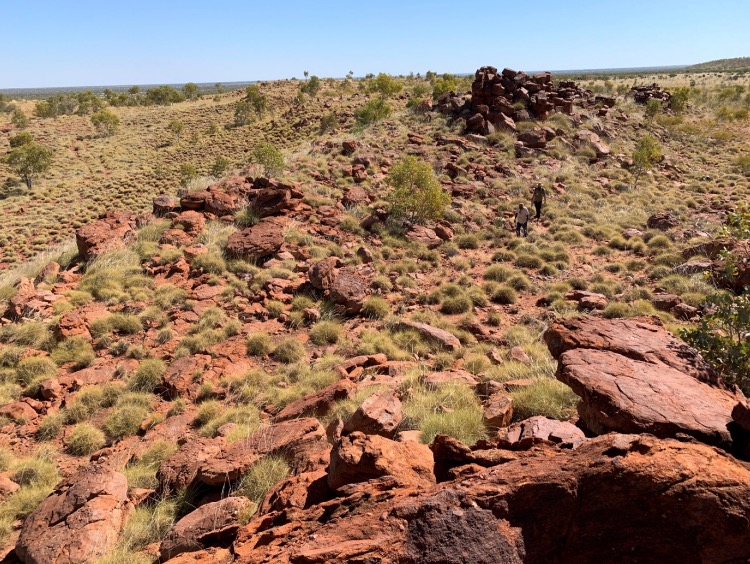
View of Pargee Sandstone outcrops at Kill Killi East.
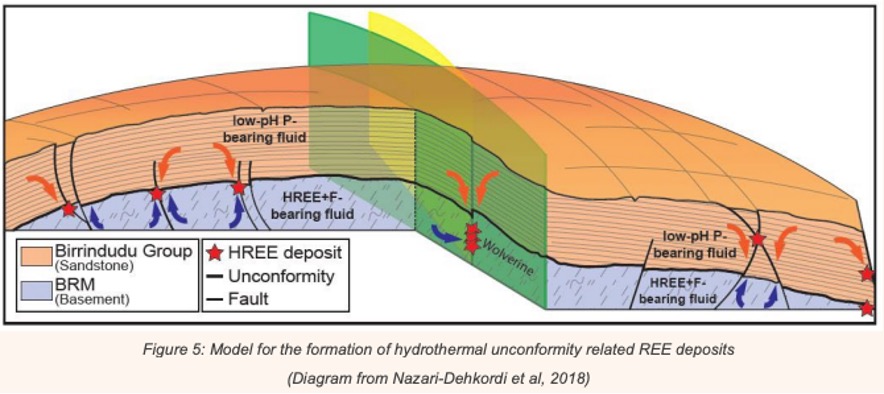
The contact between the Pargee Sandstone and the Killi Killi Formation is a regional-scale unconformity of more than 18 kilometres of strike and is considered prospective for hydrothermal unconformity-related REE mineralisation.
Essentially, this is a type of REE deposit that bears geological similarities to unconformity-related uranium deposits in Australia and Canada.
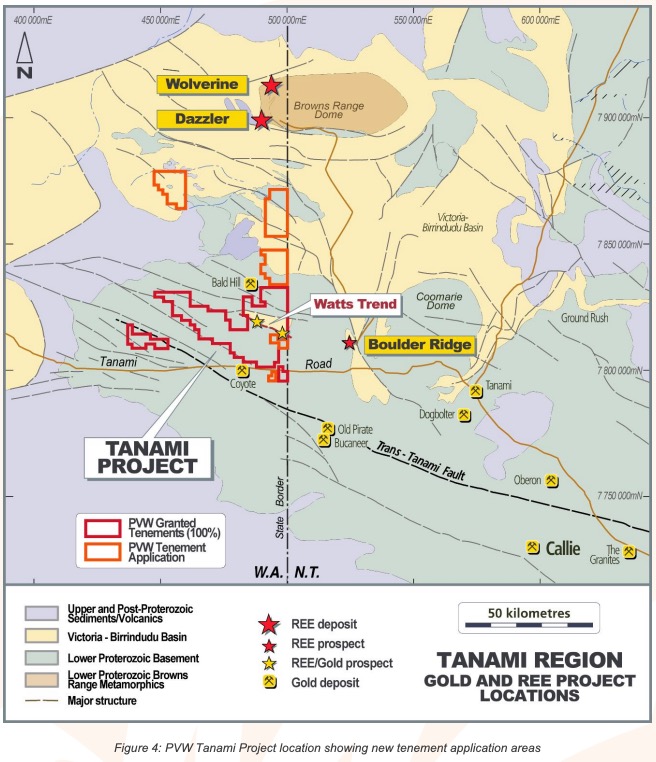
Tanami’s two main prospect areas, Killi Killi East and Watts Rise, occur 12 kilometres apart and are both close to the contact between the Pargee Sandstone and the Killi Killi Formation.
Orion’s historical mineralogical studies identified two main rare earth minerals at Killi Killi; the heavy rare earth mineral xenotime and the light rare earth mineral florencite.
It appears this combination provides a favourable mix of rare earth elements in terms of the in-demand elements used to make magnets.
Next steps
Looking ahead, PVW plans to carry out updated mineralogical studies on samples from the recent field program as its fieldwork campaign at Killi Killi continues.
Soil sampling and ground radiometrics work is set to re-commence imminently following a short delay.
Ultimately, the ASX-lister’s exploration program will target faults and structures that transect the regional unconformity and potentially act as conduits for mineralising fluids.
Down the track, potential REE deposits may require detailed geological mapping and close-spaced drilling.
Watts Rise
Rare earth mineralisation has also been observed at the Watts Rise prospect, which is about 12 kilometres northwest of Killi Killi East.
Weakly anomalous REE results were returned during Orion’s drilling campaign, with the REE mineralisation again mostly hosted in a basal conglomerate unit unconformably overlying the older Killi Killi Formation.
Interestingly, rare earth element mineralisation was recorded in the recent field program within the outcropping conglomerate.
So far, a soil sampling program targeting REE and gold mineralisation has been completed at Watts Rise, with samples submitted to a laboratory for assay.
New tenement applications
Following the recent Tanami field program, a review of regional REE targets has led PVW to submit four new tenement applications in the Tanami region.
Three of these cover areas are considered prospective for hydrothermal unconformity-related rare earth mineralisation, with applications spanning 420 square kilometres.
In addition, PVW has put in its bid for an 8.9-square-kilometre area, situated around 12 kilometres east of the nearby Coyote Gold Mine.