
Miramar Resources Ltd (ASX:M2R) has pinpointed a suite of large Whaleshark Project targets for follow-up exploration following a soil sampling program at the project in Western Australia's Gascoyne region.
The new multi-element anomalies, which could be associated with bedrock mineralisation, appears similar to that observed over the recently discovered Havieron gold-copper deposit.
Unearthed by exploration titans Newcrest Mining Ltd and Greatland Gold PLC (AIM:GGP, OTC:GRLGF, FRA:G8G), Haverion hosts 52 million tonnes of resource, grading at 2 g/t gold and 0.31% copper for 3.4 million gold ounces and 160,000 tonnes of copper.
Moving ahead, Miramar will field check the anomalies and plan infill sampling activities as it continues to develop Whaleshark’s exploration potential.
Inspires confidence
Commenting on the new targets, Miramar Resources executive chairman Allan Kelly said the company was excited about the scale and tenor of the anomalism at Whaleshark.
“The Whaleshark magnetic anomaly is a large target, so a technique like mobile metal ion potentially enables us to focus in on areas of interest before progressing to more expensive bedrock drill testing.
“To obtain strong and coherent anomalies like these, similar to Havieron, gives us the confidence to progress to the next stage of exploration,” he added.
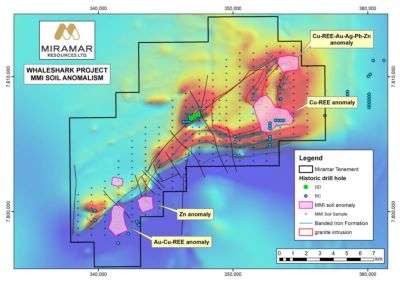
Whaleshark Project showing MMI anomalism over magnetics and interpreted geology.
Soil sampling program
Over July, Miramar completed a first pass soil sampling survey at Whaleshark, collecting 272 samples across a wide-spaced 1000-metre by 500-metre grid with lines orientated in a north-south direction.
The survey covered the prominent magnetic anomaly that’s linked to a large, complexly folded banded iron formation (BIF) beneath roughly 120 metres of sediments within the Carnarvon Basin.
Given the depth of cover and orientation at the Gascoyne asset, geochemical surveys that were carried out at Whaleshark in the 1990s, the soil samples were evaluated using mobile metal ion (MMI) analysis.
The MMI technique reports low-level results for 53 elements, including base metals, pathfinders and rare earth elements (REE).
Interpretation of the results involves:
- Calculating 'response ratios' (anomaly to background ratios) for each element;
- Calculating univariate, bivariate and multivariate statistics to determine correlation between various elements; and
- Plotting of single and 'stacked' response ratios to determine potential areas of interest.
Promisingly, the data analysis from Whaleshark identified positive correlations between copper and several REE’s and also, to a lesser extent, with gold and silver.
This group of elements is suggestive of iron-oxide copper-gold (IOCG) mineralisation, which was the original target of historical exploration during Western Mining Corporation tenure in the 1990s.
Similarities to Haverion
Importantly, the multi-element interpretation at Whaleshark may look similar to that seen during MMI sampling over the Havieron target.
This fieldwork was conducted by Greatland Gold before the 3.4-million-ounce gold deposit was discovered.
Plotting various elements at Whaleshark uncovers several large anomalies, ranging from 1 kilometre to over 2.5 kilometres in radius.
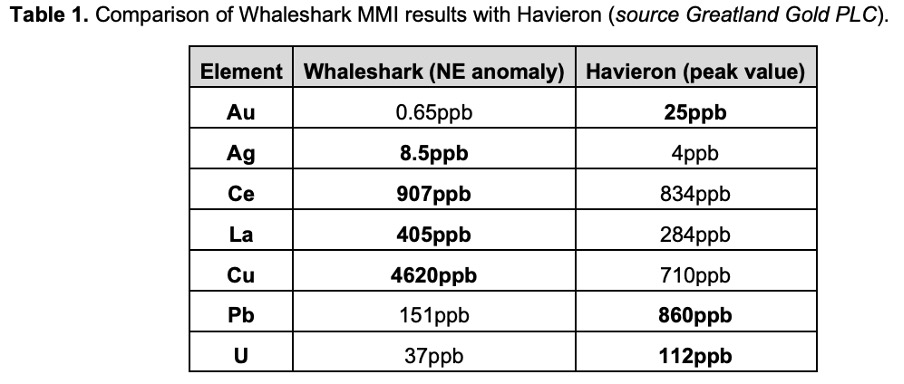
In addition, results for several elements from the far northeastern end of the survey compare favourably with peak values obtained at Havieron before the discovery.
Ultimately, the northeastern anomaly and the larger copper-REE anomaly both coincide with areas of structural complexity at the margin of the granite intrusion.
Moving ahead, Miramar intends to field check the anomalies and plan for infill sampling.
Existing gravity data will also be re-examined and extended/infilled if deemed necessary.