
Apollo Minerals Ltd’s diamond drilling program has delivered further strong zinc-lead intersections at shallow depths that point to a major zinc and lead discovery developing at the Kroussou Project in Gabon.
Additional results from drilling at Dikaki Prospect within the province-scale project support the optimism with hits of up to 11.3 metres at 3.4% zinc+lead from 9 metres, including 7.8 metres at 4.1%.
High-grade results
Assays from a further nine diamond holes at Dikaki, one of 18 prospects at Kroussou, have confirmed shallow high-grade zinc and lead mineralisation within 14 metres of surface.
Other strong results include:
- 18.7 metres at 2.8% zinc+lead from 5.5 metres including 9.5 metres at 4.6% from 7.9 metres;
- 10.5 metres at 2.5% zinc+lead from 15.6 metres including 3.9 metres at 4.0% from 21 metres;
- 38.2 metres at 2.1% zinc+lead from 20 metres including 12 metres at 4.1% from 28 metres; and
- 22.5 metres at 2% zinc+lead from 36 metres including 4.5 metres at 4% from 36.6 metres and 6.1 metres at 3.9% from 52.4 metres.
“Excited by new results”
Apollo mineral’s executive director Neil Inwood said: “We are excited by these new results at Dikaki with drilling in the east of the prospect now demonstrating significant grade continuity at very shallow depths; which has not been previously identified.
“Our maiden drill campaign is demonstrating grade and mineralisation with the potential developing for a large and shallow channel of mineralisation averaging 420 metres in width and up to 6 kilometres in the strike that could be amenable to simple low-cost open-pit mining.”
Phase 1 drilling
Kroussou Project covers 986.5 square kilometres in the Ngounié Province of western Gabon, about 220 kilometres southeast of the capital city of Libreville.
It represents a significant, large scale, near-surface zinc and lead project with more than 80 kilometres of strike length, 18 key prospects and multiple opportunities for further discovery
The project is easily accessible by the major sealed N1 road from Libreville and well-maintained provincial roads to towns bordering the project.
Phase 1 drilling at Dikaki consisted of 46 diamond drill holes for 2,260 metres and the company has received assays from 20 drill holes.
Extensive mineralisation
The assay results are demonstrating extensive high-grade zinc and lead mineralisation and the potential for a large-scale, shallow, flat-lying, broad mineralised system at Dikaki.
Dikaki is at the centre of the Kroussou project area and represents one of four prospects with historic drilling activity.
Diamond drilling at Dikaki was designed to test for the presence of mineralisation near historic exploration conducted by the French Bureau de Recherches Géologiques et Minières (BRGM).
Inwood said: “The Kroussou Project has the potential to deliver a significant, large scale, base metal province.”
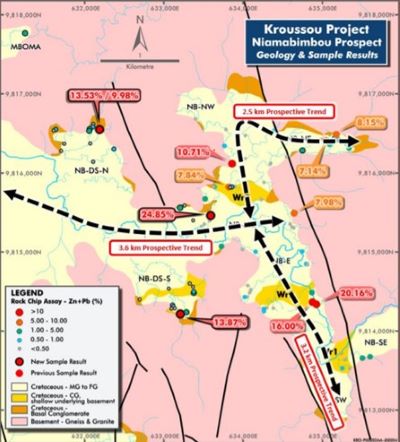
Niamabimbou Prospect: Showing rock chip samples and trend extents.
Exploration at Niamabimbou
The company is expecting strong news flow in the coming weeks with more assays pending from Dikaki prospect and also from the initial holes being drilled at Niamabimbou Prospect.
With the completion of the phase 1 drilling at Dikaki, the focus has shifted to initial drill testing of the highly prospective Niamabimbou Prospect about 13 kilometres south of Dikaki where Apollo has engaged two diamond drill rigs for continuing exploration activities.
The majority of holes drilled at Niamabimbou to date have intersected visible zinc and lead sulphide mineralisation, as observed by in-field drill core logging, with visual identification of up to 8% galena (lead sulphide) content recorded locally and this validates Apollo’s exploration targeting model.
Initial geological logging of the drill holes is showing potential for a coherent distinct sedimentary unit hosting mineralisation similar to Dikaki and coherent mineralisation footprint across the entire channel.