
Emyria Ltd (ASX:EMD) has highlighted promising results from a previously published study assessing the effects of MDMA (ecstasy) and a unique MDMA-analogue (UWA-101) in a Parkinson’s disease (PD) model.
The results indicate that both MDMA and UWA-101 extend the duration of action of L-DOPA, a common treatment for PD, and reduce the proportion of time associated with L-DOPA induced dyskinesia (LID).
UWA-101 was also shown to have fewer psychoactive effects compared with standard MDMA in animals.
The results highlight the potential of uniquely designed MDMA-analogues to elicit different neurological effects, which may lead to new treatments for psychiatric and neurological disorders such as PD.
PD major unmet need
Emyria managing director Dr Michael Winlo said: “These studies highlight how MDMA-analogues, like UWA-101, can have quite distinct neurological and behavioural effects in animal models.
“In this case, UWA-101 has shown promise as a potential treatment for Parkinson’s disease - a major unmet need, globally.
“These rich data serve as an example of the kind of robust preclinical evidence we already have and anticipate to generate during our comprehensive screening program currently evaluating UWA’s unique MDMA-analogue library of more than 100 compounds that our company has exclusive access to."
New drug development programs
“Emyria and UWA are working diligently to screen and identify additional, novel and patentable MDMA-analogues from within the large compound library," he said.
“Further positive screening results will form the basis of new drug development programs targeting major psychiatric and neurological disorders, such as Parkinson’s disease.
“These drug development programs complement Emyria’s interests in MDMA-assisted psychotherapy and are focused on registering safe and promising treatments with major global regulators like the FDA in the USA once the required clinical development and trials are complete."

Overview of assessments
The experiments to assess the potential of UWA-101 and MDMA comprised:
➢ Anti-LID assessment:
A gold standard in vivo PD model was used comparing L-DOPA alone and in combination with two dose levels of MDMA and UWA-101, respectively (1mg/kg and 3mg/kg).
Symptoms of parkinsonism (incorporating measures of impairment of range of movements, posture, bradykinesia and alertness) and dyskinesia (including chorea and dystonia) were assessed by a movement disorder neurologist blinded to the treatments given.
The duration of antiparkinsonian action (ON-time) - the amount of time for which disability scores are mild or absent – was calculated.
ON-time is considered “good” quality when there is an absence of disabling dyskinesia or “bad” quality in the presence of disabling dyskinesia.
➢ Psychoactivity assessments:
To evaluate whether UWA-101 might have reduced psychoactivity in comparison to MDMA, a series of in vivo assessments were made in a variety of models that are traditionally used to define psychopharmacology of MDMA and related drugs.
These tests comprised prepulse inhibition (PPI), drug discrimination and food intake comparisons.
Results
In combination with a vehicle (in the control experiment), L-DOPA evoked, on average, 204 minutes of ON-time.
Less than one-third of this ON-time was of “good” quality (with only mild, moderate or no dyskinesia).
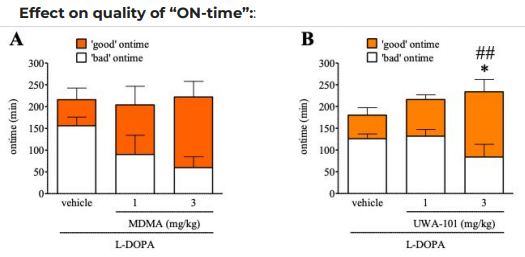
Co-administration of MDMA and L-DOPA evoked no significant change in the total duration of ON-time. However, treatment with MDMA significantly increased (by up to 180%, vehicle vs. 3 mg/kg) the proportion of L-DOPA-induced ON-time that was of “good” quality.
In contrast, UWA-101 had a significant effect on duration of total and good ON-time. UWA-101 increased the total duration of L-DOPA-induced antiparkinsonian benefit (total ON-time) by up to 30%. In addition, UWA-101 (3 mg/kg) significantly increased the duration of “good” quality ON-time by 178%.
Possible new class of therapeutic in PD
UWA-101 acts to improve both the quality and duration of L-DOPA action in a gold standard model of Parkinson’s disease.
These positive results suggest UWA-101 could represent a new class of therapeutics in PD, but, more broadly, highlights the value of studying MDMA analogues and their potential to become novel therapeutics to address other psychiatric and neurological disorders.
UWA-101 is just one of over 100 MDMA-like compounds that have been synthesised by Dr Matt Piggott and his research team at UWA and exclusively optioned to Emyria.
Emyria, along with UWA, is now screening and expanding the existing library to develop new potential therapies and inform additional drug development programs for Emyria targeting a range of psychiatric and neurological conditions, including PD.
This work complements Emyria’s interests in MDMA-assisted therapy to treat Post Traumatic Stress Disorder (PTSD).
Global patent strategy
Emyria is also pursuing a global patent strategy to support its commercial objectives and intends to pursue patent protection in key global markets, including the US, Europe and Japan.
This aligns with Emyria’s global regulatory strategy including plans to pursue registration with the FDA for Emyria’s drug development programs.