
Oar Resources Ltd (ASX:OAR)’s drilling at Gibraltar Halloysite-Kaolin Project has returned a composite sample grading 53% halloysite, which the company believes to be the highest grade halloysite observed in any project in Australia.
Detailed XRD analysis of selected samples from drilling at the project in Australia’s kaolin-halloysite hotspot on South Australia’s Eyre Peninsula has produced multiple composite samples grading in excess of 30% halloysite.
These results described as “exceptional” have been returned from a large zone of bright and ultra-bright white kaolinite and far exceed the company’s expectations.
Shares open higher
They confirm the discovery of a premium-grade halloysite material with expected strong and growing demand by global off-takers seeking supply of high-grade halloysite for its nanotube properties.
Investors responded positively with shares as much 23% higher to 1.6 cents.
Drilling “an incredible success”
Oar’s general manager Geology, Tony Greenaway, said: “These new halloysite results are the highest grades we have seen anywhere in this district and confirm to us the significant potential of our Gibraltar Halloysite-Kaolin Project.
“The regional scout drilling campaign has been an incredible success, adding significantly to the geological understanding of the area, and providing us with four clear high priority targets to take forward."
Halloysite results from the southwest target area, which stretches over 2.5 x 5.0 kilometres as defined by +70 ISO-B, have confirmed multiple coincident halloysite anomalies defined by +10% halloysite.
Three additional ‘Bullseye’ anomalies with coincident high-grade halloysite and high brightness kaolin have also been identified.
This demonstrates strong potential to define a large inventory of high-grade kaolin-halloysite at Gibraltar.
The four areas outlined by the latest results along with previous high-brightness kaolin results will be the subject of additional infill drilling.
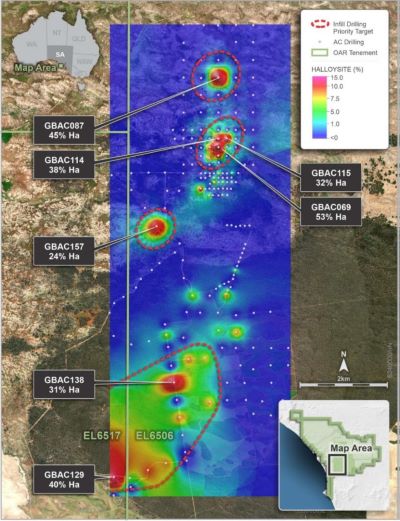
Oar’s Gibraltar Project with all aircore drill collars and maximum down-hole halloysite value contours and selected composite results.
“Clustering” of pods
“Clustering” of halloysite pods within the broader kaolinitic saprolite is typical of this style of mineralisation and is observed in other kaolin/halloysite deposits within the district where other companies have defined multiple JORC resources over an area of a similar size.
“I am particularly encouraged by the emerging cluster of halloysite pods coming out in our data. We see this pattern over other areas of a similar size both on the Eyre Peninsula and in Western Australia, where other companies have gone on to define very large JORC resources based around similar early-stage drilling success,” Greenaway said.
"We believe that we will continue to uncover additional halloysite mineralisation as we expand our drilling over the interpreted granite basement to the west and advance the target areas with the aim of estimating an initial inferred JORC resource at Gibraltar over the coming months.”
The large southwest target area, previously defined by high-brightness kaolin in scout drilling and which has now been shown to contain high-grade halloysite material, covers an area of more than 12 square kilometres and remains open and untested to the west.
Logging of drill chips from this area has confirmed the presence of felsic granitic basement, which Oar has interpreted to be part of the same granite complex underlying Andromeda Metals Ltd (ASX:ADN)’s Mt Hope Kaolin Deposit immediately south of Oar’s Gibraltar Project tenements.
Next round of drilling
Oar has already secured the services of a drilling contractor to undertake the next round of follow-up drilling, which can be completed within the existing government drilling approvals.
Preparation and logistics for earthworks and other preliminary work for the drilling is underway, with drilling expected to begin in October 2021.
The aim of this will be to better define the large southwestern anomaly that remains open to the west; and infilling the new ‘bullseye’ anomalies in order to move toward the estimation of an initial inferred JORC resource.