
Pan Asia Metals Ltd (ASX:PAM) has soared more than 150% to a record high as it seeks to add geothermal lithium, hard rock lithium and tin exploration block to its Thai portfolio after lodging applications for the Kata Thong Lithium Project.
The company has lodged five special prospecting licence applications (SPLA) in the Phang Nga province in southern Thailand, to the north of its Reung Kiet Lithium Project.
This comes as Pan Asia Metals embarks on a new, complementary initiative that will focus on the potential for geothermal hosted lithium and associated geothermal energy in Thailand.
In addition to geothermal lithium, the areas the company has identified and made application for are also highly prospective for hard-rock lithium and tin deposits.
Positioning as "low-cost producer”
Pan Asia managing director Paul Lock said: “The Kata Thong applications are the first of a series of target exploration blocks that PAM is looking to secure.
“PAM’s strategy is to identify and develop low-cost and low carbon emission lithium projects which have the potential to position PAM as a low-cost producer delivering value-added battery-grade lithium products into the emerging Thai and well-established Asian EV and LIB sectors.”

Shares have been as much as 151.7% higher intraday to 38.5 cents, a new record high.
Five new SPLAs
The Kata Thong Project comprises five new SPLA’s around 35 kilometres north-northeast of the emerging Reung Kiet Lithium Project and 50 kilometres southwest of the Rajjaprabha Hydro-electric Power Station.
Two of the SPLA's contain geothermal fields which are highly prospective for geothermal style lithium.
One of the geothermal fields abuts the lithium-rich Kata Khwam granite batholith, a 145 square kilometre granite intrusion with rock-chip assays up to 2,700ppm lithium.
Four of the SPLAs are highly prospective for lepidolite-style lithium and tin, with stream sediment assays returning strong lithium values from target catchments and each SPLA containing at least one historic tin mine.
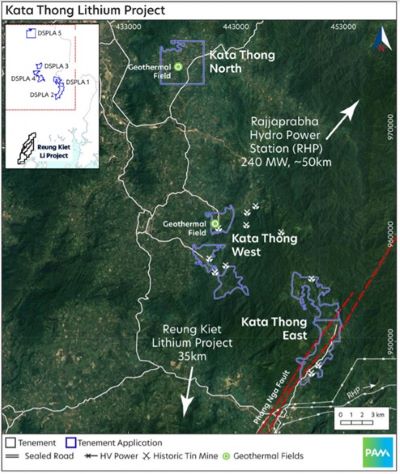
Kata Thong Lithium Project, Phang Nga Province, southern Thailand.
Zero-carbon footprint
The new applications complement PAM’s Reung Kiet Lithium Project and will allow it to share resources across the projects
Kata Thong is potentially transformative for the company, already, lepidolite-style lithium has the potential to place PAM at the bottom of the cost curve, and the nearby 240-megawatt hydro-electric power station provides the potential to produce lithium products with a near-zero carbon footprint.
The project provides PAM with the potential to produce geothermal lithium using geothermal energy with a zero-carbon footprint.
“Potential for geothermal lithium project”
Locke adds: “The geothermal aspects of the Kata Thong applications are particularly interesting, the geothermal field located in the KT West block abuts the northern end of the lithium enriched Kata Khwam granite, with lithium grades in rock chips up to 2,700ppm Li2O, which is supported by PAM’s nearby stream sediment sampling reporting assays up to 1,464ppm Li2O.
“The potential for a geothermal style lithium project is strong, with the underlying geothermal system similar to that of Cornish Lithium except that at Kata Thong the granite is exposed at the surface with nearby geothermal discharges up to 78oC at the surface and a hotter geothermal system modelled to depths down to 2 kilometres.
“In addition, the Kata Thong East and West applications are highly prospective for lepidolite-style lithium and tin.
“We see this as complementary to the Reung Kiet Lithium Project where we anticipate estimating a maiden mineral resource in November and a scoping study soon after.
“At Reung Kiet our Phase 1 objective is a 5,000-10,000 tonnes per annum lithium carbonate or hydroxide plant.
“Our objective is to increase this to 20,000 tonnes and potentially greater through additional discovery.
“PAM is rapidly positioning itself with projects that have the potential to be placed at or near the bottom of the cost curve, which provide PAM with the option to move past the mine gate and value add, and that have the potential for a low or zero-carbon footprint.”
Forward plan
PAM plans to conduct additional exploration focusing on assessing the prospectivity for geothermal and hard-rock lithium
The company will partner with Thai universities with local expertise in geothermal systems and will engage internationally reputable geothermal expertise to assist with the design and execution of exploration programs to assess the geothermal lithium and power generation potential.
PAM will also conduct stakeholder engagement and consider the key environmental, social, regulatory and infrastructure issues surrounding a project of this nature.
Based upon the results of the above PAM may then proceed to an exploration phase which is likely to include geophysics such as resistivity, magnetics, gravity, seismic and additional hydro-geochemistry.
The exploration for hard-rock lithium +/- tin will focus on identifying and sampling pegmatites and other mineralised occurrences in the project area.
This will involve mapping and geochemical sampling of rocks and soils and an assessment of potential dimensions and grades of the targets to drill testing of identified high priority targets.
PAM has been conducting additional studies to investigate the potential for both geothermal and hard-rock lithium prospectivity in other areas within Thailand expecting to report additional opportunities with these initiatives in the near term.
- Ephrems Joseph