
Matador Mining Ltd (ASX:MZZ, OTCQX:MZZMF) has delivered further strong results from Cape Ray Gold Project in Newfoundland, Canada, with the Window Glass Hill Granite (WGHG) area providing high grades of up to 36 g/t outside the existing 230,000-ounce gold resource.
The company’s confidence in Cape Ray has increased further with strong diamond drilling results and systematic power auger drilling indicating that gold mineralisation is more extensive than previously identified.
New mineralisation
Widespread mineralisation has been uncovered in previously undrilled areas with around 50% of the 3- kilometre-long and 0.5 kilometres-wide WGHG never tested with diamond drilling.
Power auger bottom-of-hole core assays up to 2.4 g/t gold have been returned in previously untested areas and have generated five new high priority drill targets.
High-grade results
Diamond drilling has returned up to:
- 8 metres at 5.1 g/t gold from 62 metres, including 1-metre at 36.2 g/t, and 22 metres at 1.2 g/t from 91 metres, including 1-metre at 5.0 g/t in hole CRD212;
- 4 metres at 3.6 g/t from 74 metres, including 1-metre at 5.2 g/t in CRD210;
- 6 metres at 2.2 g/t, including 1-metre at 9.7 g/t, from 351 metres; and
- 3.4 metres at 3.6 g/t, including 1-metre at 8.8 g/t from 141.6 metres.
Increasing mineralised region
Executive chairman Ian Murray said: “Window Glass Hill continues to deliver for the company with the first batch of results, for both the diamond and auger programs, continuing to define significant gold mineralisation.
"Our initial diamond drilling program targeted extensions to the existing Window Glass Hill mineral resource, with results successfully increasing the known gold mineralised region, providing potential for further mineral resource growth.
"Importantly, most of the drilling intersected gold at less than 100 metres from surface, which is a positive indicator for the targeted open pit gold project.
"Possibly more significant in the long-term are power auger results indicating potential for the entire Window Glass Hill Granite to be a much larger gold system than previously considered.”

Major drilling program
The company is undertaking the largest exploration program carried out at Cape Ray, with upwards of 45,000 metres of diamond drilling, targeting brownfield expansion and greenfields exploration.
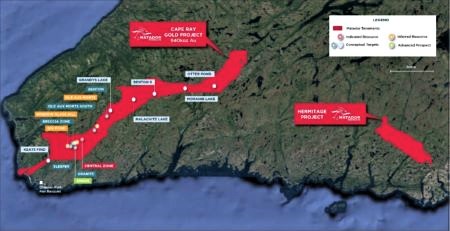
Initial diamond drilling for 2021 has focused on testing targets generated from the new detailed magnetics and power auger results.
Best result to date at WGHG
This delivered the best drill hole to date, CRD212, within the WGHG outside the existing mineral resource volume and returned eight strong intercepts totalling 81.6 gram-metres (above a 0.5 g/t cut-off).
Adjacent to this hole, CRD210 returned seven strong intercepts with other results of 7 metres at 0.9 g/t from 61 metres, including 1-metre at 2.1 g/t and 8 metres at 0.8 g/t, including 1-metre at 2.9 g/t from 126 metres.
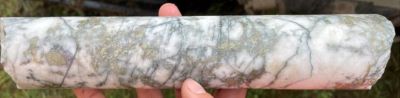
1-metre at 5 g/t gold in quartz-pyrite-galena veining from 100 metres in hole CRD212 within 22 metres at 1.2 g/t from 91 metres.
Power auger strategy
The power auger drilling strategy is central to the company’s greenfield exploration program. These agile rigs are capable of drilling through up to 10 metres of till cover, providing a basal till sample and a bottom of hole diamond core sample for gold and multi-element analysis.
This approach allows Matador to rapidly and cost-effectively test large regions with limited outcrop and no historic drilling with effective multi-element pathfinder geochemistry.
Results from this program, when combined with structural targeting using the newly acquired detailed heli-mag data, effectively de-risk and refine targets for follow-up diamond drilling.
The first task for the power auger drilling program in 2021 was to systematically test the WGHG area with a 200 x 50 metre spaced drill pattern. This area is about 3 kilometres long and 0.5 kilometres wide and contains a resource of 230,000 ounces.
However, more than 50% of the granite remains untested by diamond drilling despite clusters of historic rock chips with >1 g/t gold assay values collected from the available outcrop.
This program saw 373 power auger holes completed across the WGHG, providing two samples for each drill site, a bottom of hole (BOH) core sample as well as a till sample.
Strong anomalies
Intersecting any anomalous gold in blind BOH power auger core samples is highly unlikely in any vein-hosted gold mineral system.
The number of strong BOH power auger gold anomalies in this program (above <2ppb background gold values), combined with broader multi-element pathfinder anomaly halos, highlights that the entire WGHG is intensely altered and mineralised well above normal background gold abundance.
This is an indicator that the WGHG has the potential to be a very large, widely mineralised, system.
Murray said: "The majority of this system is untested historically, in part we believe, due to the thin till cover. We now have the tools to cost-effectively and successfully test below this veneer, providing improved understanding of the geology and generating exciting new targets at a rapid rate.”
“Five rigs now active”
"Finally, with five rigs now active in the field (two diamond and three power auger rigs) as well as being over the initial 'hump' in receiving our first significant batch of results, we anticipate ongoing news flow moving forward,” he added.
Most assays have now been returned from the power auger program over WGHG, facilitating further refinement of these five priority targets, with additional follow-up drilling planned as soon as the drilling of the priority greenfields targets at Big Pond and Benton is complete.
Assays are pending for an additional 20 diamond drill holes for 3,554 metres completed at WGHG and 330 power auger holes (bottom of hole core and till samples) drilled at Big Pond.