
Volt Resources Ltd (ASX:VRC) has utilised an innovative inverted flowsheet design to produce coated spherical purified graphite (CSPG) for battery anode material with graphite from the Bunyu project in Tanzania.
This process, which is part of ongoing test-work including lithium-ion batteries (LIB) cell cycle testing using CSPG produced from Bunyu graphite, has yielded graphite products suitable for high-value commercial applications.
The testing is being undertaken by established commercial graphite producer and processor, American Energy Technologies Co (AETC) which is headquartered in Illinois, USA, as part of a technology integration program including long-term cycle testing of Bunyu graphite for LIBs.
“Excellent results”
The company said there had been excellent results achieved in cycle testing to date.
Managing director Trevor Matthews said: “We are delighted with these initial test-work results provided by AETC.
“This further confirms previous test-work programs’ conclusions that Bunyu’s flake graphite is suitable for supply to traditional markets and for use in new high demand applications such as energy storage.
“I am especially pleased that we have been able to demonstrate successful spherodisation and purification results with the inverted flow sheet which Volt Resources is adopting for its downstream operations.
“Introduction of this flowsheet will allow us to not only convert a significant portion of our graphite into battery-ready anode material for lithium-ion batteries but will also generate a range of ultra-high purity by-products for use in battery cathodes and in a variety of valuable non-battery applications.”
Innovative flowsheet
In a traditional flowsheet, graphite concentrates are milled and then shaped into a sphere. The particles that have been spherodised are purified by a potentially environmentally damaging acid leaching process.
In addition, only 35-40% of the graphite is spherodised and converted into battery-grade material.
The non-spherical particles, amounting to 65-70% of the feed in the traditional circuit, are collected and sold into lower-margin markets such as re-carburizers, pencils, aftermarket brake pads and others.
With the flowsheet developed by AETC to produce spherical purified graphite (SPG), purification is completed first with all subsequent sizing and shaping undertaken with purified material.
The purification process was undertaken exclusively using high-temperature furnaces. No environmentally damaging acid leaching or caustic bakes were employed.
Flowsheet benefits
The main benefits Volt enjoys from this inverted flowsheet are:
- Reduced wear and tear on shaping mill parts (due to processing being accomplished with high purity graphite, which is a natural lubricant); and
- The ability to divert non-spherical portions of the purified graphite to higher-margin markets such as conductivity enhancement applications in LIB cathodes.
Battery cell cycling test-work
The goal of battery cell cycling test-work is to develop a technical support data package for market introduction of the Bunyu product and the provision of CSPG material for samples to be provided to potential LIB manufacturing customers.
The program involved the production of SPG, followed by its surface coating prior to commencing extended cycling in batteries.
Cycling tests assess the initial electrochemical performance of carbon-coated spherodised graphite in the industry-standard CR2016 coin cells (ie reversible, irreversible capacity and irreversible capacity loss).
The program is designed to perform long-term cycling (100 cycles initially), which is used to assess the viability of the Bunyu CSPG for energy storage applications.
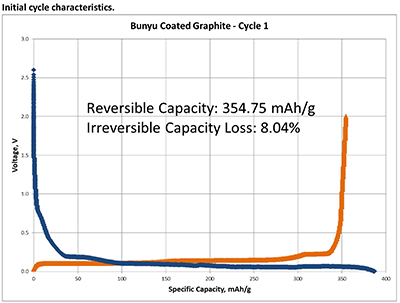
This graph represents a galvanostatic charge-discharge curve commonly used in the industry to derive values of reversible and irreversible capacity, as well as irreversible capacity loss.
It is evident that Bunyu graphite has a reversible capacity in the order of 355 mAh/g, with irreversible capacity loss amounting to less than 10% (ie 8.04%).
The second chart illustrates the initial 40+ cycles of long-term cycling. Three cells containing Bunyu CSPG are being used for the long-term cycling test-work.
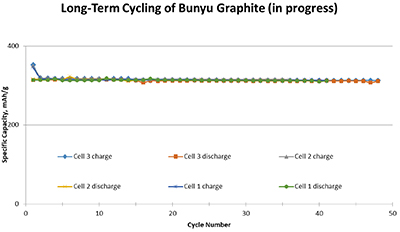
Results from the three cells cycling performance are shown and are consistent with LIB battery-grade material specifications. It is worth noting that cells designed for long-term cycling are intentionally built for slightly lower capacity ratings, therefore the reversible capacity values for the three cells in the test series range between 315 and 320 mAh/g.
These cells demonstrate highly consistent performance with virtually negligible degradation from cycle to cycle. The flat curve signals that Bunyu graphite could compete not only with natural, but also a great number of costlier synthetic graphite offerings, in its long-term cycling performance.
Other test-work results
The Bunyu graphite is composed of extremely thick particles. The thinner stacks of graphene layers are partially primed open, as seen in the scanning electron microscopy image below.
This is a unique feature that will facilitate easier intercalation and deintercalation of lithium ions that could lead to longer LIB cycle life.
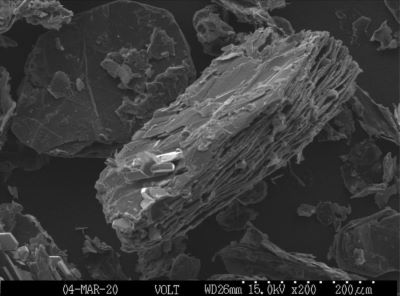
Bunyu flake graphite showing thickness.
Spherodisation
Using the Bunyu purified flake graphite as feed material, a milling stage was used to appropriately size or micronise the purified flake graphite prior to its spherodisation. The purified and micronised material may then be used for applications in lead-acid batteries and in alkaline batteries. Alternatively, they are further processed into SPG for LIBs.
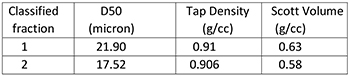
Given its properties, Bunyu flake meets the established design criteria for negative electrode active materials of lithium-ion batteries.
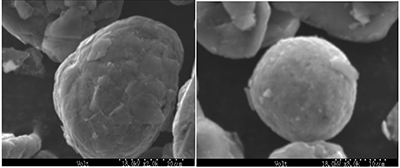
Scanning Electron Microscope (SEM) images of Carbon Coated Spherical Purified (CSPG) Bunyu natural flake graphite.