
Valor Resources Ltd’s (ASX:VAL) airborne magnetic and very low frequency electromagnetic (VLF-EM) geophysical survey have confirmed the potential for uranium at its Hook Lake Project in Athabasca Basin, Canada.
The purpose of the survey was to gather data that would help identify areas of shallow structural complexity, known to be favourable for the deposition of uranium in basement lithologies, and determine the geophysical signature of known occurrences.
Promisingly, the survey reinforces the size potential of historical uranium occurrences and highlights additional targets across the Hook Lake Project.
“Significant new geological information”
Valor executive chairman George Bauk said: “The survey has confirmed the key targets for immediate follow up and has provided data to verify additional targets for drilling.
“Significant new geological information has come out of the survey including the N-S structural features, possibly representing the Tabbernor Fault System.
“These results have exceeded our expectations with the number of target areas to follow up.”
Extensive and complex structural trends
Valor’s project-wide, hi-resolution, magnetic and VLF-EM survey was completed in April 2021.
The 5,172-line kilometre survey was completed by Precision Geosurveys using a fixed-wing aircraft at a line spacing of 75 metres.
Both the magnetic and VLF-EM data show a strong northeast-southwest structural trend similar to that present in other basement-hosted uranium deposits in the eastern Athabasca Basin area.
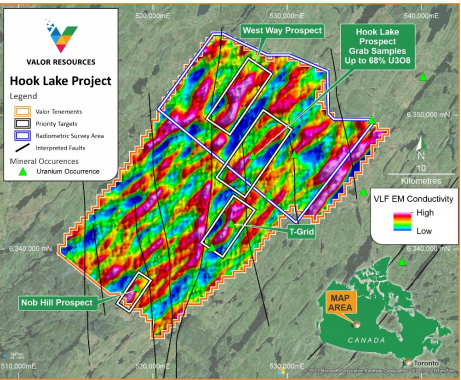
Valor’s project-wide, hi-resolution, magnetic and VLF-EM survey was completed in April 2021.
Significant prospects for follow-up exploration
Several of the known on-site uranium occurrences on the property including Hook Lake, Nob Hill and West Way are coincident with the intersection of these structural trends
The most significant uranium occurrences within the property also appear to have a close association with shallow VLF-EM conductors.
Many other conductors that have previously seen little exploration and have no known nearby occurrences, also represent prospects for follow-up exploration.
A significant north-south structural trend is also present that has features similar to those associated with the Tabbernor fault system.
The magnetic data shows the Hook Lake mineralisation may be part of a larger and broader anomalous zone than originally thought.
Notably, the 3D inversion of the magnetic data indicates a potential feeder system coming up through the stratigraphy.
Airborne radiometric survey
A high-resolution airborne radiometric survey conducted by Special Projects Inc is being flown over the north-eastern third of the Hook Lake Project, which will include the Hook Lake historical high-grade uranium occurrence.
SPI flew the radiometric survey that delineated Fission Uranium’s (TSE:FCU) Patterson Lake Corridor boulder field which eventually led to the discovery of the high-grade uranium Triple R deposit.
Any significant new radiometric anomalies generated from this survey will be followed up on the ground during the upcoming field program.
Ground exploration program
Valor has received the required work permits to carry out its follow-up ground exploration program on the Hook Lake Project
They allow Valor to conduct ground exploration, including drilling, until December 31, 2022.
Valor’s initial fieldwork program will be conducted by Dahrouge Geological Consulting Ltd and is set to commence in the next few days at the Hook Lake Project to follow up on the historical uranium occurrences and new targets generated from the recently completed magnetic/VLFEM survey.
A field crew supported by a helicopter is being mobilised to the area to carry out a field program of 2-3 weeks.
Bauk added: “We have secured all permits that allow us to follow up on the ground, including drilling, which we are targeting for the December Quarter.
“The field crew will be mobilising to site July 23, 2021.
“The Company is excited to be commencing field work in Saskatchewan and look forward to the results of the exploration effort at Hook Lake.”
- Ephrems Joseph