
Calima Energy Ltd (ASX:CE1) believes the Montney Formation in western Canada - in which it has several core assets - could play a leading role in the global energy transition.
The Montney Formation covers about 130,000 square kilometres in the Canadian provinces of British Columbia and Alberta, and is a major source of shale gas and tight oil.
Calima, which completed a transformational merger with Canadian conventional oil-weighted energy producer Blackspur Oil in February, holds a 10-year lease over 49 sections (33,643 acres) of land in the Montney Formation.
And in the first of a series of letters to investors outlining the potential of its assets at Montney, Calima says it will seek to play a large role in the global energy transition.
The Montney potential
As outlined by Calima, recent estimates by the Canadian Energy Regulator place the remaining marketable gas reserves at Montney at an astonishing 567 trillion cubic feet (TcF).
To put that in context, the US Energy Information Administration estimated that there were 7,257 TcF of proven gas reserves in the world at the start of 2020, meaning Montney would account for nearly 8% of global gas reserves.
“This would make remaining reserves in the Montney more than twice the combined reserves of the Marcellas and the Utica (214 TcF), two of the powerhouse gas plays in the US,” Calima says.
“Australia, currently the second-largest global liquified natural gas (LNG) exporter behind Qatar, has 70 TcF of remaining conventional gas reserves.
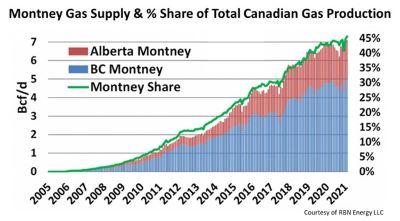
“When you consider that Canada ranks fourth in the world for gas production, then it is truly remarkable that almost half of that production comes from the Montney Formation.”
Oil & gas role in global energy transition
“Canada ranks number one amongst the world’s top exporters on environmental, social and governance (ESG) rankings and as the fourth-largest producer of both oil and gas in the world it truly is a sleeping giant when it comes to the global energy industry,” Calima says.
“Oil and gas exports provide 20% of Canada’s export earnings and companies in the sector are the largest employer of Indigenous people and the largest investors in clean technology.”
As outlined by Calima, the Canadian oil & gas industry is a global leader in reducing greenhouse gas emissions (GHG); oil sands producers have signed up to an initiative that will result in them having net-zero GHG emissions on or before 2050, involving massive investment in new technology to reduce emissions at source as well as carbon capture, utilisation and sequestration (CCUS).
LNG industry on a green path
“Canadian gas as a replacement for coal will generate electricity with up to 60% less GHG emissions and Canada’s LNG industry will have an even bigger impact,” Calima says.
“LNG facilities planned and under construction for Canada’s west coast will use power generated from hydro to deliver up to a 66% reduction in GHG emissions when compared to the global LNG facility average.
“The LNG Canada project being constructed by Shell could, on its own, reduce global CO2 emissions by an amount equal to 15% of Canada’s current GHG emissions.
“Canada, already one of the most environmentally responsible of all the major oil and gas producing countries, finds itself in a unique position to contribute to the global energy transition.
“By 2040 the International Energy Authority expects demand for natural gas to have increased by 40% and with its vast gas resources and the ability to construct the lowest GHG emitting liquefaction facilities in the world, Canada is in pole position to meet market demand.”
- Daniel Paproth