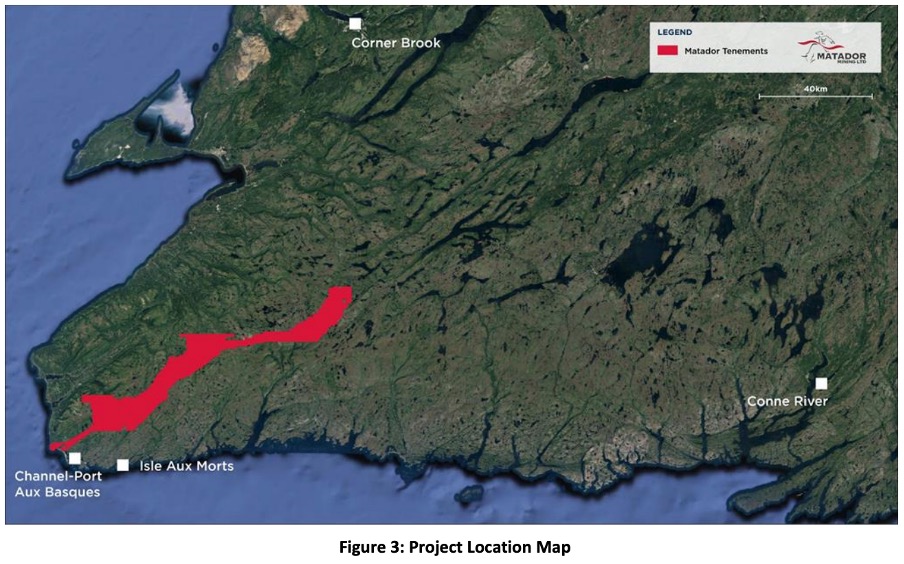
Matador Mining Ltd (ASX:MZZ) (OTCMKTS:MZZMF) (FRA:MA3) is advancing development activities across the Cape Ray Gold Project in Newfoundland, Canada, with a suite of key environmental studies nearing completion.
The gold explorer has been collecting environmental data over its project since 2019, with the findings set to form the basis of the company’s environmental impact statement, slated for government submission in 2022.
Meanwhile, Matador has also engaged with First Nations groups in the area and advanced discussions with other key stakeholders.
The gold explorer is also starting to develop its environmental, social and governance framework, aligning its strategy with global standards.
“Significant source of jobs and income”
Executive chairman Ian Murray said: “Canada has a well-defined methodology for progressing the environmental assessment and permitting process that typically incorporates an extended period of between two and five years for data collection.
“Matador has now completed most of this baseline work, with the effects assessments and valued component section writeups commencing shortly.
“Importantly, the work completed to date with our independent consultants indicates that the process should proceed on schedule, complying with all the required legislation.
“In addition, discussions with local communities and government officials in Newfoundland have shown significant support for the project with the expectation that the project will be a significant source of jobs and income in the future.”
Development activities
With baseline data collection, field and technical studies underway, Matador is preparing to commence a suite of impact assessments during 2021’s second half.
In quarter four, Matador hopes to draft the environmental impact statement (EIS) and prepare it for peer review.
After that, the gold explorer is targeting EIS submission to both federal and provincial governments in 2022’s second quarter, while the next major milestone — the permitting process commencement date — is estimated to occur in 2023.
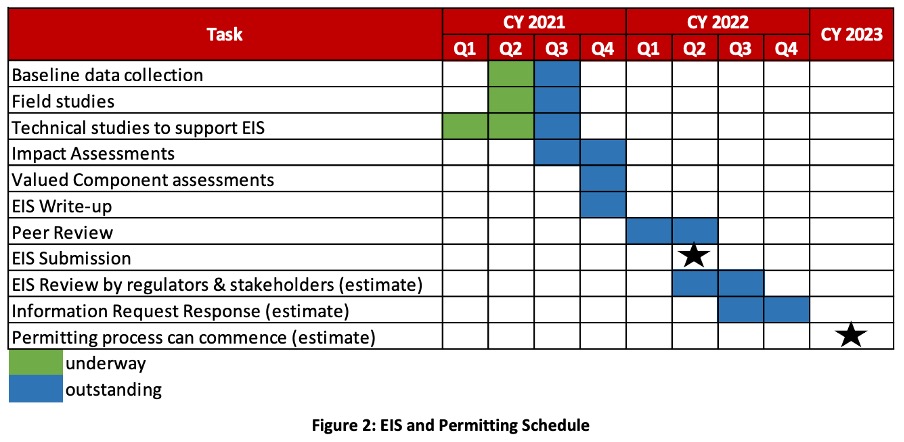
As it looks ahead, Matador has also outlined the remainder of its environmental assessment work in 2021.
Activities include:
- Final field studies;
- Final fauna data collection;
- Final data collection from surface and groundwater sites, including water quality and sediments data;
- First Nation engagement plans;
- Completion of traditional knowledge and land use assessments;
- Effect’s Assessments and;
- Valued component writeups for the EIS.
As an investment in Cape Ray’s future development, Matador is also looking into future power sources.
The ASX-lister has commissioned a local power company to identify grid connection points at the Newfoundland project for future power generation.
Positively, the Newfoundland and Labrador province is on track to achieve 98% green renewable hydroelectric power and is committed to net-zero carbon emissions by 2050.
There are two energy providers on the island, either of which Matador can select based on location and power requirements.
Powers costs for the project are estimated to land between C$0.06 per kilowatt-hour and C$0.10 per kilowatt-hour — some of the lowest power costs in Canada.
The Cape Ray Project
Matador’s flagship gold exploration asset is situated along the Cape Ray shear, one of the most prospective, yet underexplored gold regions in North America.
The Newfoundland-focused gold explorer is developing what it anticipates will be one of the world’s highest-grade open pit projects in a world-first jurisdiction.
Currently, Cape Ray hosts an 837,000-ounce gold resource, grading at 2 g/t — 96% of which is less than 200 metres from the surface.
The Newfoundland project sits along 120 kilometres of continuous strike, 88% of which has seen just 20 historical drill holes.
During its 2021 exploration campaign, Matador intends to complete more than 20,000 metres of resource exploration drilling and a major greenfield discovery program — its largest campaign to date.